1756Age 0
Birth of Wolfgang Amadeus Mozart
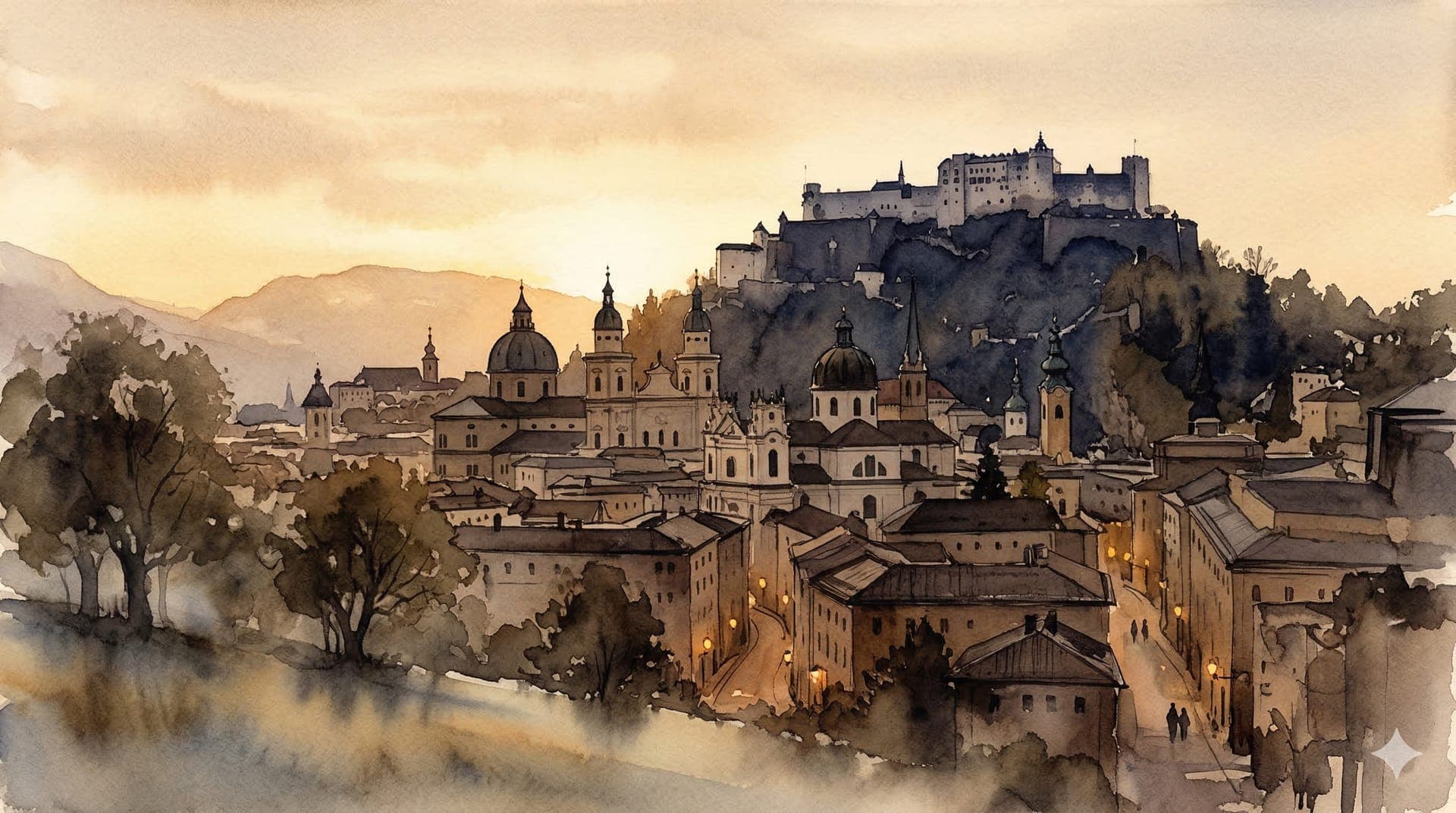
Joannes Chrysostomus Wolfgangus Theophilus Mozart is born at 9 Getreidegasse, Salzburg, the seventh child of Leopold and Anna Maria Mozart. Only he and his sister Nannerl survive infancy.
Salzburg
WOLFGANG AMADEUS MOZART · 1756–1791
The child behind the prodigy. The man behind the music. Follow Mozart through the cities, encounters and turning points that shaped an extraordinary life.
A life told in seven chapters
Scroll to exploreBEYOND THE PORTRAIT
An ambitious father. A gifted sister. Years on the road. Love, loss and the freedom to compose. Discover the moments that made Mozart, one chapter at a time.
01CHAPTER · 1756–1762
Before the travelling virtuoso, there is a child listening to his sister’s lessons. At home in Salzburg, Leopold teaches Wolfgang and Nannerl. A musical language takes shape long before the world knows his name.
Salzburg, 1756–176201Joannes Chrysostomus Wolfgangus Theophilus Mozart is born at 9 Getreidegasse, Salzburg, the seventh child of Leopold and Anna Maria Mozart. Only he and his sister Nannerl survive infancy.
The infant is baptized the day after his birth at the Salzburg Cathedral.
Three-year-old Wolfgang sits transfixed as his father Leopold teaches clavier to his sister Nannerl. He begins picking out thirds and playing short pieces from memory.
The Mozart children perform before Elector Maximilian III Joseph of Bavaria — their first audience with royalty.
The empress is so charmed by the children that she gives them court costumes. Legend holds that young Wolfgang proposed marriage to the Archduchess Marie Antoinette.
Six-year-old Wolfgang and Nannerl perform before Empress Maria Theresa at Schönbrunn Palace. Wolfgang famously jumps into the empress's lap and kisses her.
02CHAPTER · 1763–1768
A family on the road, and a world opening up. The great tour of 1763–1766 takes Wolfgang and Nannerl to Europe’s courts and concert rooms. London brings a first symphony; the years that follow bring his first experiments in opera.
Europe, 1763–1768 02
02Jun 9 1763 — Nov 29 1766
FOLLOW THE JOURNEY
Jun 1763
On 9 June 1763, Leopold, Anna Maria, Nannerl and seven-year-old Wolfgang leave Salzburg. The journey will keep them away from home for more than three years.
The first stop on the Grand Tour. The children perform for the Bavarian court, establishing the pattern for the journey ahead.
Leopold's hometown welcomes the family. Wolfgang performs on the organ at the Church of the Holy Cross.
The Mozart family departs Salzburg for an unprecedented three-and-a-half-year tour of Europe. Leopold is determined to display his children's talents to every major court.
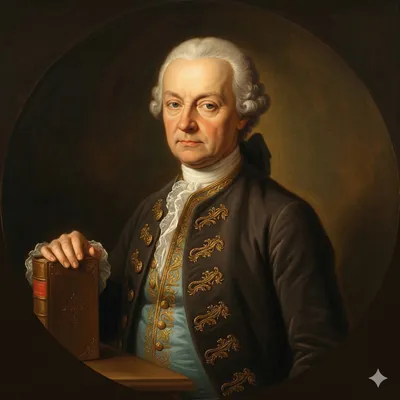
Wolfgang gives several public concerts in Frankfurt that astound audiences. Among the spectators is the fourteen-year-old Johann Wolfgang von Goethe.
The young Goethe, who will become Germany's greatest writer, attends Wolfgang's concert and later recalls the 'little man with his wig and sword' with vivid clarity.
The family stays in Brussels for several weeks, waiting for an audience with Prince Charles of Lorraine.
The Mozart family arrives in Paris, the cultural capital of Europe. They are introduced to the highest circles of French society.
The family’s stay in Paris opens the doors of Versailles. Encounters with the royal court bring prestige, but Leopold must also arrange public concerts, introductions and publications to sustain the tour.
The family crosses the English Channel and arrives in London, where they will stay for over a year — the longest stop on the tour.
Wolfgang performs before King George III and Queen Charlotte at Buckingham House. The king tests him with difficult sight-reading, which Wolfgang masters effortlessly.
Eight-year-old Wolfgang meets J.C. Bach, the youngest son of Johann Sebastian Bach. The two play duets together, and Bach's elegant galant style profoundly influences Wolfgang's musical development.
Wolfgang composes his first symphony, K. 16, in E-flat major, at age eight. It shows the unmistakable influence of J.C. Bach and the London concert style.
Both children fall dangerously ill in The Hague — first Nannerl, then Wolfgang. Wolfgang's illness is so severe that he receives last rites. Recovery takes months.
Now recovered, Wolfgang performs several concerts in Amsterdam before the family begins the long journey home.
After three and a half years and thousands of miles by horse-drawn carriage, the Mozart family returns to Salzburg. Wolfgang is now ten years old and famous across Europe.
During another visit to the Habsburg lands, the family leaves Vienna as smallpox spreads. Wolfgang falls ill in Olomouc and recovers. Touring brings risk and disruption as well as applause.
At twelve, Mozart works on the German Singspiel Bastien und Bastienne and the Italian opera buffa La finta semplice. A planned Viennese production of the latter falls through: composing an opera and getting it staged are different challenges.
03CHAPTER · 1769–1773
Three trips to Italy transformed the teenage Mozart into an opera composer. He absorbed Italian style, earned papal honors, and premiered his first major operas.
Italy, 1769–1773 03
03Dec 13 1769 — Mar 28 1771
FOLLOW THE JOURNEY
Dec 1769
Father and son depart for Italy — the land of opera. Wolfgang is thirteen. This first of three Italian trips will transform him into a mature opera composer.
Dec 13 1769 — Mar 28 1771
Father and son depart for Italy — the land of opera. Wolfgang is thirteen. This first of three Italian trips will transform him into a mature opera composer.
Wolfgang arrives in Milan, then the cultural capital of Austrian-ruled Lombardy. He receives a commission to compose an opera for the Teatro Regio Ducale.
In Verona, the thirteen-year-old Wolfgang is portrayed at a keyboard in a red coat. The painting, traditionally attributed to Saverio dalla Rosa, records a working musician at the start of his Italian education.
Wolfgang studies counterpoint with Padre Giovanni Battista Martini in Bologna, the most respected music theorist in Europe.
After hearing Allegri’s Miserere in the Sistine Chapel, Wolfgang reportedly writes it down from memory. The story comes from Leopold’s letters; the transcription itself has not survived. The famous episode reveals both his musicianship and his father’s pride.
Wolfgang performs in Naples, where audiences are so astonished by his playing that some suspect witchcraft. He is asked to remove his ring to prove it holds no magic.
Pope Clement XIV awards Wolfgang the Order of the Golden Spur, making him a Cavaliere — the same honor once given to Gluck. He is only fourteen.
At fourteen, Wolfgang passes the rigorous examination of Bologna's Accademia Filarmonica, normally reserved for composers over twenty. He is admitted unanimously.
Wolfgang's first major opera seria premieres at Milan's Teatro Regio Ducale. The fourteen-year-old conducts from the keyboard. The audience demands numerous encores.
Father and son return to Salzburg after more than a year in Italy. Wolfgang comes home with an opera success, new connections and first-hand experience of Italian musical life.
Aug 13 1771 — Dec 15 1771
On the second Italian journey, Ascanio in Alba is performed for the wedding celebrations of Archduke Ferdinand and Maria Beatrice d’Este. A contemporary letter praises the contribution of the young Mozart and his librettist Giuseppe Parini.
Oct 24 1772 — Mar 13 1773
Mozart's opera seria Lucio Silla premieres to great success. Despite the castrato arriving late and a delayed start, the opera runs for 26 performances.
The third journey ends in Salzburg. Mozart will never return to Italy, but its opera houses, singers and musical traditions remain part of his creative language for the rest of his life.
04CHAPTER · 1773–1780
Court duties offer stability, but Mozart’s ambitions stretch beyond Salzburg. New concertos, a journey with his mother, love in Mannheim and loss in Paris make these years a turning point.
Salzburg & Travels, 1773–1780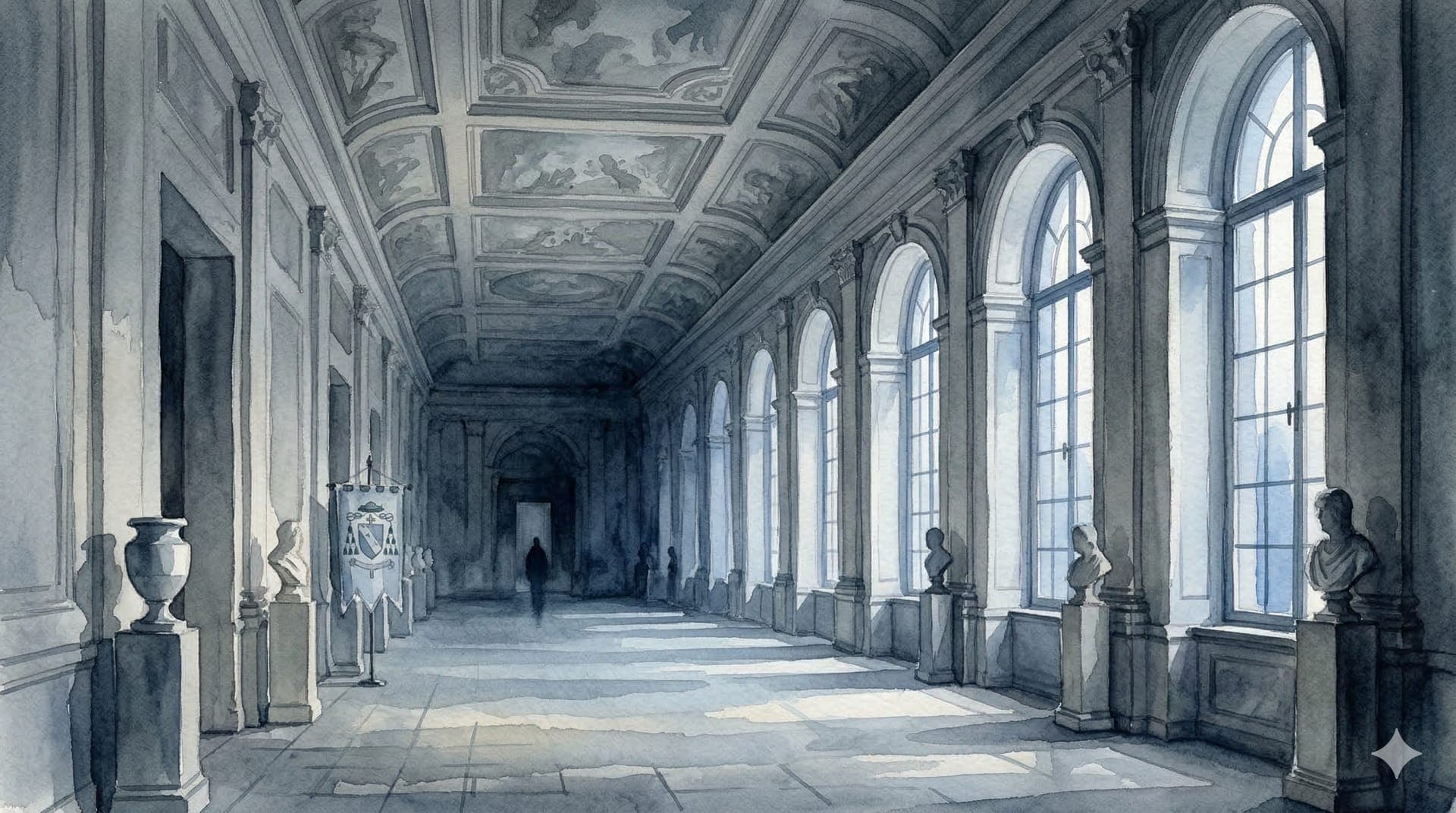 04
04After the Italian journeys, Mozart returns to his duties at the Salzburg court under Prince-Archbishop Colloredo. Church services and court occasions call for a steady flow of music, even as he looks for opportunities beyond his home city.
The 'Little G minor' Symphony, K. 183, erupts with a passion and urgency unprecedented in Mozart's work. It is one of only two symphonies he wrote in a minor key.
Still eighteen, Mozart brings La finta giardiniera to Munich’s carnival season. Its disguises, misunderstandings and tangled relationships give the young composer a new arena for musical comedy.
Mozart's pastoral opera Il re pastore premieres in Salzburg, featuring the sublime aria 'L'amerò, sarò costante' with solo violin obbligato.
The E-flat major Piano Concerto, K. 271, is associated with the pianist Victoire Jenamy. The soloist interrupts the orchestra almost immediately: a small theatrical surprise at the start of a much larger musical conversation.
Wolfgang departs Salzburg with his mother, Anna Maria, seeking better employment. It is a journey of hope that will end in tragedy.
In Mannheim, Wolfgang falls deeply in love with the soprano Aloysia Weber. Leopold sternly orders his son to continue to Paris. When Wolfgang returns months later, Aloysia has moved on.
The 'Paris' Symphony premieres at the Concert Spirituel, tailored to French tastes with its brilliant opening coup d'archet. The audience applauds mid-movement.
Wolfgang's mother dies in Paris at age 57. He is alone with her in a rented room. Unable to face writing the news directly, he first tells his father she is gravely ill.
After months of delay, Wolfgang returns to Salzburg and his position under the archbishop. He is bitter and restless, dreaming of escape to Vienna.
The Sinfonia Concertante for Violin and Viola is one of Mozart's most emotionally profound instrumental works, its slow movement a meditation on loss.
Munich's Elector Karl Theodor commissions a grand opera seria. Mozart throws himself into Idomeneo with revolutionary dramatic ambition.
05CHAPTER · 1781–1786
Breaking free from Salzburg, Mozart established himself in Vienna as a freelance musician. These golden years brought marriage, friendship with Haydn, and the greatest piano concertos ever written.
Vienna, 1781–1786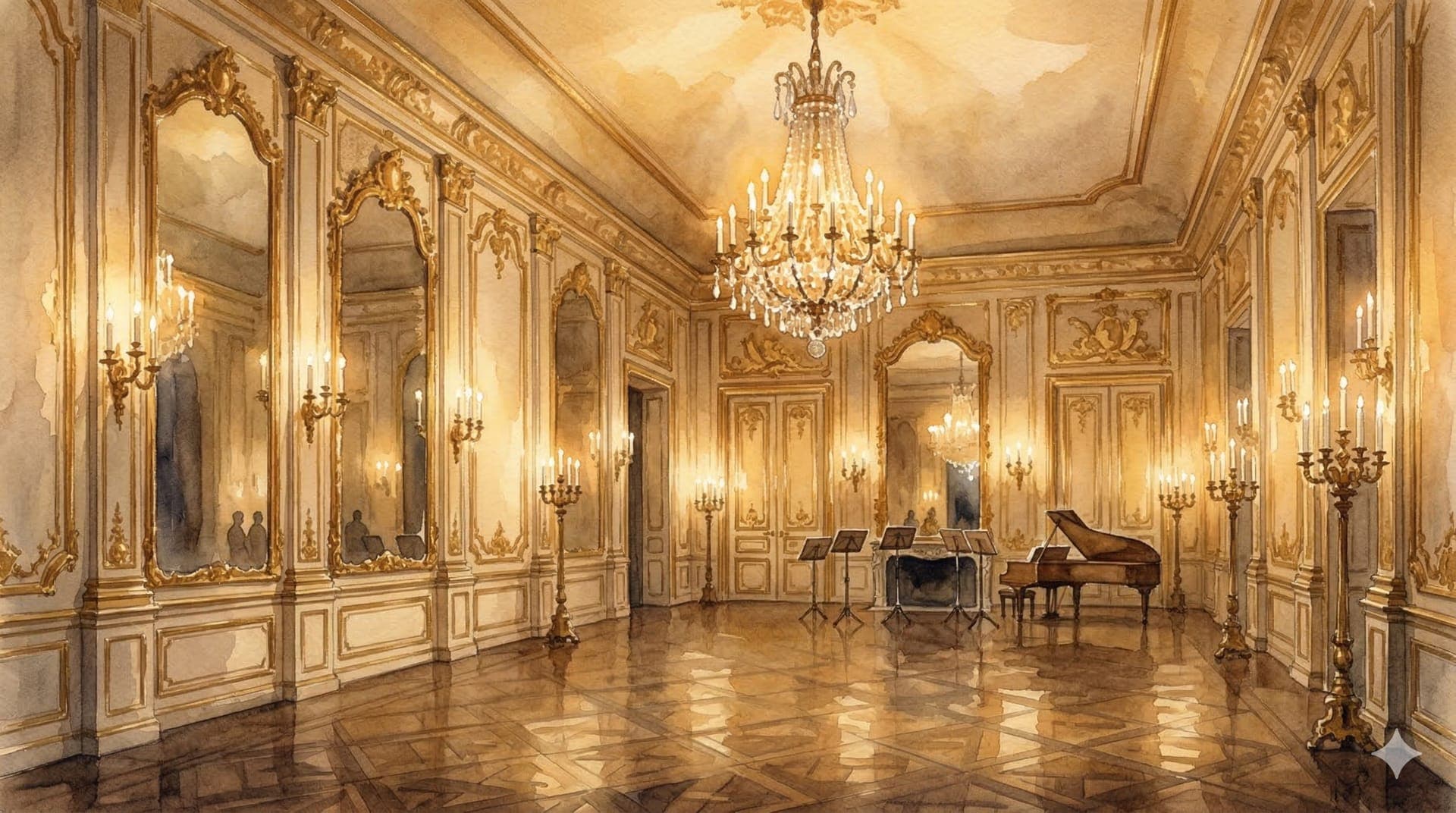 05
05Idomeneo, re di Creta premieres at Munich's Residenztheater. It is Mozart's first mature operatic masterpiece — an opera seria that transcends its genre.
Mozart’s dispute with Archbishop Colloredo ends his Salzburg employment. In a letter, he reports being dismissed with a kick from Count Arco. He stays in Vienna, building an independent career through concerts, teaching, publishing and commissions.
Die Entführung aus dem Serail opens at Vienna’s Burgtheater. With spoken German dialogue, virtuosic arias and colourful orchestration, the Singspiel establishes Mozart as a major presence in the city’s musical theatre.
Wolfgang marries Constanze Weber (Aloysia's younger sister) at St. Stephen's Cathedral. Leopold's consent arrives the day after the wedding.
The G major Quartet, K. 387, begins a group of six quartets Mozart will dedicate to Joseph Haydn in 1785. These works turn admiration into a musical conversation between two composers at the height of their powers.
Visiting Salzburg with Wolfgang, Constanze sings in a performance of his C minor Mass at St. Peter’s Church. The work remains incomplete, but its solo writing gives her a place within the music as well as within his life.
Mozart starts a handwritten record of his compositions, entering dates, instrumentation and the opening bars of each work. He keeps it until November 1791. The manuscript lets us follow these final creative years unusually closely.
The family settles at Domgasse 5, near St. Stephen’s Cathedral. Here Mozart works on Figaro and several of the Haydn quartets. It is the only one of his Viennese apartments that survives today.
Mozart joins the Masonic lodge 'Zur Wohltätigkeit' (Beneficence). Freemasonry's ideals of brotherhood and enlightenment will influence The Magic Flute and other late works.
Mozart begins his legendary collaboration with the librettist Lorenzo Da Ponte. Together they will create three of the greatest operas ever written: Figaro, Don Giovanni, and Così fan tutte.
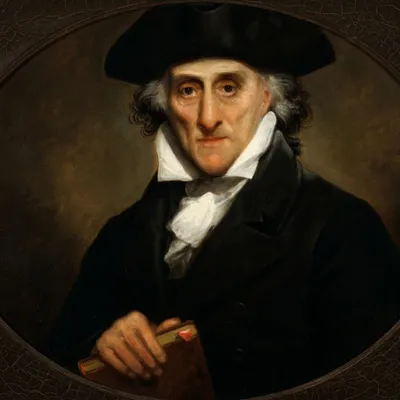
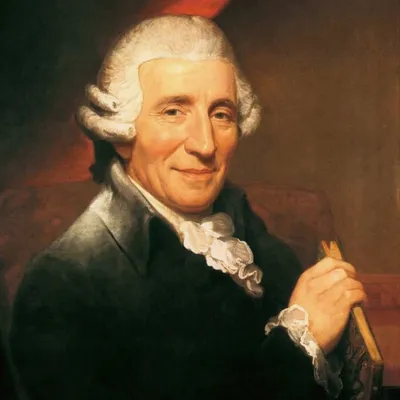
After hearing Mozart’s quartets in Vienna, Haydn praises his fellow composer to Leopold, singling out both his taste and his command of composition. Leopold records the tribute in a letter to Nannerl a few days later.
Le nozze di Figaro opens at the Burgtheater in Vienna. Mozart and Lorenzo Da Ponte transform Beaumarchais’s play into an opera where servants and aristocrats are equally human, and ensembles let several private thoughts unfold at once.
06CHAPTER · 1787–1790
Prague embraces his operas. At home, family pressures and uncertain finances coexist with extraordinary invention. Symphonies, chamber music and a third collaboration with Da Ponte open new musical worlds.
Vienna, 1787–1790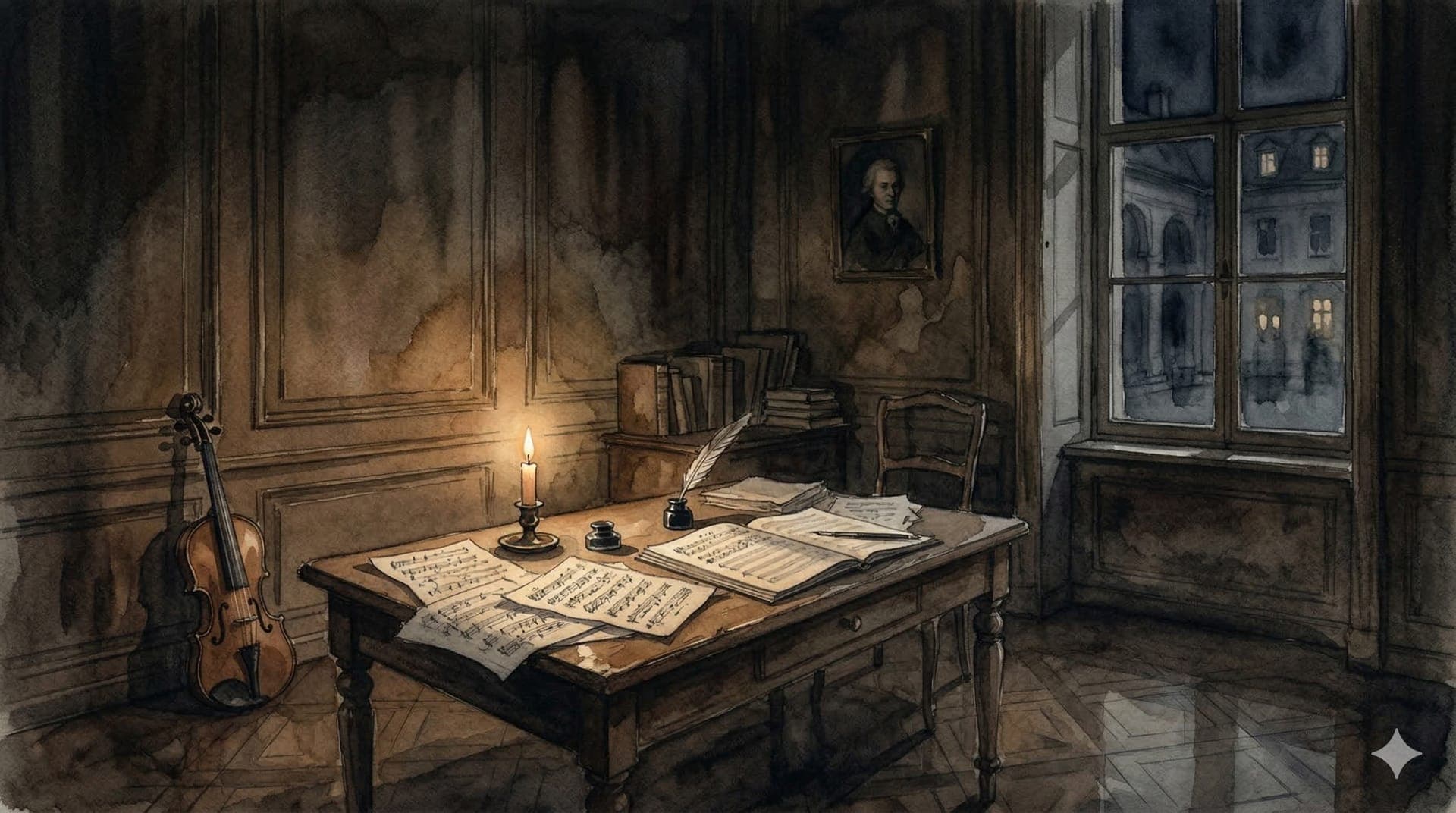 06
06Leopold Mozart dies in Salzburg at age 67. Wolfgang, who had been estranged from his father in recent years, does not attend the funeral. Shortly before, he had written to Leopold about death as 'the true goal of our existence.'
Mozart composes his most famous serenade, Eine kleine Nachtmusik, K. 525. Its opening melody is among the most recognized in all of classical music.
The 'opera of all operas' premieres at Prague's Estates Theatre. Legend holds that Mozart composed the overture the night before. The audience is overwhelmed.
After Gluck's death, Mozart is appointed Imperial and Royal Chamber Composer — but at a fraction of Gluck's salary. Mozart quips: 'Too much for what I do, too little for what I could do.'
Mozart writes desperate letters to his fellow Mason Michael Puchberg begging for loans. Public concerts have dried up, and the family moves to cheaper lodgings in the suburbs.
Mozart enters his final three symphonies in his own catalogue: No. 39 on June 26, No. 40 on July 25 and No. 41 on August 10. The festive E-flat, restless G minor and expansive C major offer three strikingly different orchestral worlds.
Mozart completes a quintet for his friend Anton Stadler. A clarinet joins two violins, viola and cello in music of intimate exchange. The instrument’s rich lower voice will return in the concerto of 1791.
The third and final Da Ponte opera premieres at the Burgtheater. Its cynical plot conceals some of Mozart's most achingly beautiful music. Performances are cut short by Emperor Joseph II's death.
Mozart travels to Frankfurt for Emperor Leopold II's coronation, hoping to advance his career. He gives a concert that is praised but poorly attended. He returns disappointed.
07CHAPTER · 1791
A fairy-tale opera, a coronation commission, a concerto for a friend, a new son. Mozart’s last year is full of life and work. Only in November does the illness that ends it take hold.
Vienna & Prague, 1791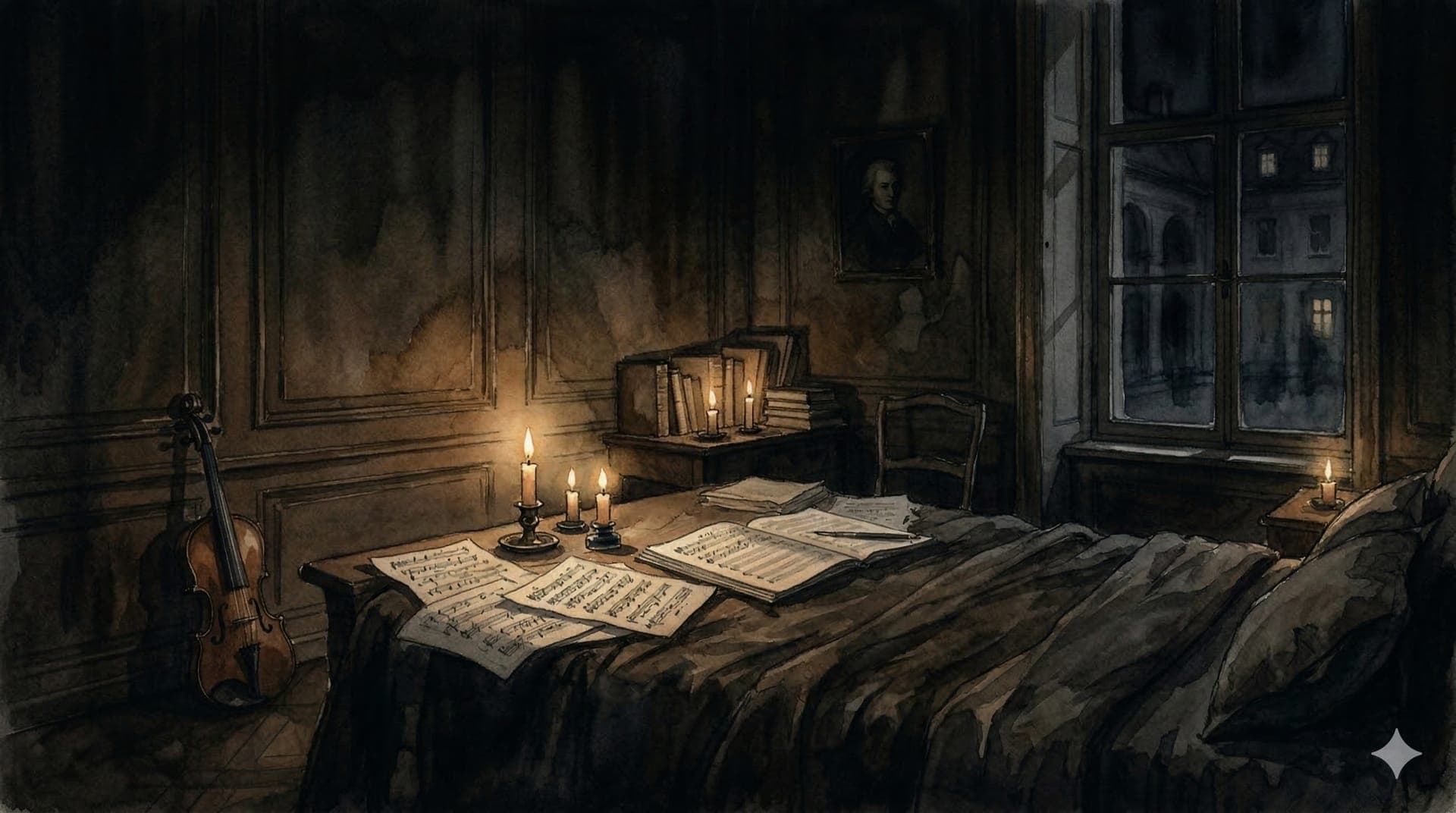 07
07Mozart begins work on Die Zauberflöte with librettist Emanuel Schikaneder. It is a Singspiel that blends fairy tale, Masonic symbolism, and sublime music.
During a visit to Baden, Mozart writes Ave verum corpus for the schoolmaster and choirmaster Anton Stoll. Just forty-six bars long, the motet finds an extraordinary stillness within the busy final year.
An intermediary commissions a Requiem on behalf of Count Franz von Walsegg, whose wife has died. Mozart leaves the score incomplete. After his death, Constanze arranges for it to be finished; Franz Xaver Süssmayr supplies the best-known completion.
Constanze gives birth to Franz Xaver Wolfgang Mozart, the younger of the couple’s two sons who will survive childhood. He later becomes a pianist and composer, living with the expectations attached to his father’s name.
Commissioned for the coronation of Leopold II as King of Bohemia, this opera seria premieres in Prague. Mozart composes it at extraordinary speed, possibly with help from Süssmayr.
Die Zauberflöte premieres at the Theater auf der Wieden with Schikaneder as Papageno. Mozart conducts. The opera is an immediate popular triumph and runs for over 100 performances.
The Clarinet Concerto, K. 622, is written for Anton Stadler and an instrument with an extended low register, now called the basset clarinet. Its warmth and long melodic lines bring Mozart’s concerto writing to a quietly radiant close.
Mozart becomes seriously ill and is confined to bed. Contemporary accounts describe fever and swelling, but the evidence does not establish a certain modern diagnosis. Stories of poisoning have no reliable historical foundation.
Mozart is buried at St. Marx Cemetery outside Vienna. An ordinary communal grave was consistent with the burial practices of the time; it is not proof of a pauper’s funeral. The precise location of his remains is unknown.
Mozart dies at his home in Vienna, aged thirty-five. He leaves Constanze, their two surviving sons, and an extraordinary body of music. The Requiem remains unfinished, becoming inseparable from the story of his final months.
1756 — 1791 — ∞
The unfinished Requiem was a final chapter, not an ending. Step from the story into the music Mozart left behind.
THE HISTORICAL RECORD
Dates, letters, manuscripts and museum research underpin this account. Anecdotes are distinguished from documented events. Maps use present-day geography and connect selected stops, rather than reconstructing eighteenth-century roads.