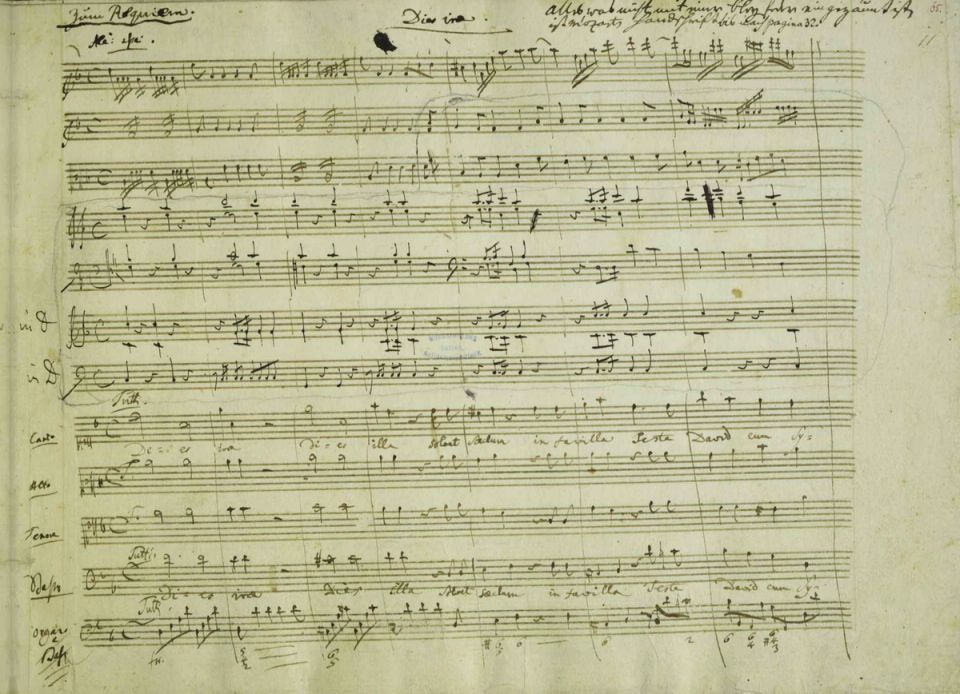
Pick up a page of Mozart's music and the first thing that strikes you isn't a note — it's the eerie perfection. Line after line of tiny, confident notation flows across the paper almost without a single crossing-out, as if the man were copying from some finished score only he could see. Soprano Barbara Bonney, gazing at the original manuscript of The Magic Flute, put it plainly: "It is amazing how perfectly it is written down, as if he was dictating it from another place."¹
Now picture Beethoven's manuscripts. Slashed-out bars, ink blots, paper ripped in fury and glued back together. Zdzisław Pietrzyk, director of the Jagiellonian Library in Kraków — which holds original scores by both composers — once noted the contrast bluntly: "Mozart was very tidy. He wrote without making any changes. Beethoven, on the other hand — his manuscripts were messy, crossed out, corrections everywhere." Two supreme geniuses, two completely opposite desks.
The night before curtain call in Prague
No story captures Mozart's uncanny speed better than the overture to Don Giovanni. On the evening of October 28, 1787 — the night before the opera's Prague premiere — the overture still did not exist on paper. According to Constanze Mozart, she kept her husband awake with fairy tales and punch while he composed through the small hours. The copyists barely finished extracting orchestra parts in time; the players sight-read the overture cold at the performance. Mozart's own handwritten thematic catalogue, now in the British Library, confirms the opera's completion date as October 28 — one day before the curtain rose.²
Modern scholars call the romantic details "plausible but embellished." The core fact, however — that Mozart finished the opera dangerously late, writing substantial portions on Prague paper bought on-site — holds up under scrutiny. He had the music in his head. He just hadn't bothered writing it down yet.
Did he really compose without corrections?
For two centuries, people assumed Mozart never revised. That myth traces partly to a fraudulent letter circulated by the early publisher Friedrich Rochlitz, portraying Mozart's creative process as effortless transcription from the mind of God. Modern scholarship tells a different story. Around 320 sketches and drafts survive, covering roughly ten percent of his catalogued works — and Constanze herself admitted she destroyed many "unusable autographs." Musicologist Ulrich Konrad has shown that Mozart employed a systematic method: melody and bass first, inner voices filled in later, different ink colors marking each layer. His scores look clean because they represent the final stage of an intensely organized process, not the absence of one.
From a father's hand to a child's first notes
Mozart's earliest compositions — four tiny keyboard pieces now catalogued as K. 1a through 1d — sit in the Morgan Library in New York, composed when he was just five. But the handwriting isn't his. Leopold Mozart notated every one of his son's first fourteen compositions because the boy could improvise music before he could hold a pen properly. Wolfgang's own hand first appears in the family's Nannerl Notenbuch around age eight, and handwriting scholar Wolfgang Plath later judged the mature Mozart flatly "incapable of calligraphy" — fast, functional, brilliant, but never pretty Read more about Mozart's early life.
Scattered across the world, and worth millions
Today, roughly eighty percent of surviving Mozart autographs reside in Berlin's Staatsbibliothek. The Mozarteum in Salzburg guards over a hundred music manuscripts, two hundred letters, and his childhood violin. The Morgan holds the Haffner Symphony and the famous Horn Concerto K. 495 — written in four colors of ink, possibly to rattle his friend the horn player Leutgeb. In 1987, a bound volume of nine Mozart symphonies sold at Sotheby's for approximately $4.5 million, then a record for any music manuscript Explore how Mozart sold his own music.
Every page that surfaces at auction reminds us how few remain in private hands — and how much a single sheet of that impossibly tidy handwriting is still worth.
Sources
¹ Barbara Bonney, quoted in "Was Wolfgang Amadeus Mozart the Greatest Composer of All?", *Gramophone*.
² Mozart's autograph thematic catalogue (*Verzeichnüss aller meiner Werke*), British Library, Zweig MS 63; the Prague premiere is documented in Otto Erich Deutsch, *Mozart: A Documentary Biography* (London, 1965), pp. 302–303.