- Köchel Number
- K9 50 | K6 46b
- Genre
- Opera & Stage Music
- Form
- Operas & Singspiels
- Date
- September–October 1768
- Place
- Vienna
- Age
- 12
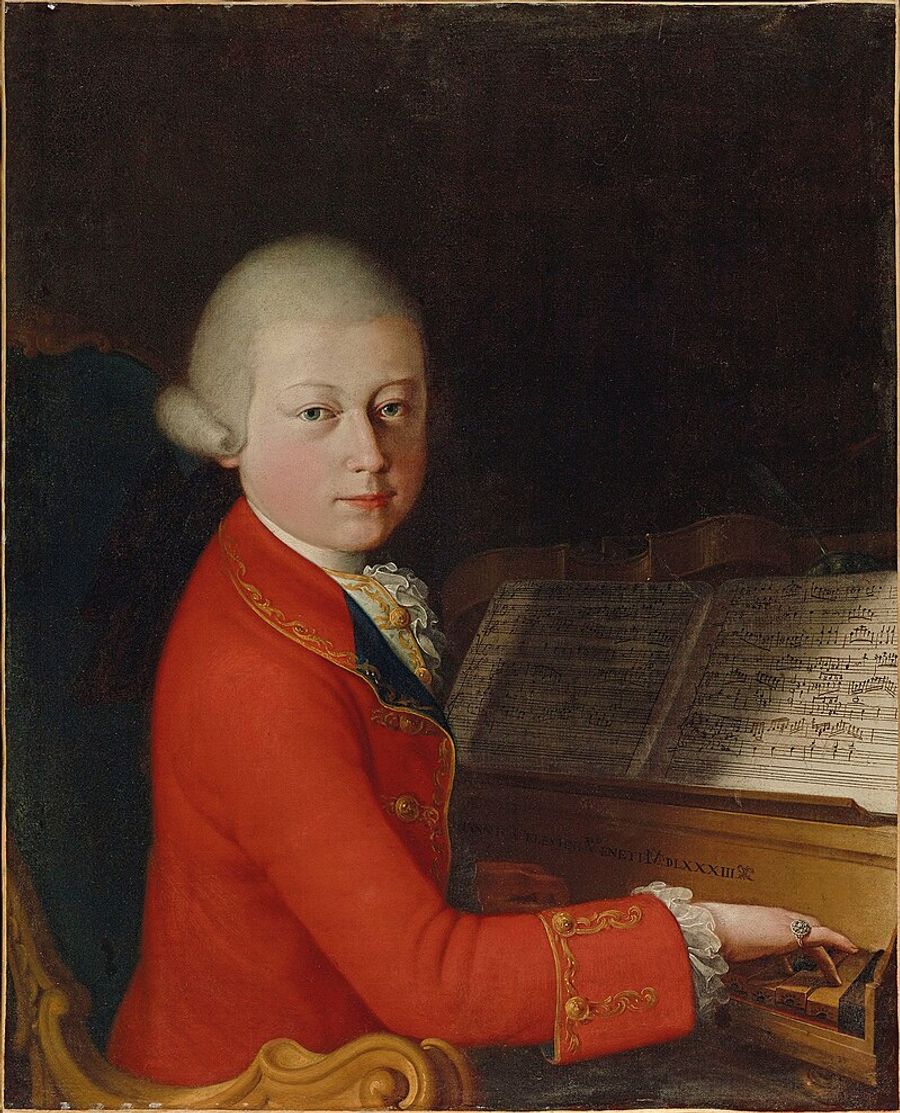
Bastien und Bastienne (K. 50) is a one-act German Singspiel composed in Vienna in 1768, when Wolfgang Amadeus Mozart (1756–1791) was just twelve. Modest in scale yet strikingly sure-footed in characterisation, it adapts a fashionable pastoral plot ultimately traceable to Rousseau’s Le devin du village.
Mozart's Life at the Time
In 1768 the Mozart family was living in Vienna, where the twelve-year-old Wolfgang was already an experienced theatre composer despite his age: he had written the Latin school drama Apollo et Hyacinthus (K. 38) the year before, and larger operatic ventures were soon to follow. Bastien und Bastienne belongs to this Viennese moment of apprenticeship—close to professional stages, singers, and the city’s appetite for light, pastoral entertainment—yet it is also unmistakably the work of a boy testing how words, gesture, and melody can turn domestic jealousy into stage comedy.12
Tradition links the work with the physician Franz Anton Mesmer, whose private garden theatre has often been named as a likely intended venue; however, the evidence for an actual 1768 performance is uncertain, and the earliest documented staging dates from much later (Berlin, 2 October 1890).23 This gap between probable origin and verifiable performance history is part of the opera’s fascination: it is an early Mozart stage work that seems to have lived more securely on paper than in the repertory.
Composition and Manuscript
Mozart composed Bastien und Bastienne in Vienna in 1768; Leopold Mozart later listed it in his own catalogue as a “teutsche Operette.”1 The German text is usually associated with Friedrich Wilhelm Weiskern, Johann Heinrich Friedrich Müller, and Johann Andreas Schachtner, though the exact division of labour (and the degree of revision) remains a matter of editorial caution.24
The libretto stands at the end of a chain of adaptations. Its immediate ancestor was a popular Viennese version of Les amours de Bastien et Bastienne (itself connected with French theatrical parodies), and the deeper model is Jean-Jacques Rousseau’s pastoral Le devin du village.25 What mattered in Vienna was less Rousseau’s philosophical aura than the stage-ready formula: two young lovers, a temporary misunderstanding, and a knowing “magician” who manipulates the reconciliation.
The score’s orchestral forces are small—appropriate to a private theatre and to youthful resources—yet Mozart thinks theatrically in instrumental colour. Typical listings include:
- Winds: 2 flutes, 2 oboes (with optional bassoon in some sources)
- Brass: 2 horns
- Strings: violins I & II, viola, cello/double bass
- Continuo: harpsichord (or keyboard)
This economy is not mere limitation: it encourages clear textures, quick dialogue-like exchanges, and an intimacy that suits the pastoral miniaturism of the piece.67
Musical Character
Bastien und Bastienne is often described as a “miniature,” but it is more than a curiosity. The drama is built for swift alternation between spoken dialogue and closed numbers, the hallmark of Singspiel. With only three named roles—Bastienne (soprano), Bastien (tenor), and Colas (bass)—Mozart must make personality audible quickly, and he does so through sharply differentiated musical manners.2
Bastienne’s music frequently leans toward the German Lied style—strophic simplicity, direct phrasing, and an air of folk-like sincerity—while other passages flirt with a more French-inflected elegance, reflecting the work’s mixed cultural ancestry.2 The comic centre, Colas, is already a recognisably “Mozartian” stage type: part charlatan, part benevolent manipulator. His famous spell-song (“Diggi, daggi, shurry, murry”) turns nonsense syllables into theatrical virtuosity, a childhood experiment in parody that anticipates Mozart’s later delight in exposing pretension through sound.2
What makes the piece distinctive within Mozart’s early output is its understanding of operatic pacing. Even at twelve, Mozart shapes the lovers’ quarrel with a sense of escalation and release: jealousy is voiced in compact, singable phrases; the reconciliation expands the musical space; and the closing ensemble gives the opera the satisfying social “reset” that pastoral comedy requires.25 For modern listeners and stagings, Bastien und Bastienne also offers something rare in the eighteenth-century operatic landscape: an early German comic opera that is short, performable with limited forces, and still full of melodic charm—an apprentice work that nonetheless reveals a future master learning, number by number, how theatre breathes.12
Sources
[1] Mozarteum Salzburg, Köchel-Verzeichnis entry for *Bastien und Bastienne* (KV 50): dating, genre, and catalogue remarks.
[2] Wikipedia: overview, librettists as commonly given, relationship to Rousseau/Favart tradition, and general performance-history notes.
[3] OperaGlass (Stanford University): performance history reference cited widely for the first documented performance (Berlin, 1890).
[4] Schott Music catalogue entry: credits for the original text authors associated with the libretto tradition (Weiskern/Müller).
[5] The Cambridge Mozart Encyclopedia (reference overview): Vienna 1768 context and derivation from Rousseau’s *Le Devin du village* via intervening versions.
[6] IMSLP work page: commonly cited instrumentation details and available scores/parts for *Bastien und Bastienne* (K. 50/46b).
[7] VMII (Vocal Music Information Index) page: roles and a concise instrumentation listing.