- Köchel Number
- K9 503 | K6 503
- Genre
- Concertos
- Form
- Piano Concertos
- Key
- C Major
- Date
- 4 December 1786
- Place
- Vienna
- Age
- 30
Mozart’s Piano Concerto No. 25 in C major (K. 503) is a large-scale work for solo piano and full Classical orchestra. This article outlines its compositional setting, instrumentation, movement-by-movement form and themes, and the concerto’s reception, including later neglect and revival and notable musical parallels.
Composition and Historical Context
Wolfgang Amadeus Mozart completed his Piano Concerto No. 25 in C major (K. 503) on 4 December 1786 in Vienna[1]. This was a remarkably productive period in Mozart’s life – 1786 saw the premiere of his opera Le nozze di Figaro, the completion of the Prague Symphony (No. 38 in D, K. 504) two days after this concerto[2], and numerous other works (including a horn concerto and chamber pieces)[3]. Mozart at this time was riding the success of Figaro and still at the height of his popularity in Vienna’s vibrant musical scene. He supported himself with concerts (“academies”) where he would premiere his own piano concertos as both composer and soloist[4]. Concerto No. 25 was written for such concerts – likely first performed by Mozart at a subscription academy in early December 1786 at Vienna’s Trattnerhof Casino[5]. In fact, Mozart himself played this new concerto on 5 December 1786 in Vienna[6], and he later featured it on tour (a Leipzig Gewandhaus concert in May 1789 drew praise for the “brilliant, glorious C major concerto”)[7].
Beyond Mozart’s personal sphere, the world of 1786 was on the eve of great change. Enlightenment ideas were flourishing in Europe under rulers like Emperor Joseph II, and the atmosphere in Vienna’s cultural life was cosmopolitan. In music, the Classical style was at its peak: composers such as Haydn were crafting symphonies and string quartets, and the young Beethoven (then 16) was absorbing influences that would soon revolutionize music. Mozart’s Piano Concerto No. 25 emerged from this milieu as the last of the twelve grand piano concertos he wrote in Vienna between 1784 and 1786[1]. It also marked a turning point – after 1786 Mozart shifted focus more to opera and his public concert appearances waned, partly due to changing audience tastes and financial challenges[8]. In this sense, K. 503 stands as the capstone of Mozart’s extraordinary concerto output in Vienna, composed at a time when he was balancing his dual roles as a virtuoso pianist and an innovative composer. The concerto’s creation was likely motivated by Mozart’s need for new repertory to showcase at his concerts, as well as his continuing artistic drive to expand the possibilities of the piano concerto genre.
Instrumentation and Orchestration
Mozart scored the C-major Concerto for a full Classical orchestra of solo piano and orchestra: specifically, one flute, two oboes, two bassoons, two horns in C, two trumpets in C, timpani, and strings (violins, violas, cellos, double bass)[9]. Notably, Mozart did not include clarinets in this score – a surprising omission given that clarinet was one of his favorite instruments, often featured in his other late works[10]. Instead, the presence of trumpets and timpani (in addition to the usual pairs of winds) gives this concerto a bright, ceremonial sonority. The orchestration is grand for a Mozart concerto and contributes to the work’s majestic, symphonic character[11]. Indeed, the work is one of Mozart’s longest concertos (typically around 30 minutes in performance)[12], and the rich scoring allows for a wide palette of textures – from fanfare-like tuttis to intimate dialogues between the piano and woodwinds. The winds, in particular, play an important role, carrying thematic material (especially in the slow movement) and adding chamber-music delicacy within the broader orchestral frame[13]. Overall, the instrumentation of K. 503 reflects Mozart’s intent to write a concerto on a symphonic scale, with a full, resonant orchestral backdrop supporting the piano soloist.
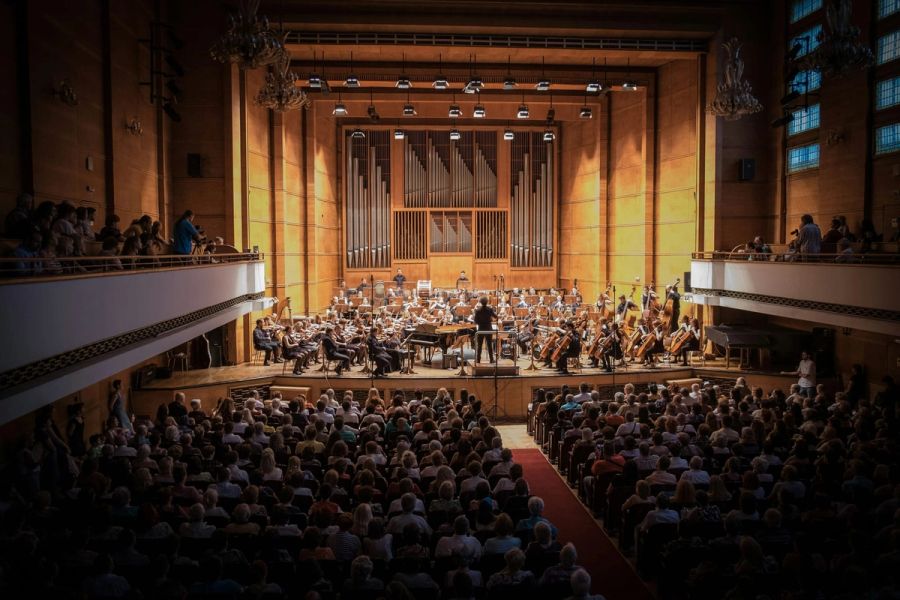
Hannes Minnaar & Philharmonie Zuidnederland - Performed at The Sunday Morning Concert, Sunday the 28th of May 2023, in The Concertgebouw in Amsterdam, The Netherlands:
Form and Musical Character
Concerto No. 25 follows the classic three-movement concerto structure (fast–slow–fast), but within this framework Mozart introduces a breadth and complexity that set the work apart from more routine concertos of the day. Each movement has its own distinct character and formal design, yet all three are unified by an atmosphere of nobility and sophistication.
Allegro maestoso (C major) – The first movement opens in grand fashion[14]. The orchestra introduces the principal themes with bold C-major fanfares and a series of rising and falling scales and arpeggios, immediately establishing a majestic, Allegro maestoso tone[14]. This extensive orchestral introduction is symphonic in scope, filled with rich contrapuntal interplay and even touches of dramatic minor-key coloring[15]. (In fact, the music subtly shifts in and out of minor several times, adding emotional depth[15].) One of the secondary themes presented by the orchestra has a distinctive martial character – it famously resembles the melody of “La Marseillaise,” the French national anthem (which had not yet been composed in 1786)[16]. After the commanding orchestral exposition, the solo piano enters rather gently, with an arpeggiated pickup that leads back into the opening theme now shared with the orchestra[14]. The piano’s entry is unassuming, but soon the soloist elaborates on the themes with virtuoso passagework and inventive figuration. Mozart integrates the piano and orchestral material closely: the movement unfolds as a sonata-allegro with a double exposition (orchestra then solo), a substantial development section, and a recapitulation. A solo cadenza (not written out by Mozart – performers either improvise or use later composed cadenzas) precedes the coda. Throughout this movement, Mozart foregoes flashy, empty virtuosity in favor of structural grandeur and rich musical content[17]. The mood remains elevated and noble; even when the piano part is technically demanding, it serves the music’s dramatic and architectural goals rather than mere display. Commentators often note that this expansive first movement is one of the most symphonic concerto movements Mozart ever wrote[15], rivaling the breadth of his later symphonies.
Andante (F major) – The second movement provides a gentle contrast. Set in the subdominant key of F major, it is a tranquil Andante that unfolds in a lyrical, singing style, almost like an operatic aria. The form is a simplified sonata form – essentially ternary or ABA’ – without a long development section[13]. The orchestra introduces the main theme softly, and notably this melody is carried by the woodwinds, showcasing Mozart’s beautiful writing for winds[18][13]. The theme has a graceful, contemplative character, and when the piano enters, it picks up this same theme, embellished with flowing lines in the right hand. The movement continues with an episode (a gentle contrasting section) before returning to the main theme in a varied way. Throughout the Andante, the wind instruments (flute, oboes, bassoons, horns) engage in intimate conversation with the piano, creating a chamber-music texture within the concerto[13]. Despite its outward simplicity and calm, the movement contains some striking harmonic excursions. Mozart ventures into unexpected keys at a few points – surprising modulations that would have caught listeners off guard in 1786[19]. (For example, contemporary commentators have pointed out sudden shifts like from C major to B♭ major, or from the home key F major to a distant E♭ major, which sound remarkably forward-looking[19].) These brief adventures add a poignancy and innovative spirit to the otherwise serene movement. Overall, the Andante’s style is one of elegant cantabile (songfulness) and delicate orchestral color. Some writers hear in it an operatic sensibility – the kind of heartfelt, simple melody Mozart might give to a sympathetic character on stage[20].
Allegretto (C major) – The finale is a brisk yet moderately paced movement in sonata-rondo form[21]. It begins with a gavotte‐like theme presented by the orchestra – a charming, symmetrical tune that in fact Mozart borrowed from one of the dance numbers in his earlier opera Idomeneo[21]. This nostalgic reference to Idomeneo (an opera seria) lends a stately, courtly flavor to the otherwise lively finale. The piano soon takes up this theme and weaves it into a series of joyful episodes and refrains. As a sonata-rondo, the movement combines the recurring refrain idea of a rondo with the developmental aspects of sonata form. Mozart treats the rondo theme seriously: as musicologist Cuthbert Girdlestone noted, this movement is more weighty and “serious-minded” than a typical lighthearted concerto finale[21]. The music traverses a variety of moods – at times playful and elegant, at times vigorous and dynamically charged. In the middle, there are a few forays into the minor mode (C minor and others), which add momentary drama or melancholy shading[21]. The piano engages in sparkling passagework but also dialogue with the winds and strings, ensuring the movement remains a conversation rather than a virtuoso solo showpiece. As the finale draws to a close, the clouds dissipate and C major reasserts itself firmly. The ending is confident and triumphant, with the full orchestra and piano united in a final exuberant statement of the theme[21]. Commentators have observed that many of the solo piano’s passages in this finale carry a wistful or reflective tone, but the very last pages turn sunny and exultant, providing a “refreshing exuberance” and a satisfying conclusion to the concerto[22].
Overall character: Mozart’s Piano Concerto No. 25 is distinguished by its heroic scale and depth. The choice of C major – a key Mozart often reserved for his most grand and celebratory works – and the inclusion of trumpets and drums give the work a regal, almost imperial aura[23]. There is an unmistakable grandeur and formality throughout, from the expansive architectural first movement to the dignified finale. At the same time, the concerto is filled with subtle ingenuity: contrapuntal textures (including canon and fugato hints) permeate the outer movements[11], and Mozart achieves a remarkable integration of soloist and orchestra. Unlike some earlier piano concertos that were designed chiefly to showcase the soloist’s brilliance, K. 503 emphasizes musical conversation and structural coherence over superficial brilliance[17]. Indeed, contemporaries noted that Mozart did “negate” the usual virtuoso fluff – yet the piano writing is in reality very challenging, requiring both technical finesse and expressive nuance (Mozart himself was one of the few who could premiere such a piece convincingly)[24][25]. The concerto’s elevated style and symphonic ambitions mean that it straddles boundaries: it has the breadth and complexity of a symphony while still retaining the dramatic, interactive qualities of a concerto, and even hints of operatic lyricism in its melodies[20]. Modern analysts view this work as Mozart pushing the concerto form to its limits, pointing the way toward the larger-scale concertos of the 19th century[26].
Reception and Legacy
Contemporary reception: Despite its musical richness, Mozart’s C-major Concerto did not achieve great popularity in his own time. The work’s premiere and early performances elicited respectful admiration but perhaps not the enthusiasm that greeted some of Mozart’s more easily accessible concertos. In Vienna, audiences in 1786 had recently been confronted with the dark and intense Concerto in C minor (No. 24, K. 491), which left some listeners uneasy in the spring of 1786[27]. With the new Concerto No. 25, Mozart returned to C major and a grander, more public style – something one might expect to delight – yet the piece’s very sophistication may have been challenging for the public. The music lacks the immediate, surface “charm” and catchy melodies of some earlier concertos, focusing instead on powerful development and formal innovation[28]. One contemporary critic, Johann F. Rochlitz, described K. 503 (in 1798) as “the most magnificent and difficult” of Mozart’s concertos, possibly even the most magnificent concerto ever written[29]. However, this praise came a decade too late – by 1798 Mozart had died, and during his final years the concerto had already slipped into neglect. There is no record of No. 25 being performed in Vienna again in Mozart’s lifetime after 1787, and it seems to have been overshadowed by Mozart’s lighter or more immediately popular works.
19th-century neglect: In the decades following Mozart’s death (1791), Piano Concerto No. 25 virtually disappeared from the repertoire. Tastes in the early 19th century often favored either the Romantic virtuoso concertos of composers like Beethoven and Chopin or the more tuneful Mozart concertos that fit the era’s image of graceful “Classical” music. Mozart’s grand C-major concerto was deemed too serious and expansive, and was long neglected in favor of his more sparkling concertos (for example, the ever-popular Concerto No. 21 in C, K. 467)[30]. Some 19th-century commentators even criticized K. 503 as “cold” or “academic” – one later critic infamously called it “frigid and unoriginal,” reflecting how misunderstood the piece was in that era[31]. The concerto was not published widely or championed by pianists of the Romantic age; consequently, it languished in obscurity. One notable exception to this neglect was Mozart’s pupil Johann Nepomuk Hummel, who greatly valued Concerto No. 25. Hummel not only drew inspiration from it for his own C-major piano concerto Op. 36, but he also made a chamber arrangement of K. 503 (one of seven Mozart concertos he arranged for flute, violin, cello, and piano)[32]. These adaptations, made around the 1820s, indicate that a few connoisseurs recognized the work’s quality even if it was not performed in concert halls. By and large, however, throughout the 1800s K. 503 was seldom heard; it was essentially a sleeping giant awaiting rediscovery.
Twentieth-century revival: The major revival of Piano Concerto No. 25 began in the 20th century. Remarkably, more than 140 years passed between Mozart’s own last known performance of it and its next public performances. In 1934, legendary pianist Artur Schnabel gave what is often cited as the modern premiere of the concerto, with George Szell conducting the Vienna Philharmonic[33]. This 1934 performance – nearly a century and a half after the work’s composition – reintroduced the piece to audiences, and it was met with acclaim. Over the following decade, other great pianists (such as Rudolf Serkin and Edwin Fischer) took up the concerto, and it slowly secured a place in the standard repertoire[34]. By the late 20th century, K. 503 had fully “ascended” to the status of a Mozart masterpiece in the public consciousness. Musicologists and performers came to regard it as one of Mozart’s finest achievements. In the words of one scholarly assessment, by common consent K. 503 is now seen as “one of Mozart’s greatest masterpieces in the concerto genre”[35]. It is frequently paired with the dramatic C minor Concerto (K. 491) as its spiritual counterpart – one a heroic C-major summit, the other a tragic minor-key summit of Mozart’s concerto output[36]. Influential 20th-century musicologists including Donald Tovey, Cuthbert Girdlestone, and Alfred Einstein have all singled out the C-major Concerto for special praise, upholding it as an exemplary work that epitomizes Mozart’s genius in instrumental music[36]. Today, Piano Concerto No. 25 is a repertoire staple for Mozart interpreters. Its performances are highlights of concert programs, and modern listeners and critics appreciate the work’s combination of magisterial breadth and profound beauty – qualities that earlier generations were slower to recognize.
Distinctive Details and Interpretations
Over the years, scholars and musicians have uncovered various distinctive features and fascinating connections surrounding Mozart’s Piano Concerto No. 25:
- “La Marseillaise” Theme: One of the most remarked-upon curiosities is the resemblance of a theme in the first movement to “La Marseillaise.” The secondary march theme introduced by the orchestra bears an uncanny likeness to the French national anthem (which was composed by Rouget de Lisle in 1792, several years after Mozart’s concerto)[16]. Of course, Mozart did not literally quote La Marseillaise – rather, it is a coincidental melodic similarity. This striking musical foreshadowing has earned K. 503 occasional nicknames like the “Marseillaise” Concerto. It provides an interesting historical echo: Mozart’s Viennese concerto unexpectedly anticipates a revolutionary song of the French Revolution era[16]. The theme’s bold, martial character within Mozart’s piece certainly embodies the heroic spirit of C major and may well have reminded later listeners of the anthem’s stirring tune.
- Connection to Mozart’s Operas: The concerto’s ties to Mozart’s operatic work are evident. As noted, the finale’s main theme is adapted from a gavotte in Idomeneo (1781)[21], which is an opera about a noble, heroic figure. This borrowing is more than a self-reference – it imbues the finale with an opera seria flavor, as if Mozart brings a touch of the dignified courtly dance into the concerto hall. Additionally, commentators like H. C. Robbins Landon have observed that No. 25 seems to straddle Mozart’s operatic and instrumental worlds[37]. The lyrical expressiveness and dramatic contrasts in the concerto’s slow movement and finale are reminiscent of Mozart’s operatic scenes (for example, one can hear pre-echoes of the graceful ensembles of Così fan tutte, which Mozart would write a few years later)[20]. At the same time, the rigorous development of musical ideas in the concerto reflects the logic of his instrumental works. This synthesis of theatrical flair and symphonic logic is a hallmark of K. 503’s style.
- Parallels with Other Works: Piano Concerto No. 25 has invited comparison to several other major works of Mozart. Its grandeur and key of C major often draw comparisons with Mozart’s Symphony No. 41 “Jupiter” (K. 551, composed 1788), which likewise is in C major and known for its majestic and contrapuntal finale. Indeed, some hear the concerto’s first movement as looking ahead to the Jupiter Symphony’s celebratory spirit and learned counterpoint[20]. Musicologist C. Girdlestone, however, felt that an even closer parallel is Mozart’s String Quintet in C major, K. 515 (written in 1787); both K. 503 and K. 515 share an expansive scale, a noble C-major tonality, and a blending of complexity with clarity[15]. Furthermore, as mentioned, K. 503 is often regarded as the companion piece to the preceding Piano Concerto No. 24 in C minor, K. 491. The two concertos—one in the darkest minor key, one in the triumphant major—form a contrasting pair. They were composed only months apart, and one scholar noted that No. 25 can be seen as “the rival and the complement” to the great C minor concerto[38]. In performance programming today, these two are sometimes featured together to showcase Mozart’s dual mastery of drama and jubilation.
- Influence on Beethoven and Others: Mozart’s Piano Concerto No. 25 also cast a long shadow forward into the 19th century. The young Ludwig van Beethoven knew Mozart’s music well, and it is widely thought that Beethoven’s own Piano Concerto No. 1 in C major (composed in the mid-1790s) shows the influence of Mozart’s K. 503[39]. Beethoven’s C-major concerto echoes elements of Mozart’s, such as its broad, orchestral introduction and the overall heroic demeanor in the first movement[39]. Moreover, musical ideas from K. 503 have been compared to motifs in Beethoven’s works – for instance, a figure in Mozart’s first movement has been noted as resembling the famous short-short-short-long rhythm that opens Beethoven’s Fifth Symphony, and both Mozart’s 25th concerto and Beethoven’s grand “Emperor” Concerto (No. 5) feature march-like themes that appear first in a minor mode and later in a glorious major incarnation[40]. These similarities underscore how far ahead of its time Mozart’s concerto was; it seems to anticipate the monumental concerto style that Beethoven would fully develop. In addition to Beethoven, as mentioned, Mozart’s student Hummel drew inspiration from K. 503 for his own works[41], and later composers and pianists gradually came to appreciate its forward-looking qualities. By paving the way for a more expansive, symphonic approach to the concerto, K. 503 can be seen as a bridge between the Classic era and the Romantic era in music[26].
In summary, Mozart’s Piano Concerto No. 25 in C major, K. 503 stands as a towering achievement of the Classical period. Its creation was embedded in the rich context of Mozart’s peak Vienna years and the broader Enlightenment culture of the 1780s. The concerto’s bold instrumentation, formal innovation, and profound musical discourse showcase Mozart at the height of his powers, simultaneously summing up the Classical piano concerto tradition and pushing its boundaries. Though underappreciated for many generations, today K. 503 is rightly celebrated as one of Mozart’s greatest masterpieces – a work of lofty elegance, intricate craftsmanship, and enduring inspiration[35][36]. Its legacy lives on in the concert hall and in the lineage of great concertos that followed, confirming Mozart’s genius in marrying brilliance with depth.
Sources:
Sources
Mozart’s Piano Concerto No. 25 is discussed in numerous musicological studies and program notes, including the Kennedy Center and Utah Symphony notes[30][42], scholarly books by Simon P. Keefe and others[36], and analyses by historians like H. C. Robbins Landon[37]. Contemporary accounts (such as Rochlitz in AMZ, 1798) and modern commentary (e.g. Georg Predota’s 2013 article) provide insight into the work’s initial reception and its long-delayed recognition[29][43]. These and other sources collectively affirm the concerto’s high stature and illuminate its historical context and musical intricacies.
[1][9][12][30][32][35][36][38] Piano Concerto No. 25 (Mozart) - Wikipedia
https://en.wikipedia.org/wiki/Piano_Concerto_No._25_(Mozart)
[2][3][4][5][8][14][18][22] Knoxville Symphony Orchestra - Mozart Piano Concerto No. 25
https://audienceaccess.co/show/KSO-2945
[6][10][11][17][20][23][24][25][26][28][31][33][34][37][43] Paving the Road!Mozart Piano Concerto No. 25
https://interlude.hk/paving-the-road/
[7] Mozart: Piano Concertos Nos 24 & 25 - APR5640 - Wolfgang Amadeus Mozart (1756-1791) - Hyperion Records - MP3 and Lossless downloads
https://www.hyperion-records.co.uk/dc.asp?dc=D_APR5640
[13][15][21][40][41] Mozart - Piano concerto no. 25 in C major: description -- Classic Cat
https://classiccat.net/mozart_wa/503.info.php
[16][19][29] 1786: Mozart: Piano Concerto No. 25 (LA MARSEILLAISE) in C major – Gary D. Lloyd – Piano Lessons
https://harpsichordwithhammers.com/2020/09/1786-mozart-piano-concerto-no-25-in-c-major/
[27][39][42] Mozart - Concerto No. 25 in C Major for Piano and Orchestra, K. 503 - Utah Symphony