- Köchel Number
- K9 16 | K6 16
- Genre
- Orchestral Music
- Form
- Symphonies
- Key
- E Flat Major
- Date
- August–September 1764
- Place
- London
- Age
- 8
Mozart’s Symphony No. 1 in E♭ major, K. 16 was composed in London in 1764, when the composer was only eight years old. Though modest in scale, it is a remarkably assured first surviving essay in the early-Classical symphony—already fluent in theatrical gesture, clean phrase structure, and bright orchestral color.
Background and Context
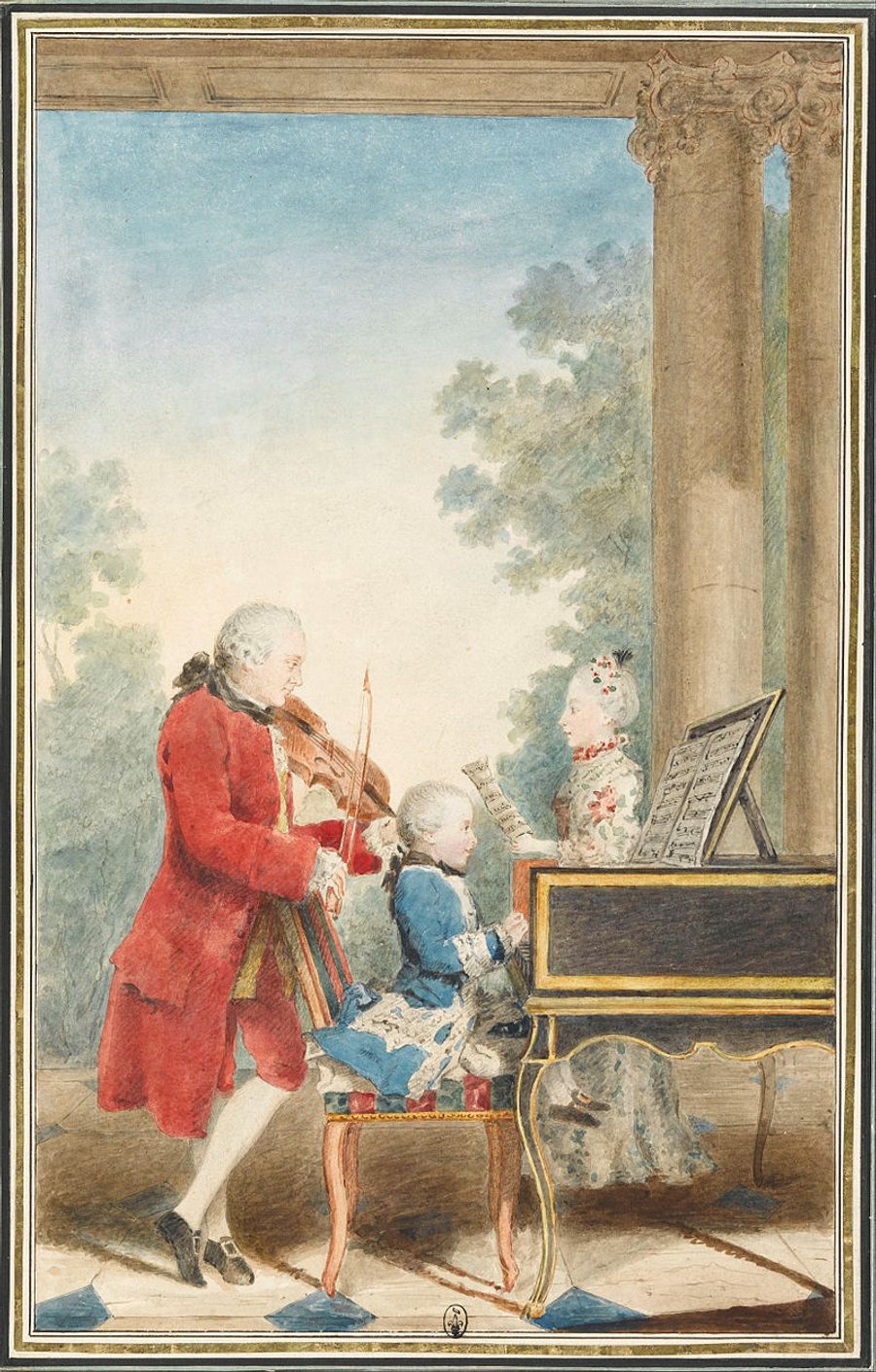
In 1764, the Mozart family was in London as part of their extended European tour—a period in which the young Wolfgang Amadeus Mozart (1756–1791) was already celebrated as a prodigious performer but was still learning how to handle larger, public genres. London offered him something Salzburg could not: a bustling concert life, cosmopolitan taste, and direct contact with fashionable orchestral writing. The city was also home to Johann Christian Bach (1735–1782), whose elegant, galant style helped shape what we now think of as “early Classical” orchestral rhetoric.
The immediate circumstances of Symphony No. 1 in E♭ major, K. 16 have often been linked to the family’s move during the summer of 1764—prompted by Leopold Mozart’s illness—when quieter lodgings were sought outside the city’s center 1. However one narrates the domestic details, the essential point remains: Mozart’s first surviving symphony belongs to the London crucible, where the boy composer absorbed contemporary idioms quickly and translated them into a coherent orchestral statement.
Composition and Premiere
The autograph manuscript bears an explicit, proudly documentary inscription: “Sinfonia di Sig: Wolfgang Mozart a London 1764,” anchoring the work firmly to place and year 2. Modern reference sources generally date the symphony to 1764 in London and emphasize Mozart’s age (eight) as part of its significance 13.
As for first performances, documentation for the earliest Mozart symphonies is thinner than for his later Viennese concert works; still, London public concerts did perform music by the child prodigy, and at least some accounts place early symphonies in the orbit of the Little Theatre in the Haymarket in 1765 4. What is most secure is not a single premiere date, but the social function the piece clearly serves: a concise, brilliant opening work—close to the three-movement Italian overture (sinfonia) model—that could animate a concert program with minimal rehearsal demands.
Instrumentation
Mozart writes for the lean, standard forces of an early symphony. The scoring is typically given as:
- Winds: 2 oboes
- Brass: 2 horns
- Strings: violins I & II, viola, cello, double bass
This is the instrumentation reported in major catalog and score repositories 35. (As often in 1760s orchestral practice, continuo/keyboard reinforcement may be added in performance, though it is not always explicitly notated in the same way later Classical scores are.)
Notably, the chosen key—E♭ major—works hand-in-glove with the horns of the period, whose open notes lend a ceremonial sheen to tuttis and cadences. Even at eight, Mozart is thinking orchestrally: winds and horns do not merely “double” the strings, but sharpen the profile of climaxes and articulate formal punctuation.
Form and Musical Character
K. 16 follows the classic fast–slow–fast layout associated with the mid-18th-century symphony’s roots in the Italian overture. The movement titles are conventionally given as Allegro molto, Andante, Presto 15. The result is a compact argument—more public-facing than intimate—yet it already rewards attentive listening.
I. Allegro molto (E♭ major)
The opening movement announces itself with confident, “public” brilliance. Its rhetoric is built from clear periodic phrases (balanced question-and-answer units) and crisp cadential goals. The writing favors bright unisons and simple harmonic routes, but that simplicity is part of the style Mozart is learning: clarity and momentum first, complexity later.
One of the most appealing features is how quickly the movement sets up contrast—tutti proclamations against lighter, more conversational passages—suggesting Mozart’s instinct for theatre in purely instrumental music. If one listens for it, the movement already behaves like a miniature stage: entrances matter, pauses matter, and returning ideas arrive with a sense of timing rather than mere repetition.
II. Andante (C minor)
The slow movement shifts to the parallel minor, C minor, creating an expressive shadow within an otherwise sunny symphony. This key choice is striking in so early a work: not “tragic” in a later, Sturm-und-Drang sense, but unquestionably more searching and inward.
Here the young Mozart shows a gift for cantabile line—melodic writing that “sings”—and for the slight intensifications that make a phrase feel inevitable: an unexpected turn toward a darker harmony, a sighing figure, a cadence delayed by just a breath. The movement’s modest scale is precisely what makes it convincing; it does not reach beyond its means, yet it unmistakably aims at expression rather than display.
III. Presto (E♭ major)
The finale returns to speed and brightness, closing the work with the kind of buoyant, forward-driving motion that suited London’s concert taste. The gestures are short-breathed, the cadence points briskly affirmed; one hears a composer learning how to end decisively.
Taken as a whole, the symphony’s three movements reflect an early-Classical ideal: a strong first movement that “gets the room,” a contrasting slow movement that briefly deepens the emotional palette, and a fast finale that restores momentum and completes the arc.
Reception and Legacy
K. 16 is sometimes treated as a charming curiosity—a “first symphony” valued mainly for Mozart’s age. Yet that framing can miss what the work demonstrates historically. Compared with many contemporary 1760s symphonies written for similar forces, K. 16 is not an outlier in length or ambition; it is, rather, a persuasive example of the genre as it was practiced in Mozart’s childhood environment 3.
Its deeper interest lies in what it forecasts. The orchestral confidence, the sense of timing, and the willingness to place a minor-key Andante at the center of a bright outer frame all point toward Mozart’s lifelong instinct: to turn public style into expressive drama. Heard alongside the next London symphonies (K. 19 and the related K. 19a), K. 16 marks the beginning of a rapid apprenticeship in orchestral form—one that would eventually lead, by the late 1780s, to symphonic works of entirely different scale and psychological depth.
For modern listeners, Symphony No. 1 in E♭ major, K. 16 deserves attention not because it is “great despite being early,” but because it is genuinely fluent in the language it chooses to speak. It is the sound of an eight-year-old not merely imitating a style, but already thinking like a composer—deploying keys, timbres, and formal contrast to make an audience feel that the music has somewhere to go, and that it has arrived.
Sheet Music
Download and print sheet music for Symphony No. 1 in E♭ major, K. 16 from Virtual Sheet Music®.
Sources
[1] Wikipedia — overview, London/Chelsea context, dating, and movement list for Symphony No. 1, K. 16.
[2] Chamber Orchestra of Santa Fe program note — cites the autograph inscription “Sinfonia… a London 1764.”
[3] Köchel Verzeichnis (Mozarteum) — work entry for Sinfonie in E♭, KV 16; points to Neue Mozart-Ausgabe volume.
[4] English Heritage Blue Plaques — Mozart’s London residence; notes K. 16 and mentions performances at the Haymarket Little Theatre in February 1765.
[5] IMSLP — score repository entry with instrumentation (2 oboes, 2 horns, strings) and standard movement layout.