This article looks at Mozart’s orchestral world: leadership from within the ensemble rather than a baton-wielding conductor, tight rehearsal routines, and the role of sight-reading and improvisation. It also surveys period venues and instruments, and Mozart’s dealings with orchestras in Mannheim, Prague, Salzburg and Vienna.
Leadership Without a Baton
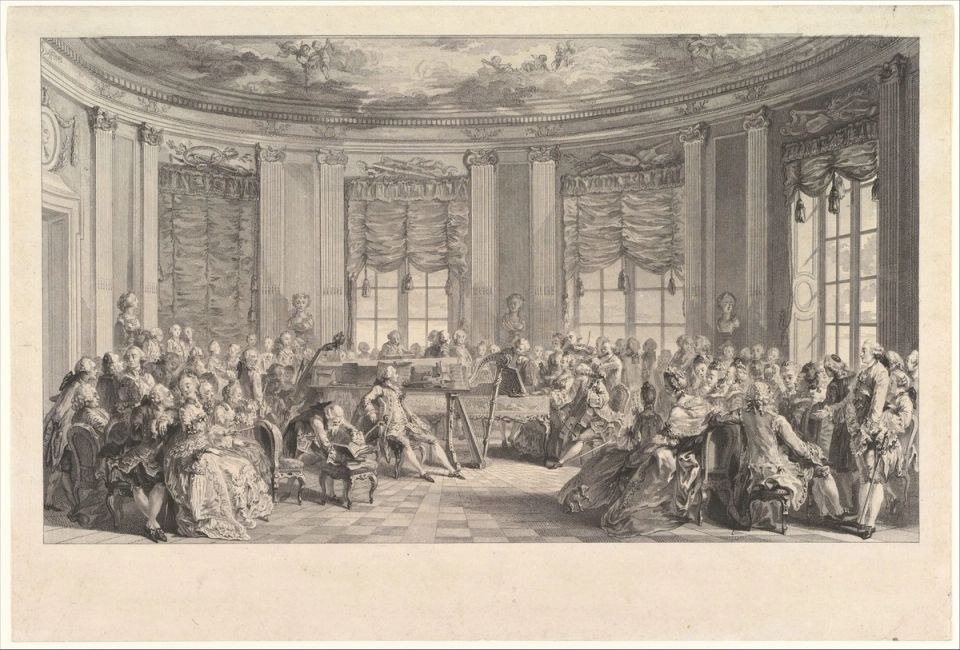
In Wolfgang Amadeus Mozart’s world there was no conductor brandishing a baton. Eighteenth‑century orchestras were led from within, directed either from the first violin desk or from the keyboard[1]. The concertmaster (the leading violinist) or the harpsichordist signaled tempo, phrasing and dynamic changes through bow strokes and body language; their cues were visible to the musicians clustered around them.
The Mannheim orchestra was especially admired by Mozart. The court ensemble was renowned for its discipline, dynamic effects and forward‑looking style. Charles Burney, who heard Christian Cannabich’s Mannheim orchestra, famously likened its players to an “army of generals,” each a virtuoso yet perfectly coordinated[2]. Precision did not come from a dominating presence but from mutual discipline and the ability to anticipate one another. According to Schubart’s description of Cannabich, “a nod of the head or a twitch of the elbow” sufficed to ensure a perfectly unified crescendo or diminuendo[3]. Gestures replaced baton beats, fostering a chamber‑like intimacy where musicians communicated through eyes, fingers and breath rather than hierarchical command.
Leadership required rhythmic stability. Leopold Mozart’s violin treatise warns that some instrumentalists could play passages but not “beat time,” urging teachers to train pupils to “beat each crotchet of the bar carefully and evenly,” because without this skill “no-one can hope to achieve perfection in the art of music”.
Rehearsing at Breakneck Speed: Sight‑Reading and Improvisation
Eighteenth‑century orchestras seldom enjoyed extended rehearsal schedules. Musicians met once, sometimes only hours before the performance. A study of Viennese orchestras around Beethoven’s time notes that the Gesellschaft der Musikfreunde normally had “one rehearsal” for concerts and that “only one-half of the players” often attended[4]—a situation inherited from Mozart’s era. Mozart’s own Linz Symphony offers an extreme example: he wrote the work in four days while traveling, had the parts copied, and probably rehearsed it just once before its premiere[5]. Such realities demanded exceptional sight‑reading; musicians needed to grasp structure, key changes and expressive indications at a glance.
Without extensive rehearsal, interpretation emerged spontaneously. Continuo players improvised harmonies, soloists embellished melodies, and winds supplied ornamentation. When the Parisian orchestra bungled the rehearsal of his “Paris” Symphony in 1778, Mozart wrote to his father that he was “exceedingly anxious” and considered snatching the first violin to conduct the orchestra himself[6]. He lamented that the performance could be wrecked by musicians who did not understand his intentions. Improvisation was not an indulgence but a necessity; players negotiated balance and phrasing in real time, often guided only by the composer’s presence at the keyboard or violin.
Spaces and Sounds: Palace Halls, Theaters, and Chapels
The venues for which Mozart composed shaped his orchestration. Baroque composers wrote for intimate palace halls, whereas Classical symphonies were first heard in rooms “similar to modern ones but smaller than those built later for popular concerts,” meaning that their reverberation and resonance requirements differed[7]. In Salzburg’s cathedral, liturgical works echoed under stone vaults; in Viennese salons, musicians performed in carpeted rooms that absorbed sound; in the Burgtheater and Estates Theatre orchestras accompanied singers before a rapt public. Mozart adjusted instrumentation accordingly: delicate chamber works were scored for strings alone; symphonies for Prague featured expanded winds to project in a theatre; church pieces exploited antiphonal effects.
Instruments of Classical Color: Horns, Strings, Bows, and Clarinets
Classical instruments sounded different from today’s. Natural horns were coiled tubes without valves; players changed keys by inserting different crooks or adjusting hand position in the bell. By the 1770s the orchestral horn had a central tuning slide and “terminal crooks” that allowed it to be set in various keys from high C to low B‑flat[8]. Mouthpieces were made of thin sheet metal and were deeper than modern ones, producing a mellow, less penetrating tone[8]. High (cor solo) and low (cor basso) parts were divided between specialists. These limitations encouraged composers to write simple arpeggios and hunting calls; the famous horn duets in Le nozze di Figaro exploit the instrument’s natural harmonics.
String instruments were strung with sheep‑gut rather than steel. Gut strings yielded a warm, resonant timbre but were sensitive to humidity and broke easily[9]. They also could not sustain as much tension, so Classical instruments had shallower neck angles and lighter bass bars than modern violins. Bows were shorter and lighter; the so‑called transitional bow of the late eighteenth century was about 20 percent smaller than a modern bow and had a pointed tip, allowing rapid articulation and nuanced shaping[9]. Innovations by bow makers such as François Tourte gradually increased length and weight to accommodate larger halls and virtuoso technique[10]. These differences influenced balance: winds could dominate easily, and leaders had to adjust dynamics carefully.
The clarinet was a newcomer. Johann Christoph Denner’s early eighteenth‑century innovation added a register key to the chalumeau; initial instruments had only two keys, and later models gradually gained more[11]. By the 1780s clarinets commonly had five keys, extending their chromatic range[12]. Their tone—reedy in the lower register and bright in the upper—intrigued Mozart. During his stay in Mannheim he wrote, “if only we had clarinets in Salzburg! You cannot imagine the glorious effect of a symphony with flutes, oboes and clarinets”[13]. He composed his Clarinet Concerto and Quintet for the virtuoso Anton Stadler, exploiting the instrument’s expressive possibilities and its recently invented basset extension.
Mozart at the Helm: Leading from Keyboard and Violin
Mozart was not only a composer but an active leader of his orchestras. In concertos he sat at the harpsichord or fortepiano, directing with his hands on the keys; in symphonies he often occupied the first violin desk, giving cues with his bow. He was proud of this dual role. In a letter from 1779, written after being refused a conductorship at the Mannheim court, he told his father, “I am a composer, and I have been born to be a conductor,” and lamented that he could not bury his talent[14]. Observers praised his leadership: Cannabich, whom Mozart admired, became his model for expressive yet disciplined direction[15]. Mozart’s gestures were economical—raising his eyebrows to indicate an entrance, swaying his body for a crescendo—but his presence at the keyboard radiated authority.
Rehearsals could test his patience. When the Paris orchestra’s rehearsal of his “Paris” Symphony fell apart, he wrote to Leopold that the performance was disastrous and that he longed to seize the violin and conduct the ensemble himself[6]. He disliked incompetence and did not hesitate to mock it. In Mannheim he described two organists: one played “miserably,” lifting his hands like a child trying to lift a millstone, while the other played even worse, wearing spectacles and attempting six‑part counterpoint; Mozart jested that if they were pounded together the result would be even more miserable[16]. Yet he could be charming and humorous, winning over musicians with jokes and wit. Cannabich was, in Mozart’s words, “the best conductor I have ever seen,” loved and feared by his players[15]. When leading his own ensembles in Vienna, he often improvised cadenzas or embellished piano parts, expecting the orchestra to follow in real time.
Relationships with Musicians: Praise, Critique and Humor
Mozart understood that orchestras were communities of personalities. In Mannheim he befriended flautist Johann Baptist Wendling, admired the disciplined wind players and lamented Salzburg’s lack of clarinets[13]. His letters from Prague gush with gratitude: during the run of Le nozze di Figaro he wrote that “nothing is talked about except Figaro; nothing is played, blown, sung, whistled except Figaro”[17]. He relished the way Prague’s musicians and audiences understood his music and later wrote Don Giovanni for them, trusting their ability to navigate the finale where three dances occur simultaneously[18].
At the same time, Mozart was merciless in his critiques. His jokes at the expense of Mannheim’s organists show his sharp eye for incompetence[16]. He called Salzburg, where he served under the Archbishop, a town where the audience looked like “tables and chairs” and complained of “injustice and abuse,” declaring that the city was no place for his talent[19][20].
Mozart’s psychological insight extended to his writing. He composed characteristically for particular players—complex wind passages for the virtuosi of Mannheim, virtuoso concert arias tailored to singers’ ranges, and idiomatic horn parts that exploited the natural instrument’s open and stopped notes. Through charm, humor and a sense of camaraderie he won over orchestras, even when he pushed them to the limits of their technique.
Favorite Orchestras: Mannheim, Prague, Salzburg and Vienna
Mannheim. Mozart’s winter in Mannheim (1777–78) revealed to him what an orchestra could be. Burney’s “army of generals” image underscores its collective virtuosity[2]. The aesthetician Christian Schubart described its crescendi as waves, thunderstorms and waterfalls, testifying to the players’ control over dynamics[15]. Cannabich’s leadership and the presence of clarinets inspired Mozart to write symphonies with richer wind palettes; he lamented that Salzburg lacked such resources[13].
Prague. The Bohemian capital embraced Mozart with enthusiasm lacking elsewhere. When Figaro played there in 1786, the city was consumed by it: people sang, whistled and even danced its melodies[17]. Mozart returned in 1787 to premiere Don Giovanni; the Act I finale famously combines a contredanse, minuetto and Deutscher (a rustic dance), requiring the orchestra to coordinate three simultaneous meters[18]. Prague’s musicians rose to the challenge, and Mozart rewarded the city with a symphony (K. 504) that shows off the wind section. He felt understood and celebrated in Prague as nowhere else.
Salzburg. Mozart’s birthplace provided solid training but limited horizons. As concertmaster at the prince‑archbishop’s court he honed his craft alongside his father, but he chafed at the archbishop’s authoritarian rule. In letters he called Salzburg a town with little stimulation; the archbishop, he complained, treated him unjustly, and audiences were unresponsive[19]. He concluded that Salzburg was “no place for my talent”[20]. These frustrations spurred his search for more cosmopolitan orchestras.
Vienna. Moving to Vienna in 1781 freed Mozart to craft his own orchestras. The city’s concert life mixed private patronage and public subscription. Mozart rented theaters, hired musicians and retained the profits at his benefit concerts; he reported to his father that he was busy with a “small concert” at his lodgings and performed at others’ concerts[21]. At one concert for his sister‑in‑law Aloysia Lange, the theater was full and he received torrents of applause[21]. Assembling his own ensembles allowed him to select skilled players and to explore new combinations of instruments. His partnerships with Viennese virtuosi—violinists Antonio Brunetti and Franz Xaver Orsini-Rosenberg, hornist Ignaz Leutgeb, clarinettist Anton Stadler—fostered a climate of experimentation that foreshadowed institutions like the Vienna Philharmonic.
The Artist’s Role: Composer‑Performer and Improviser
Mozart thought of composition and performance as inseparable: writing a concerto meant imagining how he would direct and embellish it from the keyboard. During performances he improvised cadenzas, preludes and transitions, requiring musicians to follow him instantly. This real‑time creativity fed back into his compositions; hearing a passage in rehearsal might prompt him to adjust orchestration, redistribute a melodic line or refine dynamics. His earliest concertos were written with blank sections where he would improvise; his scores often included crossed‑out passages replaced by more vivid ideas gleaned from performance.
//
References
Sources
- [1] The Birth of the Orchestra: History Of An Institution, 1650–1815
- [2][3][14] Unser Erbe: Die Mannheimer Schule
- [4] Orchestral Performance Practice in the Vienna of Beethoven and Schubert – Apollo's Fire
- [5] Mozart's Symphony No. 36 in C Major ("Linz"), K. 425 — Boston Baroque
- [6] Greg Sandow -- When Mozart Went to Paris
- [7] Sala São Paulo | The acoustics
- [8] University of Horn Matters: The Horn in the Classical Period | Horn Matters | A French Horn and Brass Site and Resource | John Ericson and Bruce Hembd
- [9] A Guide to Baroque String Instruments | H+H
- [10] The Classical violin bow
- [11] The Origins of the Clarinet:The birth of the clarinet - Musical Instrument Guide - Yamaha Corporation
- [12] History of the Clarinet | Ackerman Music
- [13] Mozart in Mannheim II
- [15] Mozart in Mannheim I
- [16]The Letters of Wolfgang Amadeus Mozart. (1769-1791.), by Wolfgang Amadeus Mozart
- [17][18] Mozart and Prague | Scottish Chamber Orchestra
- [19][20] Why Mozart Hated Salzburg
- [21] Performing in Vienna - Mozart's Experience of the Concert Hall in 1783 – London Mozart Players