- Köchel Number
- K9 6 | K6 6
- Genre
- Chamber Music
- Form
- Violin Sonatas & Variations
- Key
- C Major
- Date
- 1762–1764
- Place
- Salzburg or Paris
- Age
- 8
Mozart’s Sonata in C major for keyboard and violin, K. 6 (1764) stands at the very beginning of his violin-sonata output—music written when he was only eight years old and already being prepared for publication in Paris. Though modest in scale, it offers an unusually clear window into how the child composer absorbed contemporary “keyboard sonata with violin accompaniment” style and began turning it into something recognizably his own.[1]
Mozart’s Life at the Time
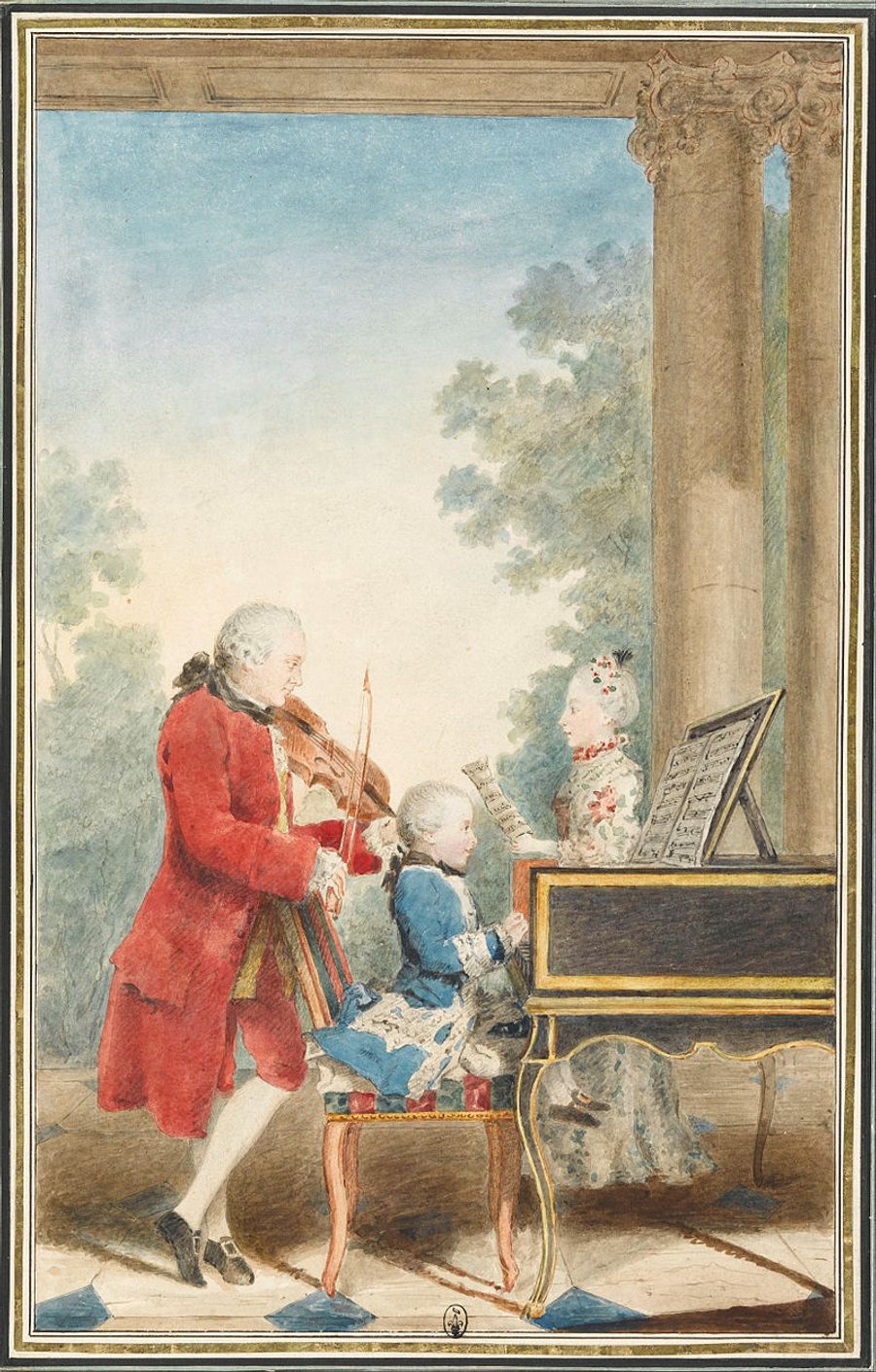
In 1764, Wolfgang Amadeus Mozart (1756–1791) was eight years old—still in the thick of the family’s early European travels, when Leopold Mozart was actively presenting his children as prodigies and seeking opportunities for performance, patronage, and publication. The sonatas K. 6–9 belong to this “Grand Tour” moment: pieces designed to be playable in cultivated households, centered on the keyboard part, and marketable to a Parisian public eager for elegant, up-to-date chamber music.[1]
That international setting matters for how one hears K. 6. The work is not yet the equal-partner dialogue of Mozart’s mature violin sonatas (especially those of the 1780s), but it already shows a gifted ear for clear phrases, poised cadences, and the kind of rhetorical “question-and-answer” that makes Classical style feel conversational even in miniature.
Composition and Manuscript
The precise place and even the precise year of composition are not completely secure in modern scholarship: proposals range from Salzburg (1762–63) to Paris (1763–64), reflecting the fluid conditions of composition during travel.[2] What is firm is the early publication context. K. 6 was issued in Paris in 1764 as part of Mozart’s Opus 1, a striking sign of how quickly Leopold tried to convert his son’s talent into a public, printed reputation.[2]
A particularly vivid detail survives in Leopold’s correspondence: writing from Paris on 1 February 1764, he discusses these sonatas and even complains about editorial meddling and errors left uncorrected—an anecdote that captures both the commercial haste of publication and the Mozarts’ early experience with the compromises of print.[3]
Musical Character
K. 6 is best understood in its original genre label: a sonata for keyboard with violin, not yet the later duo-sonata ideal of equal protagonists. The keyboard carries the thematic argument and most of the passagework, while the violin often reinforces, answers, or decorates the texture—yet the violin writing is not merely perfunctory, and 18th-century listeners could consider these parts “elaborate and demanding.”[1]
The music’s appeal lies in its economy and its stylistic fluency. In C major (a key often associated with brightness and public clarity), Mozart shapes tidy, symmetrical phrases and places cadences with a performer’s instinct for timing. One can also hear a young composer learning to balance charm with forward motion: the violin’s interjections—sometimes doubling, sometimes lightly contrapuntal—help animate what might otherwise be a purely keyboard-led design.
Why does K. 6 deserve attention today? Precisely because it is not a mature “masterpiece” in the later sense. It documents Mozart’s early encounter with fashionable mid-18th-century sonata idioms and the realities of music publishing—showing how, even at eight, he could produce a coherent, idiomatic chamber work that functioned socially (for domestic music-making) and professionally (as Opus 1 in Paris). Heard in that light, K. 6 becomes less a curiosity and more a small but telling first chapter in Mozart’s long reimagining of the violin sonata as a true musical conversation.
Sheet Music
Download and print sheet music for Violin Sonata No. 1 in C major (K. 6) from Virtual Sheet Music®.
Sources
[1] Mozarteum (Köchel Catalogue): KV 6 — work overview and context for the early violin sonatas (K. 6–9) published in Paris when Mozart was eight.
[2] Wikipedia: Violin Sonatas, KV 6–9 — outlines the disputed composition date/place and notes Paris publication in February 1764 as Mozart’s Opus 1.
[3] Mozart & Material Culture (King’s College London): K6–9 sonatas for keyboard and violin — publication/dedication context and Leopold Mozart letter of 1 Feb 1764 discussing the sonatas.