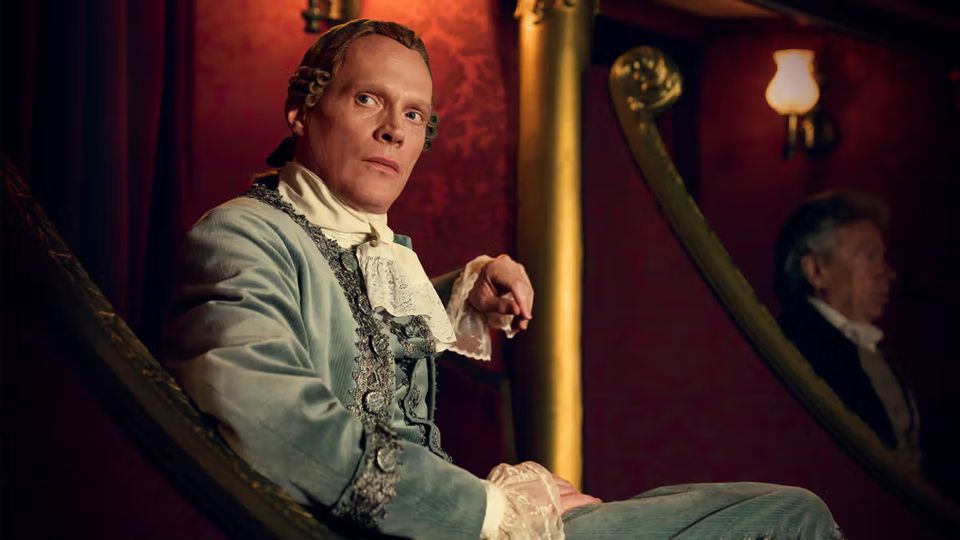
There is no reliable evidence that Antonio Salieri poisoned Mozart. The murder story grew from rumours into a cultural legend, later retold in Amadeus. Explore the historical evidence, their professional relationship and the stories that shaped the myth.
The Myth We Think We Know
For more than two centuries, Antonio Salieri has been cast in popular culture as the jealous rival who destroyed Wolfgang Amadeus Mozart. This dark legend – immortalized in plays, operas, and the Oscar-winning film Amadeus – depicts Salieri as a mediocre court composer who, consumed by envy, plots the downfall of Mozart’s genius. Thanks to these dramatic retellings, many today believe that Salieri poisoned Mozart or sabotaged his career.
The myth is so widespread that even a recent 2025 television miniseries, Amadeus, has revisited the tale for modern audiences, once again pitting Salieri against Mozart in a deadly feud. Yet the real story behind Mozart’s untimely death and his relationship with Salieri is far more complex – and almost entirely contrary to the myth.
In truth, the Mozart–Salieri murder story owes much more to theatrical invention than to historical fact. It began as a swirl of rumor and suspicion rather than documented evidence.
Over time, those rumors were amplified and reshaped by writers and composers into a compelling narrative of envy versus genius. This article will disentangle documented facts from contemporary gossip, later literary inventions, and modern reinterpretations.
We will see how a casual rumor evolved into one of Western culture’s most persistent legends – and why the dramatic Salieri v. Mozart conflict continues to captivate us, even though it never actually happened.
1791–1790s: Mozart’s Death and the First Rumors
Mozart died in Vienna on 5 December 1791 at only 35 years old, after a short illness. The exact cause of his death was not clearly documented, which left a vacuum soon filled by speculation.
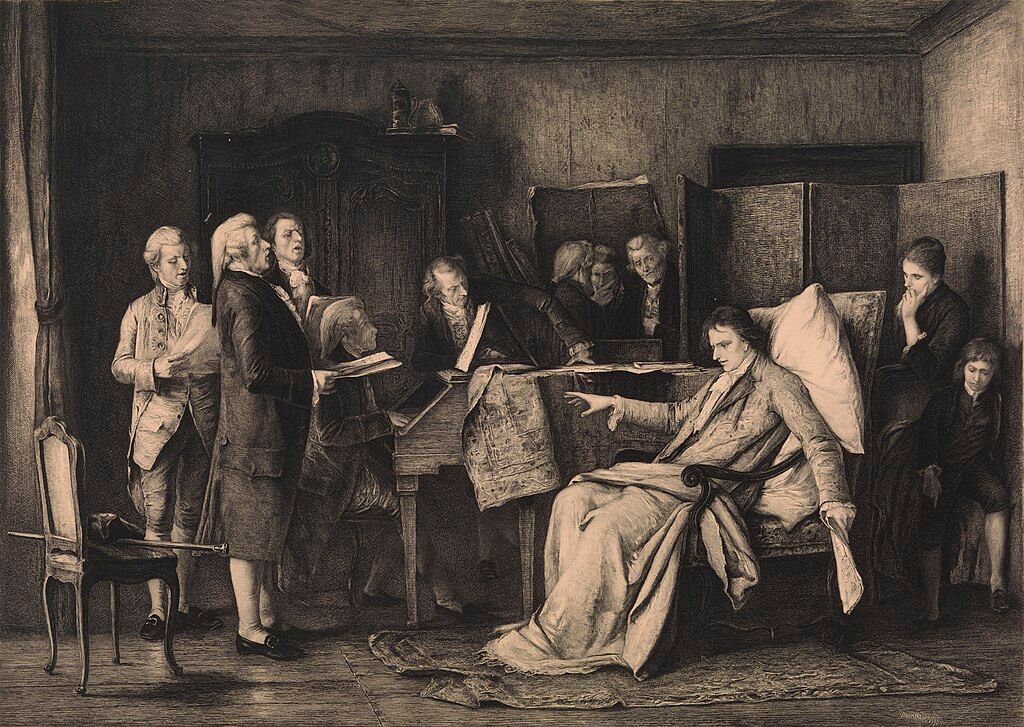
According to the official register, Mozart succumbed to “severe miliary fever,” a vague term indicating a rash and fever but not a specific disease. In the absence of a definitive medical explanation, Viennese society began to whisper that something more sinister might be responsible. Indeed, within a week of Mozart’s passing, at least one Berlin newspaper falsely reported that the famous composer had been poisoned. This early report did not name any culprit – it was simply an alarming conjecture – but it set the stage for a legend.
Mozart’s own words may have inadvertently fueled these suspicions. On his deathbed, delirious and despairing, Mozart reportedly told his wife Constanze, “I believe I am being poisoned”. In her later recollections, Constanze described how Mozart, suffering fever and swelling, felt certain that an enemy had given him a toxic draft. Such statements, made by a gravely ill and likely confused man, provided fertile ground for rumor. Friends and family were left to wonder how a vigorous young genius could be struck down so suddenly. If Mozart himself feared foul play, many reasoned, perhaps it was true.
In reality, modern physicians and historians lean toward natural causes for Mozart’s death. Retrospective analysis of reports from that winter in Vienna suggests Mozart’s symptoms – high fever, severe edema (swelling), and rash – match an epidemic of streptococcal infection that led to kidney failure in numerous patients around the same time. One contemporary doctor noted that “this malady attacked at this time a great many of the inhabitants…and for not a few of them it had the same fatal conclusion and the same symptoms as in the case of Mozart.” In other words, Mozart likely fell victim to an illness raging through the city, not a secret poison. Later researchers have proposed diagnoses ranging from rheumatic fever to kidney complication from strep throat, but none involve deliberate poisoning. As one historian put it plainly: “He wasn’t poisoned by Salieri. He was ill.”
Still, in the 1790s people struggled to accept that a healthy composer could die so abruptly. Lacking a clear answer, Vienna’s gossip mill turned to intrigue. Whispers of “poison” continued in the months and years after 1791, though no specific suspect was named at first.
In this early period, Salieri was not publicly accused – he was merely one of several prominent figures in Mozart’s circle. In fact, far from fleeing or being ostracized, Salieri remained an esteemed member of Viennese musical life (as we’ll see), and even helped oversee memorial concerts for Mozart. The idea of Salieri as poisoner had not yet taken hold. Nonetheless, the mystery surrounding Mozart’s demise – combined with the dramatic notion that he felt poisoned – proved irresistible. A seed of rumor had been planted. It would take a few decades, and the alchemy of storytelling, for that seed to grow into a full-blown myth.
Salieri in His Own Words
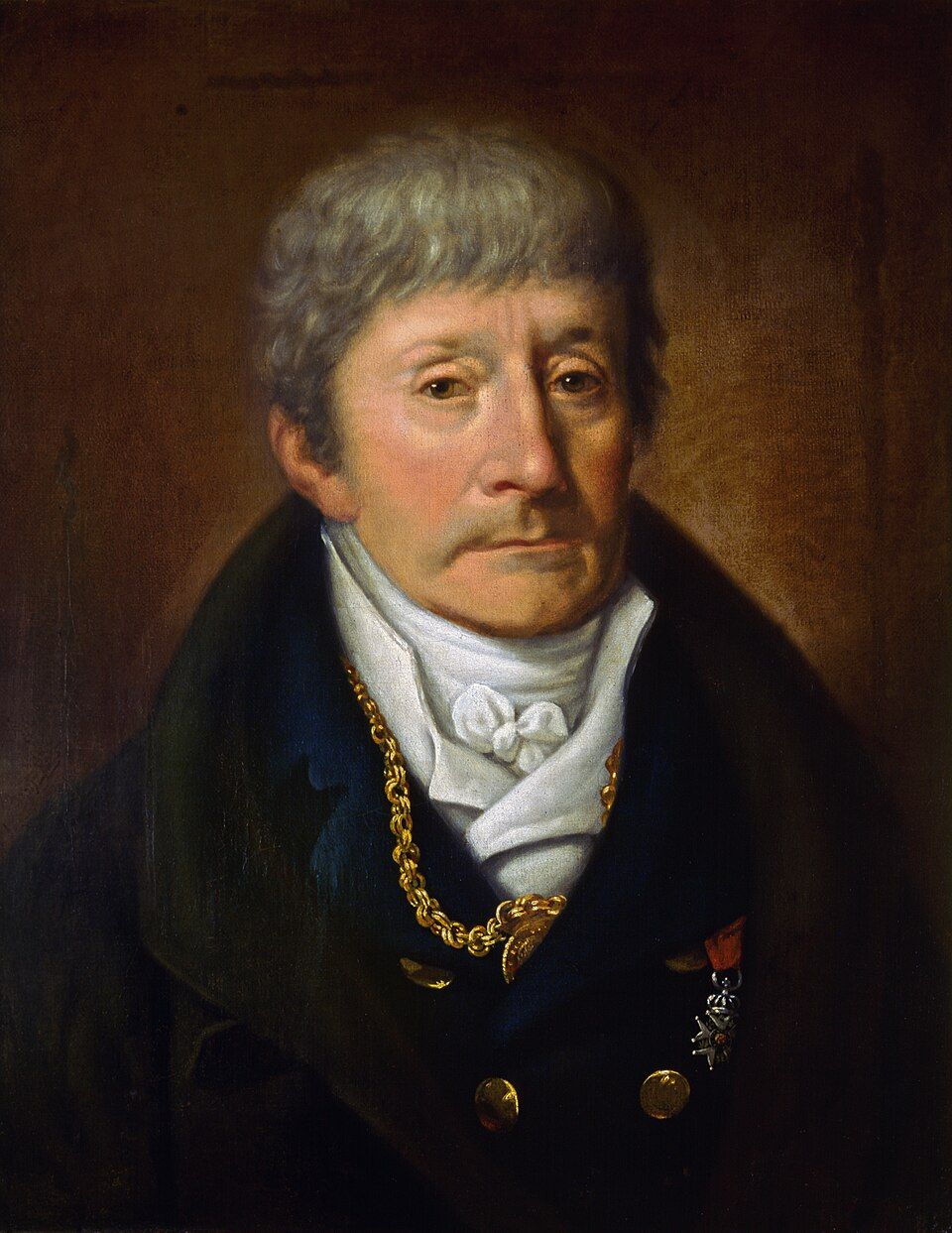
To understand how unfair the Mozart–Salieri myth is, we must consider Antonio Salieri’s actual life and his relationship with Mozart. In 1791, Salieri was not some obscure hack in Mozart’s shadow – he was the imperial Kapellmeister (music director) of the Habsburg court and one of Vienna’s most successful composers. Italian by birth, Salieri had been brought to Vienna as a protégé and quickly rose under Emperor Joseph II’s patronage. He composed over three dozen operas (in both Italian and French) that were performed across Europe. He also conducted and arranged music for the imperial chapel.
By the 1780s, Salieri was firmly entrenched as a leading figure in Viennese music, particularly in Italian opera – a genre the Austrian court prized. This success, coupled with his role as a gatekeeper for imperial musical appointments, inevitably made him a rival of other composers seeking favor, Mozart included.
Mozart and Salieri did have a kind of rivalry, but it was a professional competition typical of the time – not the personal vendetta of later legend. When Mozart moved to Vienna in 1781, he was an up-and-coming freelancer looking to make his mark. Salieri, about six years Mozart’s senior, was already established at court. Tensions did exist: Mozart and his father Leopold, in letters, sometimes complained that “cabals of Italians” led by Salieri were blocking Mozart’s opportunities[1]. For instance, when Mozart applied in 1781 for a prestigious post (music tutor to the Princess of Württemberg), Salieri won the appointment instead – an outcome Leopold bitterly attributed to Salieri’s influence. Such episodes understandably frustrated Mozart. Yet it’s equally clear that these conflicts were part of broader court politics (Italian composers did enjoy imperial favor), and not an overt, personal war between the two men. There is no evidence that Salieri bore Mozart any ill will serious enough to wish him harm. In fact, surviving records suggest a mix of competition and mutual respect.
Notably, Mozart and Salieri occasionally collaborated and supported each other’s work – behaviors hard to imagine if they were mortal enemies. In 1785, the two composers co-wrote a short cantata for voice and piano (Per la ricuperata salute di Ofelia) to celebrate the recovery of a popular singer[2]. This charming trifle, rediscovered in recent years, features music by both Mozart and Salieri, side by side. Would a “jealous schemer” bent on undermining Mozart ever agree to share a composition with him? The very idea undermines the myth. There are other examples: in 1788, when Salieri was appointed Kapellmeister, he chose to revive Mozart’s successful opera The Marriage of Figaro in the court theater, rather than promoting only his own works. And in 1791, Salieri reportedly conducted (or at least attended and endorsed) performances of Mozart’s pieces, including the popular symphony in G minor. In Mozart’s final year, their relations were evidently cordial. Mozart’s last surviving letter, written in October 1791, describes how he brought Salieri and Salieri’s mistress (the soprano Caterina Cavalieri) to a performance of The Magic Flute. Salieri “heard and saw with all his attention” and cheered “Bravo!” at every piece, Mozart wrote, clearly delighted by Salieri’s praise. This does not read like a letter about a bitter enemy – it reads like one great musician appreciating another.
Perhaps the strongest proof that Salieri harbored no lethal grudge is what happened after Mozart’s death. Far from avoiding Salieri, Mozart’s widow Constanze entrusted Salieri with the musical education of her son. In 1792, a year after Mozart died, Constanze asked Salieri to teach young Franz Xaver Mozart (her second son), which he did for some time. It’s inconceivable that Constanze would ask Mozart’s supposed murderer to mentor her child. Clearly, she did not believe the gossip that would later arise. Salieri, for his part, treated Mozart’s legacy with respect. He participated in memorial concerts for Mozart and even composed at least one piece in Mozart’s honor. Historical records mention that Salieri wrote variations on a theme from Mozart’s Don Giovanni and, later, a cantata in Mozart’s memory – gestures of homage rather than enmity. All told, Mozart and Salieri’s relationship was competitive but collegial. As one scholar put it, “They were friendly colleagues. There was a little bit of rivalry, but no more than professional rivalry.”
How, then, did Salieri become accused of the worst possible crime? The answer lies in rumors that emerged decades after Mozart’s death – rumors that preyed upon Salieri’s own troubled old age. In the 1790s, as noted, there was gossip that Mozart might have been poisoned, but no finger pointed at Salieri specifically. That began to change by the early 19th century. In 1803, the composer Carl Maria von Weber visited Vienna and “learned of the accusations” against Salieri, after which Weber (a relative of Mozart’s wife) pointedly avoided meeting Salieri. This indicates that by 1803 – twelve years after Mozart died – some people in musical circles were indeed murmuring that Salieri had poisoned him. Salieri continued his prestigious career in Vienna, but the shadow of this slander was growing.
By 1822, the rumor was widespread enough that when the famed Italian composer Rossini came to visit Vienna, he discussed the poisoning story jokingly with Salieri. Salieri, then in his 70s, had to laugh off the morbid joke that he was a murderer. Unfortunately, worse was to come. In 1823, Antonio Salieri suffered a serious physical and mental breakdown. He was elderly, ill, and reportedly sank into dementia. Confined to the general hospital in Vienna, the ailing Salieri began rambling in a delusional state – and according to later reports, he “accused himself of having killed Mozart” during his bouts of insanity. It is hard to know exactly what was said; accounts differ, and no direct transcript exists. But apparently, hospital staff or visitors heard the incoherent Salieri mention Mozart and poison in the same breath. Essentially, Salieri, in a deranged moment, may have blurted out something that sounded like a confession.
This supposed confession spread like wildfire through Vienna. Beethoven’s conversation books (notebooks Beethoven used for dialogue after he went deaf) in late 1823 show Beethoven’s associates asking him if he’d heard that Salieri admitted to poisoning Mozart. The rumor was on everybody’s lips. Importantly, when Salieri regained lucidity, he was horrified by the gossip. He vehemently denied ever harming Mozart. In the presence of his friends and doctors, Salieri insisted that the murder rumor was nonsense: “Although this is my final illness, I can say in good faith that there is no truth to the absurd rumor that I poisoned Mozart. It’s nothing but spite to tell the world that.”. This emphatic statement – essentially Salieri’s deathbed denial – was recorded by his student Ignaz Moscheles and others. Salieri’s servants and close associates likewise testified that the old man never deliberately confessed to any crime. On the contrary, he was distressed that anyone would think him capable of it. When Salieri died in May 1825, one newspaper obituary even mentioned his final declaration of innocence, attempting to put the calumny to rest.
Alas, the retraction never travels as far as the scandal. By the time of Salieri’s death, the idea that he had confessed to murdering Mozart was juicy news across Europe. It didn’t matter that it came from an unstable patient’s ravings, or that Salieri himself retracted it – the whiff of true-crime drama was too delightful to ignore. The Mozart-poisoning rumor, once a vague question mark, suddenly had a villain in the public imagination. And now that villain was conveniently dead, unable to defend himself. The stage was set for storytellers to seize upon this tale and transform it into something even more dramatic. The fragile, secondhand “admissions” of a dying Salieri would soon be woven into art, literature, and legend – with very little regard for historical truth.
1830: Pushkin Creates the Myth
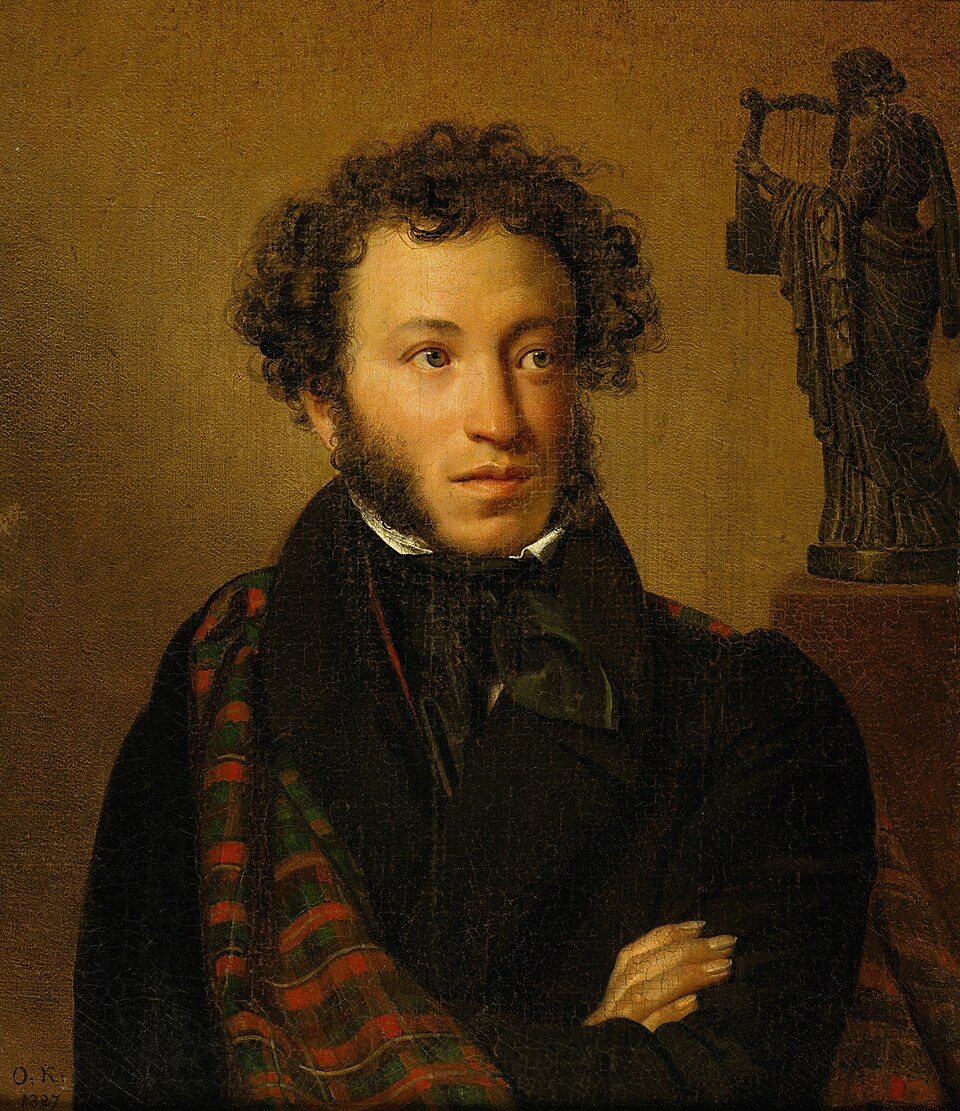
If any single moment gave birth to the enduring myth of Salieri murdering Mozart, it was the publication of Alexander Pushkin’s short play Mozart and Salieri in 1830. Pushkin, the great Russian poet, took the rumors circulating about Salieri and fashioned them into a gripping literary tragedy. In Pushkin’s two-scene drama, Salieri is depicted as the epitome of jealousy – a middling talent who becomes so envious of Mozart’s divine gift that he coldly plots and carries out Mozart’s poisoning. During the course of a tense conversation in a tavern, Pushkin’s Salieri distracts Mozart and slips poison into his glass, murdering him with a toast. Mozart, portrayed as an oblivious genius who believes all men are good, has no idea of Salieri’s hate until it is too late. The play ends with Salieri musing bitterly on how envy could drive even a virtuous man to crime, and questioning why mediocrity must coexist with genius. Pushkin titled it a “Little Tragedy,” and indeed it reads like a parable about the sin of envy and the mystery of creative genius.
Crucially, Pushkin never intended this work as a piece of history. It’s a psychological drama, almost a philosophical anecdote, not a documentary. He took the loose hearsay (“Salieri poisoned Mozart, people say”) and transformed it into a vivid narrative with moral weight. Pushkin’s Salieri is not a real 18th-century character so much as a timeless archetype: the mediocre artist who cannot accept that God has unfairly favored a greater talent. In one famous line (which later inspired Peter Shaffer), Pushkin has Salieri lament, “Why him and not me?” The play distilled the rumors into a tidy story of genius versus mediocrity, where mediocrity resorts to murder. Pushkin’s Mozart is almost a holy fool – childish, pure, touched by God – while Salieri becomes a kind of Cain figure, destroying what he cannot equal.
This little Russian play might have remained an obscure curiosity, but its impact turned out to be enormous. Mozart and Salieri was soon translated and spread through Europe. It appealed not only for its sharp dramatic conflict but also because it seemed plausible – it fit the romantic idea that great genius often provokes great envy. Pushkin had effectively cemented the myth in cultural memory: after 1830, the notion of Salieri as the jealous poisoner of Mozart took on a life of its own. As one commentator noted, Pushkin’s dramatic invention gave the rumor its “biggest boost”, turning Salieri into “music’s sorest loser” in the eyes of posterity. It’s worth emphasizing that Pushkin did not have any new evidence or secret knowledge – he was working purely from the rumor mill. In fact, Salieri’s death and alleged confession had occurred just a few years earlier, and Pushkin seized on the gossip as inspiration. He essentially asked, What if the rumor were true? and spun out the emotional and moral consequences on stage.
The cultural impact of Mozart and Salieri was out of proportion to its short length. It inaugurated a long tradition of depicting Mozart and Salieri as mortal foes. By dramatizing the poisoning as if it were fact, Pushkin blurred the line between rumor and reality for his audience. Future generations would often assume there must be some truth behind the tale – after all, why else would someone like Pushkin (and those after him) keep telling it? In reality, this was a case of art creating its own truth. Pushkin’s play created the version of Salieri that most people know, far more than any real document ever did. From 1830 onward, Salieri was immortalized in literature as the archetypal jealous rival. The myth had a gripping storyline and a moral lesson, and that made it stick. Still, the myth was about to be reinforced even further – this time with the help of music itself.
1898: Rimsky-Korsakov Turns Myth into Music
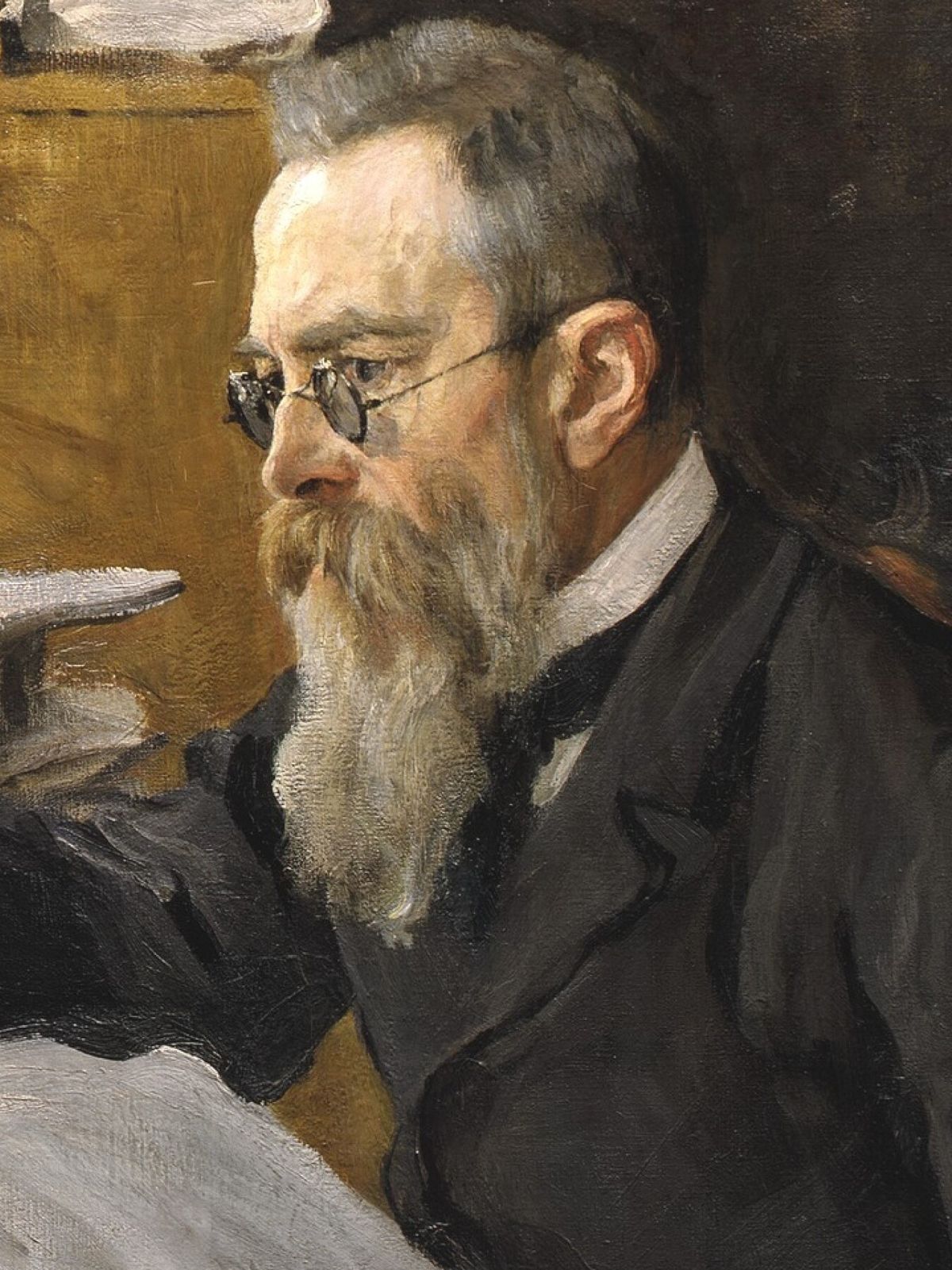
By the late 19th century, the Mozart–Salieri murder legend had percolated through literature and theater, but it gained another boost in 1898 thanks to Nikolai Rimsky-Korsakov – who gave the story an operatic soundtrack. A renowned Russian composer, Rimsky-Korsakov adapted Pushkin’s Mozart and Salieri almost verbatim into a one-act opera of the same name. In doing so, he reinforced the myth for a new audience and medium. Rimsky-Korsakov was a devotee of Pushkin’s works and treated the Mozart and Salieri play with great respect; he set Pushkin’s exact Russian text to music, essentially creating an opera libretto from the play. The result is a short opera (only about 45 minutes) in which Salieri, sung by a baritone, delivers anguished arias about his envy and fate, and ultimately duets with Mozart before administering the poison. The opera ends as the play does: with Mozart dead and Salieri crying out against a seemingly unjust God.
What Rimsky-Korsakov’s opera did was embed the Salieri myth into musical culture itself. Now the story was not just told about musicians; it was told through music. Audiences who saw Mozart and Salieri on stage would hear quotes of Mozart’s own works woven into the score, making the experience even more poignant. For instance, Rimsky-Korsakov incorporates a melody from Mozart’s Requiem – the piece Mozart was writing at the time of his death – as a haunting motif. This kind of artistic touch made the opera a powerful emotional argument: it felt true, even though it wasn’t. Reviewers noted how the opera portrays Salieri with a mix of villainy and tragic pathos, emphasizing the psychological torment Pushkin had outlined. The moral framing remained clear – Salieri’s crime is the product of envy and the inability to reconcile mediocrity with someone else’s genius.
Rimsky-Korsakov’s adaptation ensured that the myth gained an international musical audience. The opera was performed not only in Russia but eventually in translation elsewhere, bringing the Pushkin narrative to anyone who loved classical music. Imagine the irony: Salieri, a composer who actually wrote many operas, is remembered in an opera by someone else as a poisoner of his colleague! It certainly did no favors for Salieri’s reputation. Throughout the 19th century, Salieri’s own music had fallen into obscurity, but this new opera kept his name alive in the worst possible context. As one musicologist observed, by the turn of the 20th century “Mozart’s reputation continued to rise, while Salieri fell into obscurity. When Salieri’s music finally began to be performed again, it was inevitably linked with a legend that had gotten too big to stop”. The legend was now enshrined in both literature and music. All it needed was the 20th-century medium of film to catapult it into global popular consciousness – which is exactly what happened next.
1979: Peter Shaffer’s Amadeus
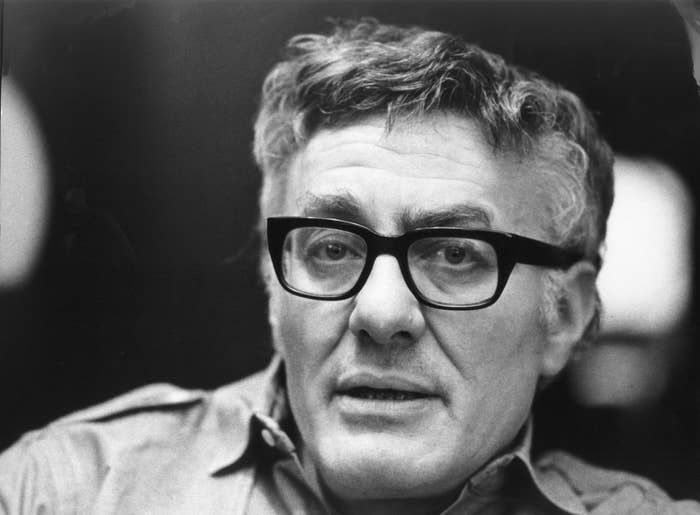
If Pushkin created the myth and Rimsky-Korsakov set it to music, it was Peter Shaffer who transformed the Mozart–Salieri tale into a modern psychological drama acclaimed the world over. Shaffer’s 1979 stage play Amadeus (premiered in London’s West End) took the basic premise of Pushkin’s story – Salieri sabotaging Mozart out of envy – and expanded it into a richer, more introspective exploration of jealousy, faith, and the nature of genius. Importantly, Shaffer shifted the focus: Amadeus is less about the act of murder and more about Salieri’s internal downfall.
In Shaffer’s Amadeus, Salieri is the narrator and tragic hero. The play is framed as his confession many years after Mozart’s death. An elderly Salieri, near the end of his life (and in an asylum, as historical rumor had it), directly addresses the audience, claiming that he was responsible for Mozart’s demise. From the outset, Shaffer makes it clear this is Salieri’s subjective account, not an objective history. We are seeing Mozart through Salieri’s eyes – and through the lens of Salieri’s agony over his own mediocrity. This storytelling device allows Shaffer to delve deeply into Salieri’s psyche, portraying him as a man who bargained with God and felt betrayed. Unlike Pushkin’s relatively straightforward villain, Shaffer’s Salieri is a complex figure who oscillates between admiration and hatred for Mozart. He refers to himself ironically as the “patron saint of mediocrities,” consumed by the knowledge that he can recognize musical greatness but not achieve it.
Shaffer’s genius was to make the conflict metaphysical: Salieri isn’t just envious of Mozart; he’s at war with God. In the play, Salieri enters into a desperate pact – he will keep his vow of piety and chastity if only God makes him a great composer. When Mozart arrives in Vienna, a vulgar, giggling youth who nonetheless produces angelic music, Salieri feels that God has betrayed the bargain by choosing Mozart as His instrument. Shaffer amplifies this theme in one of the play’s most famous lines, when Salieri hears Mozart’s sublime work and realizes the injustice: “It was as if he had been handed God’s own pen to write with,” Salieri says, “and I was relegated to a ...house of mediocrity.” In Shaffer’s telling, Salieri’s crusade against Mozart is almost incidental – it’s really a revolt against a God whom Salieri sees as unjust. This is a profound departure from simple poisoning; it turns the story into an existential tragedy about merit, reward, and divine silence.
Of course, Amadeus still takes vast liberties with historical truth – quite knowingly. Shaffer never claimed to be writing documentary history. In fact, he stated openly that Amadeus was a fantasy “loosely based on facts” and heavily inspired by Pushkin’s play. The play mixes real people and events (the Emperor’s musical court, the premieres of Mozart’s operas) with completely fictional episodes (Salieri masquerading as a mysterious patron to commission Mozart’s Requiem, for example). Shaffer used the rumor of poisoning as a metaphorical framework rather than a literal accusation. In the play, Salieri does announce that he poisoned Mozart – but it’s left ambiguous whether he literally did so or if Mozart’s collapse was natural and Salieri is claiming responsibility to spite God. The actual method of Mozart’s demise in Amadeus is exhaustion and shock: Salieri drives Mozart into a frenzy of work and psychological torment, indirectly causing his death, rather than slipping arsenic into his food. This subtle difference shifts the emphasis from crime thriller to psychological character study.
Shaffer also took care to portray Mozart in a specific (and controversial) way: as an immature savant with a maniacal laugh and a penchant for scatological humor, yet capable of writing music of unearthly beauty. This was deliberately a dramatic conceit – a way to heighten the contrast between Mozart’s miraculous talent and his human flaws. Many scholars and musicians bristled at this depiction of Mozart as “a divinely gifted drunken lout”, but Shaffer defended it as a valid interpretation of Mozart’s extant letters and an exploration of the paradox of genius. Likewise, the portrayal of Salieri as the tormented mediocrity was an artful construction, not a verdict on Salieri’s real music (which, as modern listeners now know, was far from incompetent). Shaffer took artistic license in service of deeper themes. As one writer put it, Amadeus was “never intended to be perfectly historically accurate… [Shaffer and director Miloš Forman] crafted a dramatic fantasy” about genius and mediocrity, explicitly “not a documentary”.
What Shaffer knowingly invented, above all, was the elaborate psychological and spiritual framework around the Salieri–Mozart relationship. Historically, there’s no evidence Salieri declared war on God or plotted to destroy Mozart’s soul. These were poetic extrapolations, meant to resonate with modern audiences. And resonate they did – Amadeus was a sensation. After its London debut in 1979, it moved to Broadway in 1980 and won the Tony Award for Best Play. Audiences were enthralled by the sumptuous period setting, the witty and poignant script, and the interplay of two vivid characters on stage. Even those who knew the story was fiction found themselves drawn into its emotional core. In Amadeus, Salieri emerges as a curiously sympathetic antagonist – a man who does a terrible thing, but whom we understand (and even pity) because we share, in some measure, his pain of being ordinary. Mozart, though victimized, appears almost as a magical creature whose presence both elevates and destroys Salieri. By shifting the story from straightforward murder to a complex morality play, Shaffer ensured that Amadeus would have staying power beyond a simple whodunit. And indeed, it set the stage for an even bigger popular breakthrough when it hit the silver screen.
1984: Amadeus Becomes Canon
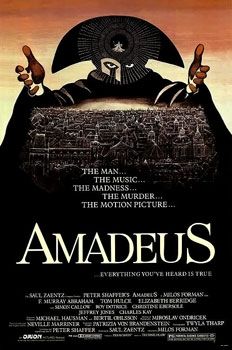
In 1984, the film adaptation of Amadeus, directed by Miloš Forman and written by Shaffer himself, brought the Mozart–Salieri myth to its widest audience yet. The movie was a global phenomenon – a critically acclaimed box-office hit that won eight Academy Awards, including Best Picture and Best Actor for F. Murray Abraham’s mesmerizing portrayal of Salieri. For many millions of people, Amadeus (the film) became the definitive depiction of Mozart’s life and death. With its lavish portrayal of 18th-century Vienna, its glorious soundtrack of Mozart’s greatest hits, and its intense performances, the film had a seductive authenticity. Viewers left the cinema feeling they had witnessed a true story – which made the Salieri-murdering-Mozart myth more entrenched than ever in the public mind.
The film Amadeus follows the broad outlines of Shaffer’s play, but cinema allowed the story to be told with even more dramatic contrast and emotional impact. Visually, Forman exaggerated the differences between the two composers: Mozart (played by Tom Hulce) is seen as wild-haired, giggling, and brilliantly spontaneous, while Salieri (Abraham) is composed, calculating, seething behind a facade of piety. The movie’s narrative is framed as Salieri’s confession to a young priest in an insane asylum – a powerful storytelling device that bookends the film and reinforces the myth that Salieri admitted to the crime. Through flashbacks, we see Salieri’s version of events: how he first admired Mozart’s talent, then grew resentful and undertook to block Mozart’s success at every turn, ultimately driving him into destitution and ill health. The film’s climax shows Salieri helping the desperately ill Mozart compose his Requiem (a fictional scene), only for Mozart to collapse and die, whereupon Salieri claims to have killed him through his scheming. It’s a tour de force of drama, even though none of it happened in real life.
Why is the film so persuasive? For one, it expertly blends fact and fiction in ways that are hard for casual viewers to untangle. Real historical figures (Emperor Joseph II, Constanze Mozart, librettist Lorenzo Da Ponte) appear alongside authentic details of Mozart’s operatic premieres and the Vienna court, lending an air of legitimacy. The musical performances – from the riotous success of The Marriage of Figaro to the private, haunting dictation of the Requiem – are staged with care and splendor. All this makes the invented parts (Salieri’s secret plotting, the whispered accusations, the manipulating of patrons) feel plausible. The emotional truth of the story shines through even if the literal truth does not. Audiences witness the agony in Salieri’s eyes as he recognizes Mozart’s genius and realizes his own limitations; they see Mozart’s childlike joy and later his despair. The film medium also allowed for internal monologues and visual metaphors: when Salieri leafs through Mozart’s original manuscripts in astonishment, hearing the music in his head, the audience shares in the awe – a scene that beautifully conveys why Salieri both loved and hated Mozart. Such moments drive home the film’s theme of transcendent art versus human pettiness in a way no academic account ever could.
However, Amadeus is also deeply misleading if taken as biography. It presents as “gospel” many events that are pure fiction or extreme exaggeration. For example, in the film Salieri bribes a housemaid to spy in Mozart’s household – an invention. He sabotages Mozart’s chances of getting court positions by spreading rumors – largely invented (there’s scant evidence Salieri ever actively did this). The famous scene where Salieri masquerades in a costume to commission Mozart’s Requiem, intending to drive him to exhaustion, is fictional; historically, the anonymous commission came from Count Walsegg, unrelated to Salieri. And of course, the overarching idea that Salieri “murdered” Mozart – even if in the film it’s indirect – is false. Mozart’s grim final days in the movie, coughing up blood and collapsing at the piano, are dramatized; the real Mozart was ill but not in the operatic fashion depicted. Yet the film is so expertly made that these falsehoods imprint on the mind. As one classical music commentator noted, Amadeus “reintroduced the rivalry to global audiences, dramatizing Salieri’s jealousy and alleged crime” with unforgettable potency. After the 1984 film, virtually everyone knew the story of Mozart and Salieri – or thought they did. The myth had effectively become canon, a “truthy” narrative repeated in classrooms, books, and casual conversation: Did you know Mozart was killed by a jealous rival? Many accepted it unquestioningly, not realizing its origin in artistic license.
To the filmmakers’ credit, both Shaffer and Forman have acknowledged that Amadeus is not literal truth but rather, in Shaffer’s words, a “fantasia on events”. They expected viewers to understand this was a creative interpretation. Unfortunately, the boundary between fact and fiction often gets blurred for general audiences, especially when a story is this compelling. The film’s legacy has been double-edged. On one hand, it sparked enormous popular interest in Mozart’s music and life; on the other, it cemented a false image of Salieri. By the late 20th century, poor Antonio Salieri had become, in the popular imagination, the patron saint of musical jealousy, the man who silenced Mozart. He was “one of history’s all-time losers – a bystander run over by a Mack truck of malicious gossip,” as one writer memorably put it. It is a supreme irony that Salieri owes his modern fame to the myth that he was Mozart’s mortal enemy. The film Amadeus virtually ensured that if people know Salieri’s name today, it is in connection with this myth. As a result, late 20th-century efforts by musicologists to rehabilitate Salieri’s reputation had to fight an uphill battle against what “everyone knows” from the movie. The power of cinema made the myth feel more real than the reality.
2025: A New Retelling for Modern Times

Even in the 21st century, the Mozart–Salieri saga continues to be retold – a testament to the myth’s enduring appeal. In 2025, a new television miniseries titled Amadeus (produced by Sky UK) once again revisited the legendary rivalry, clearly drawing inspiration from Peter Shaffer’s narrative tradition. This recent adaptation signals that the story still resonates with contemporary viewers, though our interpretation of it continues to evolve with the times. The 2025 series explicitly bills itself as a dramatization “of Mozart’s supposed rivalry” with Salieri, not a factual documentary. Like the film before it, it embraces the dramatic lore: promotional materials acknowledge it is “far more theatre than genuine biography.” In practice, the series reimagines scenes from Shaffer’s play and the 1984 film for a modern TV audience – complete with Salieri (played by Paul Bettany) as an aging narrator and Will Sharpe as a mercurial Mozart. While one might hope a new production would correct some historical inaccuracies, early reviews indicate the show mostly perpetuates the familiar fictional trope of Salieri undermining Mozart out of envy, albeit with some added nuance and backstory. In short, the latest retelling continues the myth rather than debunking it. It seems each generation finds something in this tale that speaks to its own preoccupations – whether it be the nature of genius, the struggle for recognition, or the bitter loneliness of envy.
What is notable about the 2025 miniseries (and similar modern takes) is how they reflect today’s sensibilities. For instance, Shaffer’s metaphysical angle (Salieri vs. God) is somewhat downplayed; instead, the focus shifts more to humanizing Mozart and exploring Salieri’s psychological state in a grounded way. The themes of mental health, legacy, and the cost of ambition get attention, resonating with current audiences. Yet, the core narrative – Mozart as an otherworldly genius and Salieri as the resentful nearly-man who cannot cope – remains largely intact. The persistence of this narrative in 2025 underscores just how captivating and adaptable the myth is. Even with our greater access to historical research, creators return to the story because it’s dramatically and metaphorically rich. The Sky series may be the latest iteration, but it likely won’t be the last. As long as people are fascinated by the dynamics of talent and envy, the Mozart–Salieri myth will find new life in art.
Conclusion – Why the Myth Refuses to Die
Why does the legend of Mozart and Salieri – a tale mostly disproven by historians – refuse to die? The endurance of this myth reveals as much about us and our cultural psyche as it does about the two long-dead composers. First and foremost, the story is simply too good. It has all the ingredients of a classic fable: a God-given genius, an embittered rival, dramatic reversals of fortune, and the dark allure of secret crime. This archetypal quality gives it a dramatic appeal that pure history rarely provides. As one commentator noted, the trope of the envious mentor destroying a prodigious talent “resonates powerfully in storytelling,” embodying archetypal themes of jealousy, betrayal, and the capriciousness of fate. In the Mozart–Salieri myth, people see a reflection of broader questions: Is genius a divine gift or a cruel accident? Is it fair that one person is chosen for greatness while another toils in obscurity? The myth offers a narrative answer – however fanciful – by casting the overlooked man as the villain who asserts some cosmic justice (however twisted) by striking down the favored one. It’s a narrative of cosmic imbalance corrected by human action, however immoral. Such narratives are inherently satisfying to our sense of drama.
Secondly, the myth persists because of the ambiguities in the historical record. Mozart’s early death was real, sudden, and to this day not explained with absolute certainty. The lack of a definitive medical cause (“miliary fever” is not very specific) leaves room for speculation. As one writer observed, “absence of concrete medical data invites speculation. A generic death record leaves space for imaginative narratives.” Similarly, Salieri’s alleged confession in 1823, though recanted, created a historical question mark – a whiff of possibility that storytellers could latch onto. Humans are pattern-seeking creatures; when presented with unanswered questions, we tend to fill the gaps with stories. The Mozart–Salieri case had just enough gaps (no autopsy, some personal rivalries, a supposed confession) to enable conspiracy theories to flourish. In a way, it’s akin to later historical mysteries that spawn legends (think of the death of a famous figure with rumor of foul play, and how legends grow if evidence is thin). Here, the lack of definitive evidence against poisoning did not stop people from imagining it; on the contrary, it gave imagination free rein.
Moreover, each era that retold the tale added its own reinforcement. The myth has been continually reintroduced and reinforced in culture, making it a self-sustaining cycle. Pushkin’s play kept the rumor alive; Rimsky-Korsakov’s opera added emotional weight; Shaffer’s play and Forman’s film reached worldwide audiences; the latest series revives it again. For many, hearing the story in so many forms over time lends it a veneer of truth – the “where there’s smoke, there’s fire” effect. If multiple famous artworks across centuries depict Salieri as Mozart’s nemesis, it starts to feel like an accepted historical fact, even if it began as fiction. This kind of cultural reinforcement cements the scenario “as plausible in popular consciousness,” as one source aptly put it. In short, repetition legitimizes. Salieri himself feared this, as evidenced by his plaintive insistence that the rumor was “nothing but spite” and by friends’ efforts to clear his name. But once the legend took on a life in art, it was beyond the reach of mere facts to fully dispel it.
Finally, the Mozart–Salieri myth endures because it speaks to something universal: the discomforting reality of unequal talent and the human response to it. Salieri’s character – in myth, if not in reality – represents anyone who has ever felt eclipsed by someone else’s brilliance. His envy, however destructive, is a fundamentally human emotion. As long as extraordinary genius exists, there will be ordinary people struggling with jealousy and feelings of inadequacy. The myth dramatizes those feelings on an operatic scale. It’s often noted that audiences, guiltily perhaps, identify with Salieri’s plight (as crafted by Shaffer) almost as much as they admire Mozart’s genius. In that sense, the story “tells us far more about ourselves than about either man,” to paraphrase the prompt of this article. We keep returning to it because we see our own fears and hopes mirrored there: the fear of being mediocre, the desire for recognition, the moral questions of what one would do in the face of unfairness.
In reality, Antonio Salieri was a respected composer, a teacher of Beethoven, Schubert, and Liszt, and by all accounts a decent man who did not murder Mozart. He lived to see his name dragged through the mud by gossip, something he could scarcely combat. One could say that in the long run it was not Mozart, but Salieri who had been poisoned – poisoned by a lie that would overshadow his genuine legacy. Today, thanks to scholarship and performances of Salieri’s music, we can appreciate him for his true contributions and not just as a caricatured antagonist. Yet the myth remains irresistibly alluring. It refuses to die because it has long left the realm of fact and become a cultural legend – a legend about genius and jealousy that we find perennially compelling.
In the end, the Mozart–Salieri myth survives not because it is true (it isn’t), but because it feels true on a thematic level. It satisfies our narrative instincts and our yearning for meaning behind life’s injustices. Mozart’s real death may have been due to microbes and bad luck, but that is prosaic – the myth gives it Shakespearean grandeur. As readers and viewers, we must keep in mind the distinction between legend and fact. The real Mozart and Salieri were not locked in a mortal struggle; that story was written by others. And while that story will likely live on, we can choose to enjoy it as myth and metaphor, rather than history. In doing so, we honor the truth of both men’s lives. Mozart, the unparalleled genius, and Salieri, the diligent craftsman, each made their mark on music without the need for murder. The true tragedy of the Mozart–Salieri saga is that one of them was immortalized for a crime he never committed – but the true lesson is what we choose to learn about envy, talent, and humanity from that very myth.
Sources
Sources
[1] Antonio Salieri - Wikipedia
https://en.wikipedia.org/wiki/Antonio_Salieri
[2] Is Amadeus A True Story? The Real History Of Mozart's Salieri Feud | HistoryExtra
https://www.historyextra.com/period/georgian/amadeus-true-story-real-history-mozart-salieri-feud/