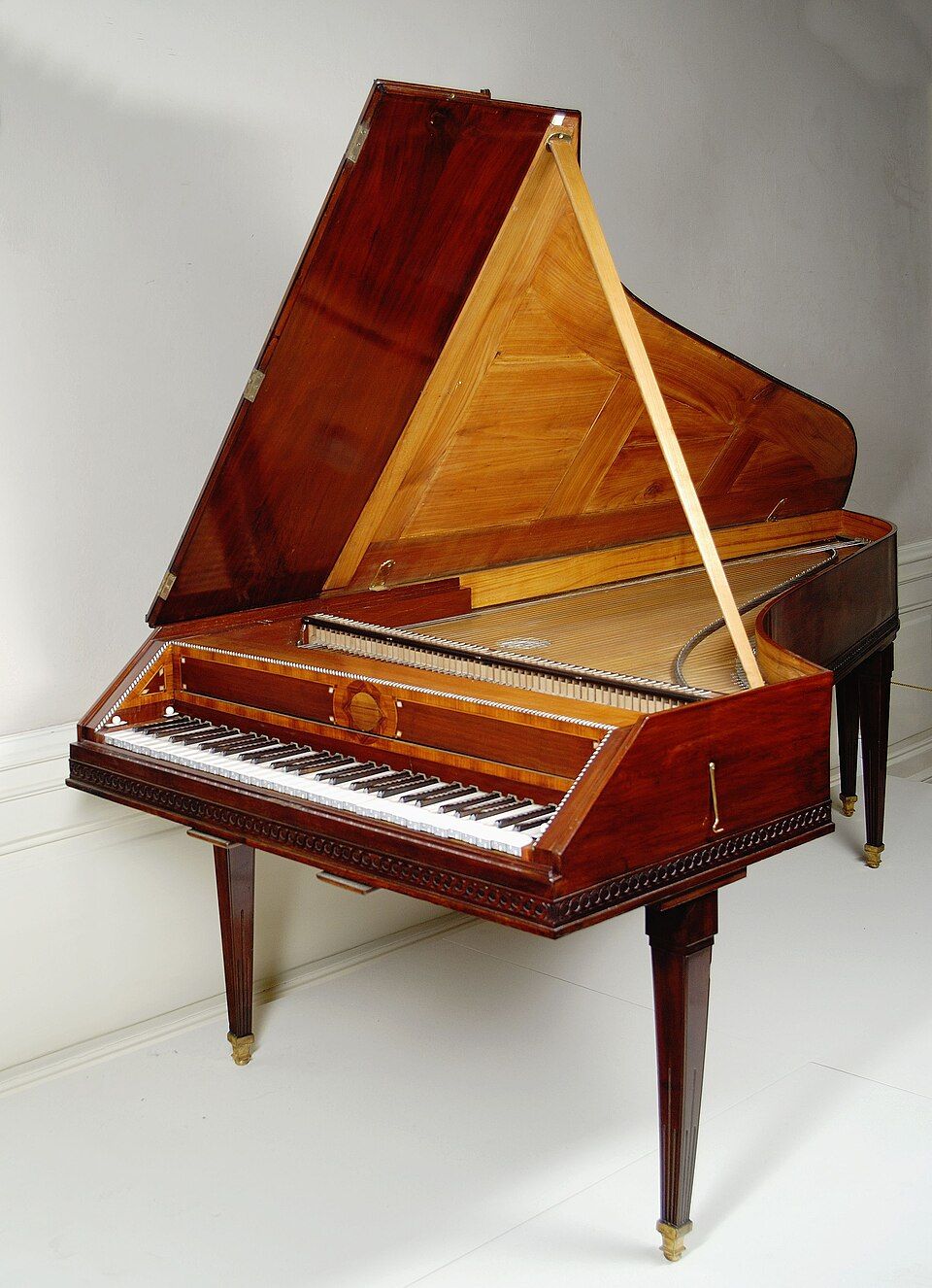
This article traces how Mozart moved from harpsichord culture into the fortepiano’s expanding world, where touch and dynamics mattered. It covers his reactions to Johann Andreas Stein’s instruments, Vienna’s competitive piano scene, and how the early piano’s sound and mechanisms shaped works such as K.242 and his use of an Anton Walter fortepiano.
From Harpsichord to Fortepiano – A New Dynamic Era
In the mid-1700s, the keyboard world was dominated by the harpsichord (often called cembalo) and the clavichord. The harpsichord’s strings were plucked, meaning it could not change volume with touch – notes sounded at fixed loudness. The clavichord, meanwhile, allowed expressive control but produced only a gentle sound suitable for private practice. As the Classical era dawned, musical tastes began to crave dramatic shifts in dynamics – sudden fortes and whispered pianos – which these old instruments could not fully deliver. The solution was a new invention: the pianoforte (or fortepiano), which struck strings with hammers and could play soft (piano) or loud (forte) depending on how the keys were pressed. This innovation – first achieved by Bartolomeo Cristofori around 1700 – slowly set off a revolution in sound.
Mozart grew up playing the harpsichord – his early tours as a child prodigy billed him as a wunderkind on that instrument. Harpsichord keys offered no dynamics, so young Mozart initially mastered a style of crisp articulation and ornate embellishments suited to plucked strings. Yet, the times were changing. By the 1760s and 1770s, pianos were gaining ground in Europe. Mozart likely encountered his first fortepianos as a boy in London, where Johann Christian Bach gave one of the world’s first piano concerts in 1768. He definitely played a piano in public in Munich in 1775. These experiences hinted at the piano’s potential, and Mozart was listening. The fortepiano promised something revolutionary: a keyboard on which the player could communicate emotion through touch, shaping phrases with crescendos and diminuendos that a harpsichord simply couldn’t execute.
A visit to the workshop of Herr Stein
A defining moment came in 1777. Mozart, then 21, visited the workshop of Johann Andreas Stein in Augsburg, Germany – one of the era’s great piano builders. There Mozart had a firsthand look at the cutting edge of piano design. He was astonished by what he found. In a delighted letter to his father, Mozart lavished praise on Stein’s pianofortes. “Before I had seen any of his make, Späth’s claviers had always been my favorites. But now I much prefer Stein’s,” Mozart wrote, noting that Stein’s instruments had superior damping (muting of strings) so that when a note was released, the tone stopped exactly when he wanted. No lingering buzz or blur of sound – Stein had solved one of the key technical challenges. Mozart marveled that “in whatever way I touch the keys, the tone never jars; in a word, it is always even.” Stein’s piano could be played hard or soft without ever rattling or going out of control. The secret was Stein’s development of an escapement mechanism that let the hammer strike and then fall back without bouncing against the string. This was cutting-edge technology in 1777 – “not one in a hundred” makers bothered with an escapement, Mozart noted – but it made Stein’s instruments remarkably responsive and clean in tone.
Crucially, Stein had also introduced a new way to lift the dampers and sustain notes: knee levers. Earlier keyboards sometimes had hand stops or levers to raise all the dampers (requiring an extra hand or even an assistant!), but Stein’s pianos featured a knee-operated lever under the keyboard. Mozart was impressed by Stein’s implementation of this device. “He also makes the mechanism where one presses with the knee better than anyone else,” Mozart wrote. “I hardly need to touch it, and it goes beautifully, and as soon as one takes one’s knee off…one does not hear anything sounding on at all.” In other words, Stein’s knee-lever sustain was smooth and sensitive: a gentle push with the knee would lift the dampers for a flowing legato or resonant effect, and a quick release would instantly silence the strings. This was the forerunner of today’s sustain pedal, and Mozart loved it.
Mozart’s encounter with Stein’s pianos was more than just talk – it led to music. During that 1777 stay in Augsburg, Mozart and Stein organized a public concert together. For the occasion, Mozart composed and performed a Concerto for Three Pianos (K.242), with Stein and another pianist joining him on three of Stein’s fortepianos. We can only imagine the scene: three early grand pianos gleaming in candlelight, their soundboards strengthened by Stein’s careful techniques (he would deliberately weather and pre-crack his wood to ensure stability), and Mozart at one of the keyboards, reveling in the new dynamic possibilities. The concert was a success, and Mozart’s enthusiasm for the fortepiano only grew. By the end of that year, he had effectively “made the switch” – from then on, all his keyboard compositions were conceived for piano rather than harpsichord. He was now a fortepianist.
Vienna’s Piano “Arms Race” in the 1780s
The Austrian capital in the 1780s was a bustling marketplace of new pianos and new music. Instrument makers, performers, and composers were all pushing each other in a rapid cycle of innovation – a true “piano arms race.” Johann Andreas Stein, the very man Mozart befriended, had showcased his designs in Vienna and inspired local craftsmen. One such craftsman was Anton Walter, who started building pianos in Vienna in the early 1780s and quickly became the city’s most famous maker. Walter took Stein’s light, responsive Viennese action and introduced his own improvements – reinforcing the wooden frames and tweaking the design for a bigger, stronger tone. The results were impressive enough that Mozart himself ended up buying an instrument from Walter around 1782–1783. Despite Mozart’s earlier praise of Stein, it was the piano by Anton Walter that became Mozart’s personal pride and joy in Vienna.
Mozart was by no means the only pianist fueling this competitive atmosphere. The 1780s also saw the arrival of virtuosos like Muzio Clementi, an Italian pianist-composer who came through Vienna on a European tour. Clementi had been sent in part to promote the latest English pianos (from the Broadwood firm) – instruments that had a heavier action and more power in the bass. On Christmas Eve 1781, Emperor Joseph II couldn’t resist pitting these talents and technologies against each other: he staged a famous contest between Mozart and Clementi at court. Before a glittering audience, the two keyboard lions dueled on the pianoforte. Clementi dazzled with rapid runs and technical wizardry; Mozart answered with his own brilliant improvisations. The Emperor declared the duel a draw (both men received a purse of 50 ducats), but privately Joseph II believed Mozart had won – and indeed Mozart’s effortless elegance made a strong impression on Vienna’s elite. The episode underscores how high the stakes were in this piano boom: even the Emperor cast himself as an aficionado of the latest piano music. (Amusingly, Mozart reported that the Emperor had placed a bet on him to win, and collected on it against a noble lady who favored Clementi.) These public tests and rivalries spurred makers to build ever better instruments. Viennese pianos began to sprout extra octaves – climbing beyond the roughly five-octave (61-key) compass that had been standard in Mozart’s youth. Keyboard range expanded step by step toward the six and seven octaves that the next generation (Hummel, Beethoven, etc.) would demand. Frames were strengthened with better bracing to support thicker, tenser strings. Inventors added novel gadgets: one builder in London, John Broadwood, even introduced foot pedals by 1783, replacing the knee levers with the now-familiar foot-operated sustain and soft pedals. Piano-making was the Silicon Valley of the late 18th century – a fast-paced industry, with Vienna as its hub. By 1800, around 60 piano makers were active in Vienna alone, a remarkable explosion from the lone piano or two that existed there mid-century. Mozart lived right at the center of this ferment, as both a contributor and beneficiary. He knew many of these makers personally and undoubtedly helped drive further improvements.
The Fortepiano Experience: Knee Levers, Lighter Touch, and New Sounds
What was it like to play or hear these early pianos that Mozart knew? In a word, different – thrillingly different – from the modern grand piano experience. The fortepiano of Mozart’s day was a lighter, more delicate creature. Mozart’s own instrument built by Anton Walter had a wooden frame without the metal reinforcements of modern pianos. It was far smaller and lighter than today’s concert grands. Its strings were thinner, and they were strung straight (not crossed in the bass as in a modern piano), giving it a transparent, singing tone. Contemporary descriptions and modern restorations indicate that a Classical-era fortepiano has a bright, clear sound with a bell-like treble and a resonant but not booming bass. “Its sound is fresher and brighter than that of a modern piano,” observed one expert of Mozart’s Walter piano, “with lighter action and hammers, but [the sound] fades faster.” Indeed, notes on Mozart’s piano did not sustain for very long – especially compared to the lingering, powerful tone of a modern Steinway. This meant that the pianist had to employ a finely controlled touch and, when available, the damper lift (sustain) lever to connect singing phrases.
The instrument invited conversation with the orchestra rather than domination of it. In Mozart’s piano concertos of the 1780s, one can hear this balance: the piano sings and sparkles, but the strings and woodwinds are equal partners in the musical dialogue. Part of this was Mozart’s artistic choice, but part was practical reality – the fortepiano simply could not overpower a full orchestra of the time, so Mozart wrote cadenzas and interplay that worked with the orchestra’s tone colors. Contemporary accounts often remarked on the “silvery” timbre of Viennese pianos – a silvery, clear sound that could speak quickly. Rapid passagework and articulated runs came out crisply on these instruments, like pearls on glass. The famed light touch of the Viennese action also enabled fleet fingerwork: a virtuoso could really fly, eliciting quick trills and delicate nuances that might get lost on a heavier modern piano.
On the flip side, the early piano’s dynamic range and sustain were limited compared to today’s grand pianos. A fortepiano could certainly play loud (Mozart’s fortissimo would startle audiences used to the harpsichord’s genteel volume!), but its loud was more like a bold spoken exclamation than the orchestral shout a modern Steinway can produce. The soft end of the spectrum was delightfully whispery. Listeners noted how expressively players like Mozart could shade dynamics and suddenly drop to a gossamer pianissimo – a dramatic effect new to music at the time. Composers quickly took advantage of these effects. The very term crescendo (gradually getting louder) became a hallmark of Classical style, pioneered by orchestras like Mannheim and embraced by keyboard composers once the piano made it possible. Mozart’s scores began to include dynamic markings and accentuations that make little sense on a harpsichord but shine on a fortepiano (for example, the accented sforzando chords and contrasting dynamics in his Piano Concerto No. 20 in D minor). And because the fortepiano’s tone faded relatively quickly, Mozart’s writing featured fast Alberti bass patterns and trills to sustain harmony in lieu of long-held chords. Musicologist Nathan Broder noted that once Mozart had the piano at his disposal, his style evolved: florid rococo ornaments “tended to disappear,” melodic lines became more “flowing and song-like,” and sustained tones began to appear for expressive effect – all due to the piano’s hammer action enabling new possibilities.
Mozart’s Own Fortepiano – A Tangible Link to the Past
Amazingly, Mozart’s personal piano has survived to this day. It is a fortepiano by Anton Walter, built in 1782, which Mozart purchased for around 900 florins – a hefty sum, but one he never regretted. This instrument was Mozart’s constant companion in Vienna: he composed on it, taught students with it, and performed his private concerts on it. For about nine years (1782–1791) it was “played almost daily” by Mozart. On this very keyboard he wrote more than 50 works, including his mature piano concertos and sonatas. After Mozart’s premature death in 1791, the piano passed to his son Carl and eventually to Salzburg’s Mozarteum museum. In modern times, scholars and musicians have been able to study and even play this precious relic. It’s a four-and-a-half octave instrument (about five octaves, F₁ to C₆), shorter in range than a modern piano – you won’t find the deep bass notes or the very high sparkle beyond its compass. Its tone is described as bright, intimate, and clear. Pianist Robert Levin, who has performed and recorded on Mozart’s Walter fortepiano, noted that playing it reveals secrets of Mozart’s music. The weight of the keys, the shallow key dip, and the balance of the sound make certain passages “click” in ways they don’t on a modern piano. “You understand things about the weight of the keys going down and the repetition and the balance in sound,” Levin says of Mozart’s piano, “and all of these things bring you very, very close to the music and make you say ‘A-ha, that’s why it’s written that way.’” Indeed, sitting at Mozart’s own instrument is like time-travel for a pianist – a direct auditory connection to the 1780s. The experience can be overwhelming: one modern player called it “easily the biggest day of a musician’s life.”
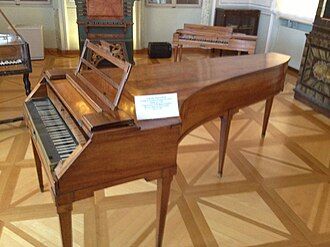
Mozart's Walter piano in his memorial house in Salzburg
This particular piano underwent careful restoration so it could sound again. When it was exhibited in Mozart’s former Vienna apartment in 2012, experts strung it with softer 18th-century-style strings to achieve a rounder, authentic tone. Hearing Mozart’s music on this instrument is revelatory: the balance between piano and orchestra in the concertos, the clarity of fast passagework, and the tender warmth of the piano’s voice all make perfect sense. It reminds us that Mozart, ever the practical musician, was writing for the instrument he had at hand – and he knew exactly how to make it shine.
A Composer in a Revolution – Mozart’s Legacy
Mozart’s life (1756–1791) neatly straddled one of the great turning points in musical instrument history. As a child he wowed kings and empresses on the old harpsichord; as an adult he became the poet laureate of the new fortepiano. He witnessed – and propelled – the piano’s evolution from a curiosity to the centerpiece of the modern orchestra and home.
By the late 1780s, works like the Piano Concerto in C minor, K.491, exploit dark, expressive shadings and bold dynamic contrasts that were unthinkable a generation prior. Mozart was keenly aware of the “sound revolution” happening around him – after all, he was living it. New instruments were joining the orchestra (he was among the first to feature clarinet, for example), and the piano was expanding in real time. Vienna’s concert halls were still intimate compared to today’s, but they were growing, and audiences were hungry for powerful musical experiences. The fortepiano’s development ran hand-in-hand with this trend: instrument makers responded to the demand for more volume and range, enabling composers to push the envelope further.
Mozart’s career shows how a great artist can be both a product of technology and an agent of its progress. He took the nascent piano and made it speak, forever transforming keyboard composition. His partnership with the evolving piano enriched the instrument’s design, pushing builders to new heights, which in turn opened new artistic horizons. The next generation – Beethoven and beyond – would benefit from those innovations as they stormed the musical heavens. But it was Mozart, in that exciting moment of the 1770s–1780s, who first demonstrated the piano’s true poetic soul.
//
References
Sources
- The Metropolitan Museum of Art – “The Piano: Viennese Instruments” (essay on 18th-century Viennese pianos and makers Stein and Walter).
- https://www.metmuseum.org/essays/the-piano-viennese-instruments
- Wolfgang Amadeus Mozart – Letter to Leopold Mozart, 17 October 1777 (Augsburg), in Digital Mozart Edition (English translation), describing Stein’s pianofortes and their qualities.
- https://dme.mozarteum.at/DME/objs/raradocs/transcr/pdf_eng/0352_WAM_LM_1777.pdf
- Reuters (Georgina Prodhan) – “Mozart’s piano returns home to Vienna”, Oct. 25, 2012. News article on Mozart’s 1782 Walter fortepiano, its characteristics, and modern exhibition.
- https://www.reuters.com/article/business/mozarts-piano-returns-home-to-vienna-idUSLNE89O02P
- Philharmonia Baroque Orchestra – “Piano, Pianoforte, Fortepiano: To-may-to, To-mah-to?” by Bruce Lamott (2016). Blog post contrasting harpsichord vs. fortepiano dynamics and describing Viennese vs. English piano actions.
- https://philharmonia.org/piano-pianoforte-fortepiano
- Christina Kobb – “#12: A Grand Piano was not always Grand!” (2020). Blog article on early piano development, including compass, knee levers, and the evolution of pedals.
- https://www.christinakobb.com/a-grand-piano-was-not-always-grand
- Die Welt der Habsburger – “The pianist: Mozart as virtuoso performer” by Julia T. Friehs. Describes Mozart’s 1781 contest with Clementi and context in Vienna’s musical life.
- https://www.habsburger.net/en/chapter/pianist-mozart-virtuoso-performer
- Robert Greenberg – “Dr. Bob Prescribes: Mozart Piano Sonatas” (2017), quoting Nathan Broder on Mozart’s piano style adapting to the new instrument and quoting Mozart’s 1777 letter about Stein.
- https://robertgreenbergmusic.com/dr-bob-prescribes-mozart-piano-sonatas