- Köchel Number
- K9 7 | K6 7
- Genre
- Chamber Music
- Form
- Violin Sonatas & Variations
- Key
- D Major
- Date
- 1762–1764
- Place
- Salzburg or Paris
- Age
- 8
Mozart’s Violin Sonata No. 2 in D major (K. 7) belongs to the extraordinary first publications issued under his name in Paris in 1764, when he was just eight years old. Although conceived primarily as a keyboard sonata with optional violin accompaniment, it already shows a child composer learning to shape clear themes, tonal plans, and courteous galant dialogue within a compact, domestic genre.
Mozart's Life at the Time
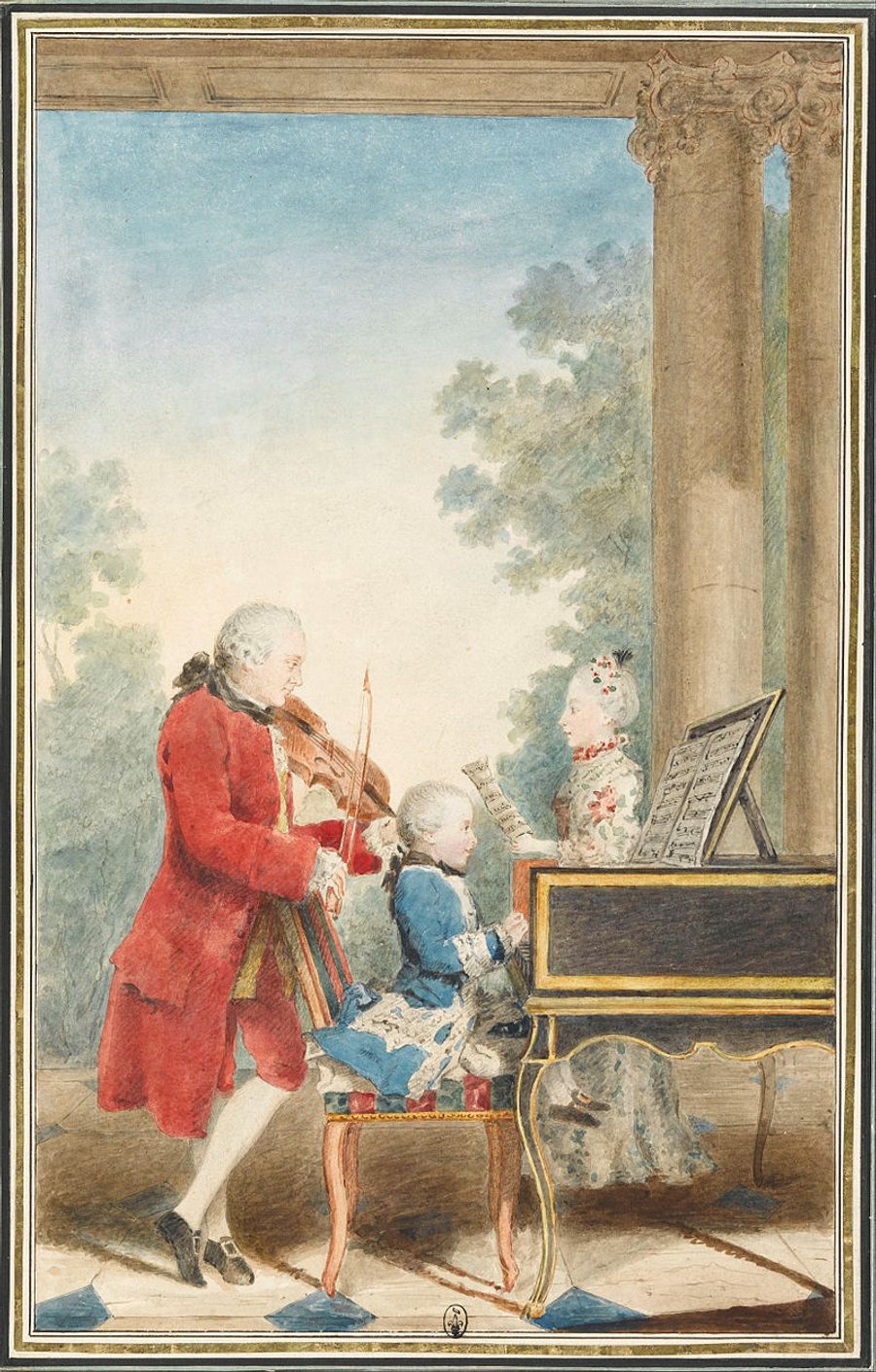
In 1764 Wolfgang Amadeus Mozart (1756–1791) was eight years old and already a seasoned traveler. The Mozart family’s “grand tour” had taken them through major musical centers, and early 1764 found them in Paris—an environment in which printed music, fashionable salon genres, and aristocratic patronage could quickly turn a prodigy into a marketable name. K. 7 belongs to the set of early keyboard-and-violin sonatas K. 6–9, issued as the child’s first “opus” publications in Paris and presented in the language and style of French music commerce: Sonates pour le clavecin… avec l’accompagnement de violon (“for harpsichord… with violin accompaniment”).1
That wording is not a mere nicety. It describes a real performance practice in which the keyboard carries the musical argument and the violin primarily colors, doubles, or lightly responds—music designed for cultivated amateurs, quick study, and social performance rather than public virtuoso display.1
Composition and Manuscript
For K. 7, even the most basic biographical question—where Mozart wrote it—remains uncertain in general reference literature: Salzburg or Paris is commonly given, with a broad dating to 1764.2 What is secure is the work’s close connection to Paris publication. Leopold Mozart arranged for K. 6 and K. 7 to appear as Op. 1 and dedicated them to Madame Victoire, daughter of King Louis XV; contemporary documents around the family’s Paris stay discuss the presentation of “opus 1” at Versailles.3
Modern scholarship and editions treat K. 7 as a “Sonata in D for clavier with accompaniment of a violin,” reflecting the original hierarchy of parts and the genre category under which these pieces first circulated.4
Musical Character
K. 7 is best heard as an intelligent apprenticeship piece: not a “miniature masterpiece” in the later Viennese sense, but a clear snapshot of how an eight-year-old absorbed the galant idiom and the keyboard-centered sonata type then fashionable across Europe.
A typical reading of the sonata emphasizes three interlocking traits:
- Keyboard-led discourse: the right hand’s singing line and the left hand’s harmonic scaffolding articulate the form; the violin often reinforces cadences, doubles key melodic tones, and adds brightness to the texture.14
- Compact, polite contrasts: the music favors short phrases, regular punctuation, and quickly legible tonal motion—virtues in a genre aimed at domestic music-making and quick dissemination in print.
- Charm in the “accompaniment” role: precisely because the violin is not yet treated as an equal partner, its entries can feel like a conversational courtesy—arriving to echo a cadence, sweeten a reprise, or add sheen to a closing gesture.
Why does K. 7 deserve attention today? Partly because it documents Mozart’s earliest public “author” persona: a child whose music could be engraved, marketed, dedicated, and sold in Europe’s most influential musical city.3 But it also illuminates a long arc within Mozart’s chamber output. From these Parisian Op. 1 sonatas—keyboard-first, socially functional—Mozart would eventually arrive at works where the violin becomes an equal dramatic protagonist (for example, the late sonatas written for virtuoso partners). Heard in that wider frame, K. 7 is not a curiosity at the edge of the canon; it is a starting point, showing the young composer learning the grammar of sonata writing before he began to transform it.
Sheet Music
Download and print sheet music for Violin Sonata No. 2 in D major (K. 7) from Virtual Sheet Music®.
Sources
[1] Wikipedia — overview of the set K. 6–9, including original French title indicating keyboard primacy and publication context
[2] IMSLP — work page for Violin Sonata in D major, K. 7 (basic cataloging and score access)
[3] MozartDocuments.org — Paris/Versailles context for the first publications (Op. 1: K. 6 and K. 7) and dedication to Madame Victoire
[4] Köchel-Verzeichnis (Internationale Stiftung Mozarteum) — catalog entry classifying K. 7 as a sonata for clavier with violin accompaniment; references to NMA VIII/23/1