- Köchel Number
- K9 1a | K6 1a
- Genre
- Piano Music
- Form
- Piano Pieces
- Key
- C Major
- Date
- Early 1761
- Place
- Salzburg
- Age
- 5
This article explores the Andante in C major, K. 1a, commonly cited as Mozart’s earliest preserved composition from the family notebook. It outlines his Salzburg upbringing and Leopold’s note-taking, then looks closely at the tiny ten-bar keyboard piece, including its shift from 3/4 to 2/4.
Family Background in an Enlightenment Era Salzburg
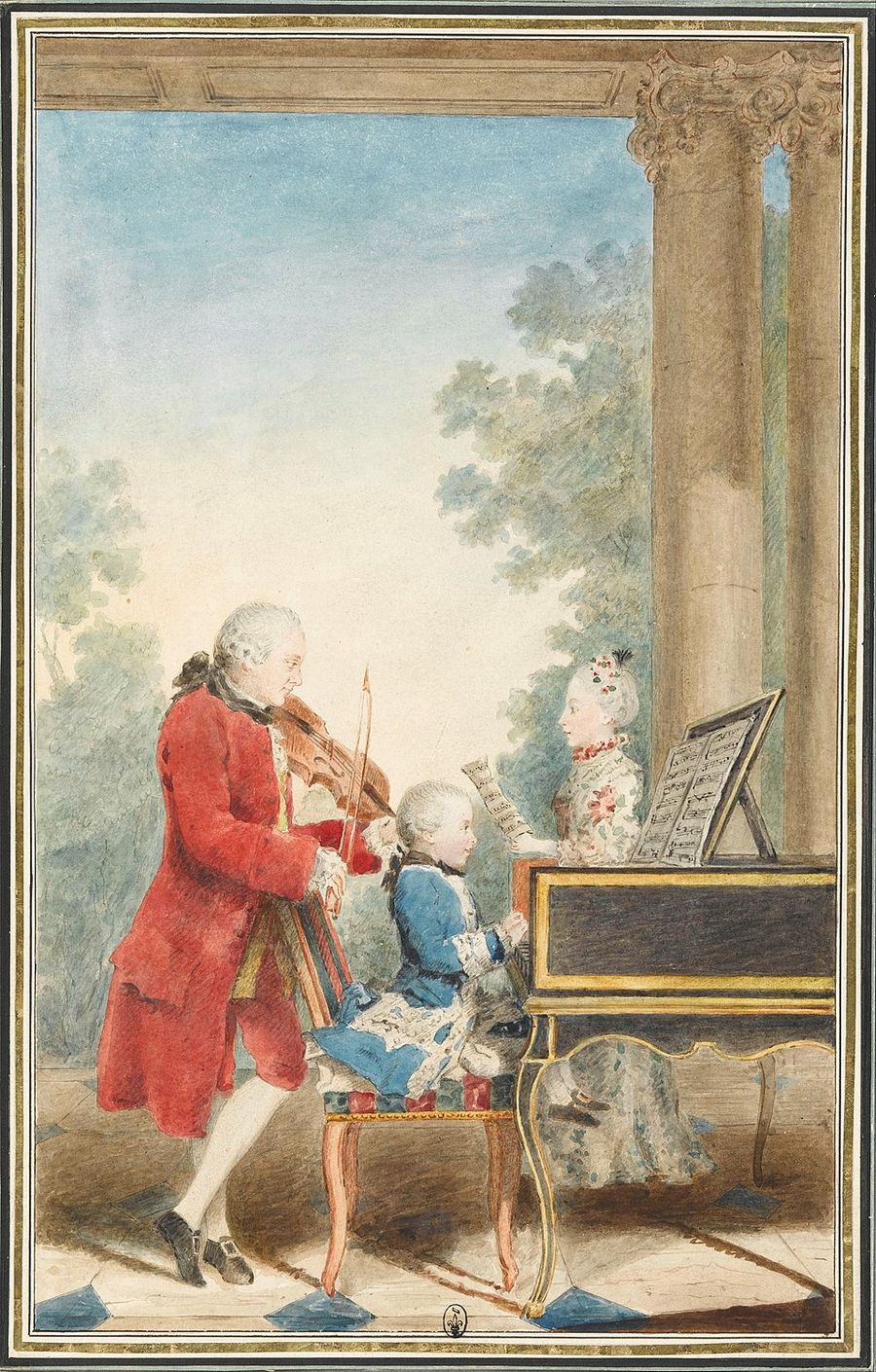
Wolfgang Amadeus Mozart was born on January 27, 1756, in Salzburg, a small but vibrant principality of the Holy Roman Empire ruled by a Prince-Archbishop. He was the seventh child of Leopold and Anna Maria Mozart, and one of only two (along with his elder sister Maria Anna “Nannerl”) to survive past infancy.
Wolfgang’s father Leopold Mozart was a violinist, composer, and deputy Kapellmeister in the Salzburg court orchestra. Just months before Wolfgang’s birth, Leopold had published a successful violin textbook – a sign of his skill as a teacher.
The Mozarts’ world was one of music and learning: Leopold taught his children not only music but also languages, mathematics, and other subjects at home. Culturally, mid-18th-century Salzburg was influenced by the Enlightenment and the galant style in music. Court and church music thrived under Archbishop Sigismund von Schrattenbach’s patronage, and Leopold was well-connected in these circles.
From the start, the Mozart family environment combined disciplined musical training with an atmosphere of love and curiosity. Leopold recognized something exceptional in his son, referring to young Wolfgang as “the miracle that God allowed to be born in Salzburg”, and felt it his duty to nurture this God-given talent.
A Child Immersed in Music
Wolfgang’s five-years-older sister Nannerl was an accomplished young pianist, and as she took lessons with “Papa”, the toddler Wolfgang watched with fascination. Years later Nannerl reminisced about their childhood: her little brother “often spent much time at the clavier, picking out thirds… and his pleasure showed that it sounded good.” Noticing Wolfgang’s keen musical ear, Leopold began teaching him small keyboard pieces “for a game” when he was only three turning four. “He could play [the minuets] faultlessly and with the greatest delicacy, keeping exactly in time,” Nannerl recalled.
Even more astonishing, by the time he was five years old “he was already composing little pieces, which he played to his father who wrote them down.” Leopold would carefully jot down the notes as Wolfgang improvised melodies at the clavier.
Mozart’s early training also included the violin; one famous anecdote recounts that the little boy, unbidden, picked up a violin and perfectly played a part his father’s friends were practicing, even though he’d never been taught the instrument – a feat that left Leopold stunned at his son’s innate ability.
Not everything came effortlessly to the young prodigy (for instance, he initially feared the loud sound of trumpets), but overall Wolfgang absorbed music “with a tremendous appetite and without effort,” as one writer notes.
The Mozarts’ home life, however, was not all strict practice; by accounts it was a happy household where the children’s playfulness was encouraged even as their father diligently honed their skills. This balanced upbringing helped Mozart’s extraordinary musicality blossom at a tender age.
The First Composition: Andante in C, K. 1a
In the early months of 1761, not long after Wolfgang’s fifth birthday, the Mozart family music notebook began to include the first original pieces by the little composer.
The very first of these is known as Andante in C major, K. 1a – the opening entry in Ludwig Köchel’s later catalog of Mozart’s works.
Leopold Mozart noted in Nannerl’s notenbuch that these were “des Wolfgangerl Compositiones in den ersten 3 Monat(en) nach seinem 5ten Jahre” – Wolfgang’s compositions in the first three months after his fifth birthday. In other words, K. 1a was composed when Mozart was just five years old. Leopold penned the piece into the notebook for little Wolfgang.
The little Andante in C is extremely short – only 10 measures in length. It is written for keyboard (in Mozart’s day, likely a harpsichord) and has no formal structure to speak of; it’s more like a musical sketch or idea.
The music begins in ³/₄ time with a simple one-bar melody which is immediately repeated, forming a balanced phrase. A second short phrase follows and is also repeated, much like a child’s imitation of the graceful little minuets he had been learning. Midway through K. 1a, however, Mozart makes a charming shift: the time signature changes to ²/₄ for the final few bars. In these closing measures, the five-year-old composer slips into a somewhat older-fashioned, Baroque-style figuration before ending the piece with a straightforward authentic cadence (a standard closing chord progression).
The effect is that of a musical child’s play: a few sweet ideas presented, a sudden change of pace, and then a polite ending. The entire piece lasts under a minute in performance. K. 1a gives us a glimpse of Mozart’s earliest musical language – uncomplicated and innocent, yet already showing an eagerness to experiment with rhythm and style within even a tiny composition.
A Closer Look and Leopold’s Guidance
Later analysis of K. 1a reveals how much Mozart’s musical instincts at age five were shaped by his environment. The little Andante’s phrases resemble the simple minuets and keyboard pieces Wolfgang had been practicing under Leopold’s tutelage.
In fact, scholars have noted that all of Mozart’s earliest compositions in Nannerl’s notebook (K. 1a through K. 1f) are strongly influenced by the music of his teacher (Leopold) and of composers like Georg Christoph Wagenseil, whose works the Mozart children studied. In K. 1a, the alternating 3/4 and 2/4 sections likely reflect Wolfgang imitating different styles he’d heard – the graceful courtly dance versus the quicker, old Baroque rhythms – without yet knowing the “rules” of form.
Leopold Mozart’s role in this process was crucial. As a seasoned pedagogue Leopold understood both how to instruct and when to step back. He wrote down Wolfgang’s ideas faithfully, without “correcting” the boy’s small creative quirks.
For example, the mixture of meter and style in K. 1a might have seemed odd to a trained musician, but Leopold let it stand, presumably delighted that his son was inventing music at all. Modern educators have pointed to this as a wise approach: Leopold allowed young Mozart’s creativity free reign, polishing only what was necessary (like proper notation). In doing so, he preserved the unique voice of the child composer.
The result is that K. 1a, while a very rudimentary piece, comes to us essentially as Mozart conceived it – a genuine product of his five-year-old imagination.
//
Sources:
Sheet Music
Download and print sheet music for K. 1a – Mozart’s Very First Composition from Virtual Sheet Music®.
Sources
Wolfgang Amadeus Mozart - Wikipedia
Wolfgang Amadeus Mozart: His Family and Childhood
Wolfgang Amadeus Mozart | Vienna Mozart Concerts
Listening to the Complete Mozart | The New Yorker
Earliest compositions, K. 1a-1d : manuscript in the hand of Leopold Mozart, 1761. | Mozart, Wolfgang Amadeus, 1756-1791. | The Morgan Library & Museum
Nannerl Notenbuch - Wikipedia
Leopold Mozart’s guide on how to teach composition to creative kids – Rebekah Maxner
Wolfgang Amadeus Mozart - Geniuses.Club