Discover the Mozart melodies you may already recognise, then explore Mozart Portal’s own favourites — from playful horn music and luminous flute and harp to the drama of the piano concertos and opera.
You may already know more Mozart than you think. A tune from a film, a piano lesson or a television advert can feel familiar long before you know its name.
Start with that recognition. Then listen for what happens around the melody: an answer, an interruption, a change of colour.
That is where Mozart becomes especially interesting.
His instrumental music has no single storyline. But it can suggest playfulness, anxiety, tenderness and the pleasure of finding a way forward. In opera, those changing moods belong to actual people. The selections below offer a few doors into that world, including Mozart Portal’s own favourites.
The K. numbers identify works in the Köchel catalogue. They help you find the right music among similar titles. [1]
Mozart melodies you may already know

Eine kleine Nachtmusik, K. 525 — I. Allegro. That confident opening is a natural starting point. Stay beyond the first phrase: hear how the strings answer the announcement and keep the movement moving.
Piano Sonata in C major, K. 545 — I. Allegro. Often called the “Sonata facile,” this is another familiar piano opening. [12] Listen to the clear melody above the gently turning left-hand pattern, then to the quick runs that carry it forward. It is an inviting way to hear how much Mozart can do with a light, uncluttered texture.
Piano Sonata No. 11, K. 331 — III. Alla turca. The “Turkish March” is the sonata’s finale. Its crisp rhythms and quick contrasts are instantly engaging; the opening theme and variations reveal a gentler side of the same work.
Piano Concerto No. 21, K. 467 — II. Andante. The piano melody seems to float above a gently moving accompaniment. The nickname “Elvira Madigan” comes from the 1967 film that used this movement, rather than from Mozart. [2]
Symphony No. 40, K. 550 — I. Molto allegro. Here the familiar tune carries unease. Listen to the restless accompaniment underneath it: Mozart can be compelling without sounding comfortable.
Symphony No. 25 in G minor, K. 183 — I. Allegro con brio. The “Little G minor” Symphony opens with urgent rhythms and sharp contrasts. [13] If you recognise its dramatic energy, stay for the quieter replies: the tension comes as much from the exchanges as from the force of the opening.
Three Mozart Portal favourites
These are personal recommendations from Mozart Portal: music we would put on for someone discovering Mozart, alongside the familiar favourites.
Flute and harp: a bright summer day

Begin with Concerto for Flute and Harp in C major, K. 299 — II. Andantino.
To our ears, this feels like a light summer day. The flute sings while the harp gives the music a delicate shimmer, and their exchanges make it easy to follow. Mozart wrote the concerto in Paris in 1778 for a flute-playing father and his harp-playing daughter. [3]
If the slow movement wins you over, hear all three movements. There is more sparkle in the opening Allegro and a lively return to motion in the finale.
Horn Concerto No. 4: Mozart with a smile

Begin with Horn Concerto No. 4 in E-flat major, K. 495 — III. Rondo: Allegro vivace.
This is our pick for Mozart’s playful side. The tune is cheerful, slightly odd and wonderfully buoyant. Listen for the horn’s calls and leaps, and for the familiar refrain returning after each excursion. That returning idea is what makes it a rondo.
It is hard to resist its good humour.
Fantasia in D minor: a conversation at the piano

Begin with the complete Fantasia in D minor, K. 397.
One pianist can seem to become several speakers. A thought hesitates; another interrupts; the music suddenly rushes ahead or pauses. We recommend listening to it as a dramatic conversation, with new turns appearing just when you think you know its direction.
That theatrical connection has a real counterpart. In Barrie Kosky and 1927’s production of The Magic Flute, shortened spoken dialogue becomes silent-film-style text panels, accompanied by music from this Fantasia and the C-minor Fantasia, K. 475. [4]
There is one twist in K. 397 itself: the familiar closing bars are not securely Mozart’s. Henle’s critical edition explains that they come from an unauthorised 1806 print; the work was probably left as a fragment. [5]
The piano concertos: colour, drama and conversation

For Mozart Portal, the piano concertos are a particularly rewarding route beyond the famous tunes. Start with Nos. 20, 21, 23, 24 and 27, then explore their neighbours.
Listen for who has the idea — and who answers.
The piano is sometimes the leading voice, sometimes a listener entering a conversation already under way. Strings and woodwinds give the same material different colours. The patterns become more interesting when you follow those exchanges.
In No. 20 in D minor, K. 466, begin with the first movement’s agitated orchestral opening. The piano enters with its own quieter thought. The concerto’s final movement eventually turns towards D major: a striking release after so much tension. [6]
Then try No. 23, K. 488 — II. Adagio, for inward, singing piano and wind replies; No. 24, K. 491 — III. Allegretto, for a theme transformed through variations; and No. 27, K. 595 — II. Larghetto, for gentler, spacious exchanges.
These offer different kinds of pleasure. Choose the one that catches you, then hear the whole concerto.
Opera: put faces to the music

The Magic Flute, K. 620 — “Der Hölle Rache” gives the Queen of the Night’s fury an unmistakable sound. The high notes are part of the drama: a mother demanding that her daughter commit murder. The opera combines musical numbers with spoken dialogue. [7]
For its cheekier side, try Papageno’s entrance song, “Der Vogelfänger bin ich ja” — “I am the birdcatcher.” [14] He introduces himself with an easy, jaunty tune, proudly singing about his trade. Listen to the little pipe calls between his phrases: they help make his character immediately recognisable.
For a warmer comic entrance, try The Marriage of Figaro, K. 492 — “Non più andrai.” Figaro teases Cherubino about military life; the swaggering tune carries the joke. [8]
Then watch an ensemble scene with subtitles. In the Act II finale of Figaro, people arrive, stories unravel and the music keeps reacting. Mozart’s gift for conversation becomes visible.
If that draws you in, Don Giovanni offers a darker world, while Così fan tutte makes beautiful singing part of an unsettling comedy about love.
Voices: tenderness as well as grief

“Laudate Dominum” from Vesperae solennes de confessore, K. 339 is another Mozart Portal recommendation. Follow the soprano’s long line, then notice how the arrival of the choir expands its gentle sound.
For a very different experience, hear the Lacrimosa from the Requiem, K. 626. Voices and orchestra turn the text’s grief into something collective and powerful. Mozart left the Requiem unfinished; the familiar performing version includes music completed after his death. [9]
Sacred Mozart has room for both consolation and anguish.
Why an ending can feel so satisfying
One pleasure we keep returning to is Mozart’s sense of arrival. After uncertainty or interruption, a phrase can settle with a completeness that feels reassuring.
There is some evidence behind that response. A study using excerpts from Mozart’s piano sonatas found that musicians and listeners without musical training responded to different strengths of cadence — the melodic and harmonic gestures that mark an ending. [10]
The study concerns short excerpts and musical closure; feeling uplifted remains a personal response. Mozart can also leave us in a darker place: Piano Concerto No. 24 ends in the minor key. [11]
Our own recommendation is to listen for the journey into the ending. For us, the bright conclusion of Piano Concerto No. 20 can leave a particularly positive feeling because of the darkness that comes before it. [6]
Where to go next

For quiet warmth, try the Clarinet Concerto, K. 622 — II. Adagio. For a smaller musical conversation, follow it with the Clarinet Quintet, K. 581 — II. Larghetto.
For richer wind colours, hear the “Gran Partita,” K. 361 — III. Adagio. For two string soloists answering one another, try the Sinfonia concertante for violin and viola, K. 364 — II. Andante.
And for the excitement of several musical ideas coming together, head to the finale of the “Jupiter” Symphony, K. 551.
You do not need to learn the catalogue in order.
Begin with a melody you love. Stay for the conversation around it.
Sources
[1] International Mozarteum Foundation, Ludwig von Köchel and the Köchel Catalog. Catalogue explanation, especially the identification and revision of K. numbers. Accessed 13 October 2026. Source.
[2] Boston Symphony Orchestra, Mozart — Piano Concerto No. 21 in C, K. 467. Programme note: the Andante and its use in Bo Widerberg’s 1967 film Elvira Madigan. Source.
[3] Orrin Howard / Los Angeles Philharmonic, Concerto for Flute and Harp. Programme note: Paris, 1778; the Duke de Guines and his daughter; instrumentation and the three movements. Source.
[4] Komische Oper Berlin, Ein magisches Märchenbuch. Interview with Barrie Kosky, Suzanne Andrade and Paul Barritt: shortened dialogue presented as silent-film intertitles, with eighteenth-century fortepiano accompaniment from K. 475 and K. 397. Source.
[5] G. Henle Verlag, Fantasy in D minor K. 397 (385g), HN 52; edited by Ullrich Scheideler. Publisher’s critical-edition explanation: probable fragment; frequently performed closing bars derive from an unauthorised 1806 print, with no surviving authorised source for them. Source.
[6] Herbert Glass / Los Angeles Philharmonic, Piano Concerto No. 20. Programme note: orchestral opening, the piano’s contrasting entrance and the finale’s conclusion in D major. Source.
[7] Komische Oper Berlin, The Magic Flute. Synopsis, Act II: the Queen’s demand to Pamina. The shortened spoken dialogue is also documented in the production interview listed as source 4. Source.
[8] Opera Ballet Vlaanderen, De aanstekelijke muziek van Le nozze di Figaro. 16 May 2023. Non più andrai: Figaro’s mocking advice to Cherubino about military service. Source.
[9] Orrin Howard / Los Angeles Philharmonic, Requiem. Programme note: Mozart’s unfinished work and posthumous completion. Used only for that documented fact, not for the note’s more speculative deathbed narrative. Source.
[10] David Sears, William E. Caplin and Stephen McAdams, Perceiving the Classical Cadence. Music Perception 31(5), June 2014, pp. 397–417, doi:10.1525/mp.2014.31.5.397. Results and General Discussion, especially pp. 410–414: completion judgments by musicians and nonmusicians for excerpts from Mozart’s keyboard sonatas. Source.
[11] David Hattner / Portland Youth Philharmonic, Camerata PYP Program Notes: Wolfgang Amadeus Mozart, Piano Concerto in C minor, KV 491. 11 May 2022. The finale’s theme and variations, major-key episodes and minor-key ending. Source.
[12] International Mozarteum Foundation, KV 545 — Sonate in C für Clavier. Official Köchel catalogue entry: C major, nickname Sonata facile, first movement Allegro. Accessed 13 October 2026. Source.
[13] Herbert Glass / Los Angeles Philharmonic, Symphony No. 25 in G minor, K. 183. Programme note: the urgent orchestral opening, syncopations, silences and contrasts. Source.
[14] International Mozarteum Foundation, KV 620/02 — Aria: Der Vogelfänger bin ich ja. Official Köchel catalogue entry identifying Papageno’s aria and linking the critical score in Neue Mozart-Ausgabe II/5/19. Source.
Image credits
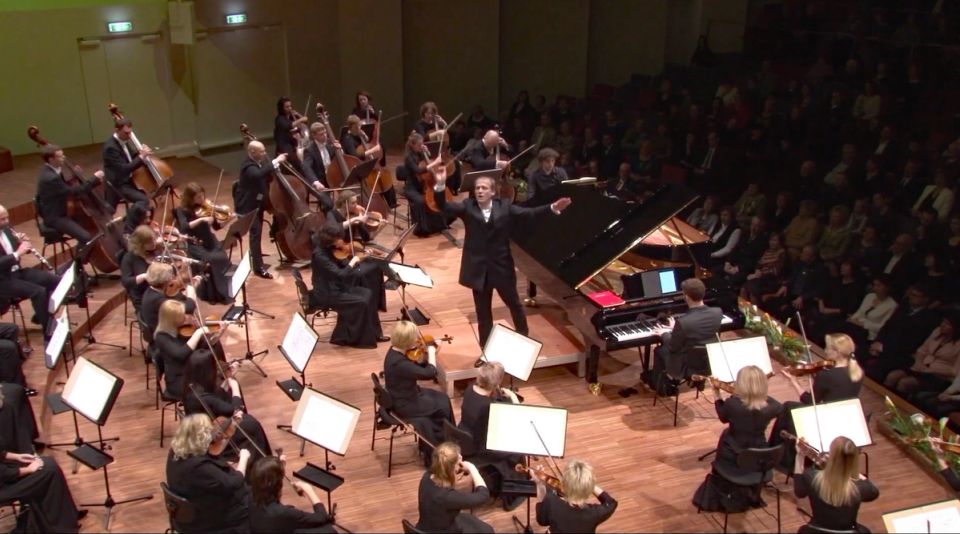
SintaBerzins / Wikimedia Commons. CC0. Duo Amal and the Liepāja Symphony Orchestra performing Mozart’s Concerto for Two Pianos, K. 365, with conductor Matthias Manasi. Image source. Licence. Unmodified.
Mozart83 / Wikimedia Commons. Public domain. The Vienna Mozart Orchestra in historical costumes: a modern concert presentation of Mozart. Image source. Licence. Unmodified.
Gloue / Wikimedia Commons. CC BY-SA 4.0. The Andantino from the Flute and Harp Concerto, K. 299, in manuscript: two solo voices sharing the page. Image source. Licence. Unmodified.
Staatliches Institut für Musikforschung, Musikinstrumenten-Museum / Jürgen Liepe / Wikimedia Commons. CC BY-SA 4.0. An inventions horn in Berlin’s Musikinstrumenten-Museum: an example of the instrument’s history. Image source. Licence. Unmodified.
PianoTiger106 / Wikimedia Commons. CC BY-SA 4.0. A solo piano recital at Swarthout Recital Hall, Lawrence, Kansas, July 2015. Image source. Licence. Unmodified.
Wolfgang Amadeus Mozart / Wikimedia Commons. Public domain. The opening of Mozart’s autograph score of Piano Concerto No. 23, K. 488. The piano shares its world with strings and winds. Image source. Licence. Unmodified.
Neil Mackenzie / NZOpera / Wikimedia Commons. CC BY-SA 4.0. The Magic Flute in a 2006 New Zealand Opera production. Image source. Licence. Unmodified.
Jonathan Harker / Wikimedia Commons. CC BY-SA 4.0. Orchestra Wellington, conductor Marc Taddei and the Orpheus Choir at the Michael Fowler Centre, August 2017. Image source. Licence. Unmodified.
Gisbert König / Wikimedia Commons. CC BY-SA 4.0. A basset clarinet laid across the score of Mozart’s Clarinet Quintet, K. 581: a closer, smaller world of musical conversation. Image source. Licence. Unmodified.