- Köchel Number
- K9 595 | K6 595
- Genre
- Concertos
- Form
- Piano Concertos
- Key
- B Flat Major
- Date
- 5 January 1791
- Place
- Vienna
- Age
- 35
This article surveys Mozart’s Piano Concerto No. 27 in B-flat major, K.595, his final piano concerto. It covers its composition history and early performances, the intimate scoring without trumpets or timpani, the three-movement design (including links to K.596), and later reception and performance practice.
Composition and Context
Mozart’s Piano Concerto No. 27 in B-flat major, K.595, was his final piano concerto, composed during his last year of life (1791)[1]. The autograph manuscript is dated January 5, 1791, though paper analysis suggests much of it was actually written around late 1788[2]. In fact, Mozart likely began the concerto in 1788 (completing two movements and part of the finale) and set it aside, only returning to finish it in early 1791 when a new concert opportunity arose[3]. This ended a nearly three-year hiatus since his previous piano concerto – the longest break in his concerto output since moving to Vienna[4]. At the start of 1791 Mozart was optimistic about the future, despite recent financial difficulties and waning public popularity[5]. He had just been appointed assistant Kapellmeister at St. Stephen’s Cathedral and was busy composing other works of that miraculous final year (including numerous dances, the opera The Magic Flute, the Clarinet Concerto and the unfinished Requiem)[6].
The B-flat concerto appears to have been written without a specific commission, likely intended for Mozart’s own use. It was first performed in Vienna on 4 March 1791, at a private concert in Jahn’s Hall with Mozart as the soloist[7]. This event – hosted by the clarinetist Joseph Beer – is believed to have been Mozart’s last public appearance as a pianist[8][7]. A contemporary report from that premiere noted that “everyone admired Mozart’s art, in composition as well as execution”[9]. (An alternate account suggests the concerto might have been premiered a few weeks earlier by Mozart’s pupil Barbara Ployer at the Palais Auersperg, but modern consensus leans toward the 4 March performance[10].) Sadly, Mozart fell ill later that year and died on 5 December 1791, making this concerto something of a musical farewell. It was published posthumously by Artaria in 1793 and, as the last of Mozart’s 27 piano concertos, it holds a special place as his final statement in the genre.
Instrumentation
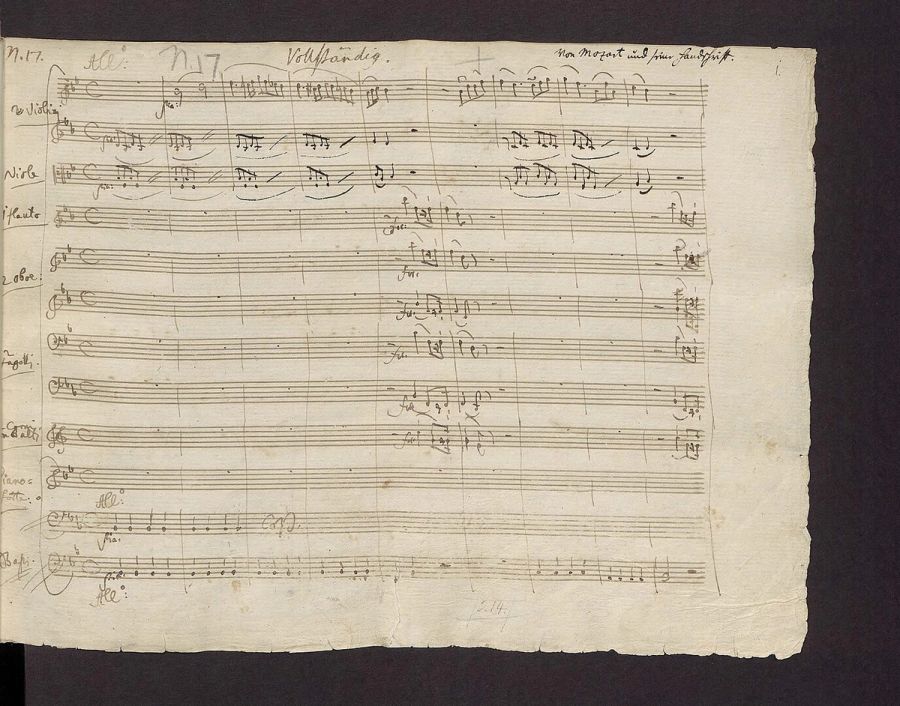
Opening bars of Mozart’s autograph score of the concerto (1791), showing the orchestral staves. Notably absent are any trumpet or timpani parts, giving the work a lighter, more intimate orchestral palette.
The concerto is scored for a relatively small Classical orchestra: a single flute, two oboes, two bassoons, two horns in B-flat, and strings, with the solo piano (fortepiano)[11]. Unlike most of Mozart’s other late piano concertos, No. 27 pointedly omits trumpets and timpani, resulting in a thinner orchestral texture[11]. (In fact, all of Mozart’s late Viennese concertos except No. 23 in A major featured trumpets and drums, whereas K.595 does not[12].) This restrained instrumentation contributes to the work’s gentler sonority. The woodwinds are given a prominent role, often carrying melodic dialogues with the piano, which lends the concerto a special warmth and color. Contemporary commentators have noted that Mozart’s frequent reliance on the winds in this score “enhances the warmth that is the most prominent feature of the Concerto”[13]. The absence of brass fanfare and percussion also reinforces the piece’s intimate, chamber-like character. Overall, the orchestration serves to support the piano with subtlety and clarity, befitting the concerto’s mellow and lyrical nature.
Form & Musical Character
The concerto follows the traditional three-movement fast–slow–fast structure of Mozart’s piano concertos:
Allegro (B-flat major) – The first movement is in concerto-sonata form. It opens with an orchestral exposition introducing several graceful themes. The principal theme is a gently lyrical melody shared between violins and woodwinds, establishing an elegant, “floating lyricism” in the orchestra[14]. Several contrasting ideas follow – one theme is more humorous and playful with twittering violin figures, and another is songful and serene[15]. Notably, although the movement is in a major key, Mozart hints at shadows of minor: for instance, the second theme appears in the dominant minor key (F minor), and a brief foray into a distant minor key occurs early in the development section[16]. The piano enters by restating the main theme with delicate embroidery, then proceeds to elaborate and vary the themes in dialogue with the orchestra[15][17]. The development is concise yet thematically rich – Mozart fragments and recombines motives, and executes daring modulations (changing key around 20 times in 60 measures)[17][18]. Despite its structural sophistication, the movement maintains a poised, unforced character. The solo writing is limpid and relatively undemanding (especially compared to the virtuosic sparkle of Mozart’s earlier concertos)[13], suggesting Mozart was more concerned with expressive dialogue than technical display. After a nuanced recapitulation, Mozart includes a cadenza (an improvised solo flourish). At the premiere he likely extemporized this, but he later wrote down cadenzas for this movement (and the finale) – a fortunate survival, as it provides performers with Mozart’s own ornamentation[19]. The cadenza revisits earlier themes (especially the lyrical second theme) before a final orchestral tutti gently closes the movement[20]. Overall, the first movement balances Classical elegance with a poignant undercurrent; its “subdued intimacy” and clear textures give no overt sign of the composer’s personal woes[21].
Larghetto (E-flat major) – The second movement is a tranquil slow movement marked Larghetto, set in the subdominant key of E-flat. Its form is a simple ternary (A–B–A) song-like design. The piano presents the main theme at the outset: a “lovely melody”, gentle and heartfelt, which the orchestra then takes up in turn[22]. This melody unfolds with an almost aria-like quality, often compared to an operatic cantabile – indeed, one scholar describes the movement as “pristine, operatic miniaturism” in its delicate expressiveness[23]. The middle section (B) introduces a new graceful theme and modulates to a distant key, providing a contrast in color[24]. Despite the overall major-key serenity, Mozart again allows fleeting darkness to enter: partway through the Larghetto, the music touches the tonic minor (B-flat minor), and at one point the orchestra introduces a striking dissonance before the phrase resolves[22]. These moments of tension are brief, however, and serve to deepen the movement’s emotional poignancy. The return of the opening section brings back the initial theme, now enriched by the journey. The atmosphere throughout is one of calm and poetic introspection – commentators often note a sense of contentment tinged with melancholy. As one description puts it, the Larghetto lets the piano’s right-hand solo line “soar and float” with a gentle poignancy over the accompaniment[25]. Mozart’s handling of the slow movement is remarkably intimate and unadorned**, allowing the sheer beauty of the melody and harmony to speak plainly.
Allegro (B-flat major) – The finale is a cheerful, unhurried Allegro in B-flat that combines rondo and sonata elements. Its principal theme is a graceful, folk-like tune which Mozart actually borrowed from one of his own German songs, “Sehnsucht nach dem Frühlinge” (Longing for Spring, K.596)[26]. This gives the movement a warm, almost nostalgic flavor – Mozart placed that spring song right after the concerto in his catalog, suggesting he composed them back-to-back in early 1791. The rondo theme’s lyrics (“Come, sweet May…”) hint at Mozart’s hopeful outlook as he wrote the piece[27]. The movement proceeds by alternating the refrain theme with contrasting episodes. One episode introduces a more vigorous idea and a brief minor-key excursion, adding a touch of drama before the sunshine returns. Throughout the finale, the mood remains good-humored and contented, without the barnstorming finales or showy virtuosity found in some of Mozart’s earlier concertos. A short cadenza (for which Mozart also left his own written version) appears before the final reprise and coda[28][19]. This cadenza, like the first movement’s, is modest in scale and focuses on melodic lyricism rather than technical display. The concerto then ends quietly and cheerfully, in a spirit of gentle farewell. Notably, Mozart achieves a subtle cyclical integration between movements: the principal theme of the Larghetto reappears briefly within the finale (as a secondary theme)[29], forging a link that was an unusual forward-looking touch for the time. This thematic recall, along with the reuse of the spring song melody, lends the concerto a cohesive narrative quality.
Stylistically, K.595 stands apart from the grand, virtuosic concertos Mozart wrote in his mid-1780s. Instead of glittering brilliance, it exudes a “mature serenity” and simplicity that some have called “mellow” or “affectingly reticent”[21]. The piano’s role is often reflective and integrated with the orchestra, rather than overtly extroverted. Yet beneath its gentle surface, the music carries an unmistakable depth of feeling. Certain 19th- and 20th-century critics (most famously Cuthbert Girdlestone) interpreted this concerto as tinged with autumnal sadness – “resignation and nostalgia [which] spread a veil of sadness over the whole concerto… casting an evening light, announcing the end of a life”[30]. While such poetic interpretations likely arose from knowing this was Mozart’s final concerto, they highlight the work’s quiet emotional undercurrents. Indeed, the piece’s placid beauty is not without a wistful, introspective quality. However, many analysts caution against reading too much tragedy into the music itself. The concerto’s formal balance and melodic grace project an atmosphere of contentment that “gives no real musical indication of the composer’s impending fate”[31]. As the Los Angeles Philharmonic’s program notes observe, Mozart seems to “close the door on his incomparable piano concerto literature without heroics, without self-pity – with just a smile,” albeit one touched by “a sad resignation” at the corners[23]. In sum, Piano Concerto No. 27 is characterized by an understated, lyrical beauty and a profound sense of closure – a work often described as autumnal, intimate, and poignant, offering a gentle farewell rather than a grand valediction.
Reception and Legacy
Upon its debut in 1791, Mozart’s final piano concerto was reportedly well-received by those present – as noted, listeners admired both the composition and Mozart’s own pianism at the premiere[9]. However, in the decades following Mozart’s death, this concerto did not immediately attain the fame of some of his earlier concertos. During the 19th century, it was performed less frequently than flashier works like the D minor or C major concertos. Mozart’s late style in K.595 – so subtle and understated – may have been out of step with the 19th-century taste for more overtly dramatic concertos. Musicologist Simon Keefe notes that neither the “Coronation” Concerto (No. 26) nor No. 27 ranked among Mozart’s most popular instrumental works in the 1800s, and only in the 20th century did No. 27 begin to receive the scholarly admiration it deserves[32]. In fact, for a long time critics paid relatively little attention to this concerto compared to Mozart’s earlier Viennese concertos[33].
Over time, however, performers and analysts came to treasure Piano Concerto No. 27 for its unique qualities. Its gentle lyricism and introspective tone have been praised as hallmarks of Mozart’s late genius. While early commentators like Girdlestone saw in it a foreshadowing of Mozart’s end[30], later writers have balanced that view by emphasizing the music’s serenity and lack of overt gloom[21]. This dialogue of interpretations has actually enriched the concerto’s legacy: it can be heard both as a wistful farewell and simply as an instance of Mozart’s pure, classical refinement. Modern program notes often highlight the work’s autumnal charm and “transfigured” calm, comparing it to other late Mozart masterpieces (such as the Clarinet Concerto or certain passages of the Requiem) that convey an otherworldly peace. Moreover, scholars have pointed out how Mozart was subtly reinventing the piano concerto form in his last two concertos. The integration of themes across movements and the pared-down orchestration in K.595 can be seen as Mozart exploring new, forward-looking ideas on the cusp of the 19th century[34].
In the 20th century the concerto’s reputation grew steadily. It became a staple in the Mozart concerto canon, especially as pianist–scholars and historically informed performers rediscovered its nuances. By the mid-1900s, leading pianists were programming and recording it, often bringing out its chamber-music qualities. Today, K.595 is regarded as a masterpiece of restraint and lyricism. Although it may lack the immediately hummable fame of, say, the “Elvira Madigan” Concerto (No. 21) or the stormy drama of No. 20, many consider No. 27 a deeply moving culmination of Mozart’s work in the genre. Its legacy is also tied to the poignancy of being Mozart’s last concerto – a fact that lends it a special, if bittersweet, place in music history. Some have even drawn parallels to later composers: for example, Johannes Brahms (whose own Second Piano Concerto was his last) reportedly admired Mozart’s No. 27, and one analyst has observed a possible nod to it in Brahms’s concerto orchestration[35]. Whether or not such connections are intentional, it is clear that Mozart’s final concerto has inspired reflection by generations of musicians on how a great composer bids farewell.
Interpretations and Recordings
Because of its subtle character, Mozart’s Piano Concerto No. 27 is often seen as a pianist’s concerto that rewards sensitivity and clarity over virtuoso fireworks. Mozart himself was the first interpreter, giving the work an auspicious start with his 1791 performance. After Mozart’s death, the concerto was occasionally performed by his pupils and later by 19th-century pianists, but it truly entered the standard repertoire in the 20th century as the Mozart revival took hold. By the 1930s and 1940s, pianists like Artur Schnabel championed Mozart’s concertos; Schnabel, in fact, was soloist for the Los Angeles Philharmonic’s first performance of K.595 in 1939[36]. Since then, virtually every renowned Mozart pianist has tackled the piece. It has been praised in the hands of artists such as Clara Haskil, Lili Kraus, Wilhelm Kempff, and Walter Gieseking in the mid-20th century, all of whom brought out its elegance. Later, the great Mozart interpreters Daniel Barenboim, Alfred Brendel, Murray Perahia, Mitsuko Uchida, Maria João Pires, Richard Goode, András Schiff (among many others) have given notable performances and recordings.
Different interpretive approaches highlight various facets of the concerto. Some pianists perform it on fortepiano (the 18th-century ancestor of the modern piano) to recapture the work’s original sound world; for example, Malcolm Bilson and Robert Levin have recorded it with period instruments, emphasizing its intimate scale. On modern pianos, performers often adopt a chamber orchestra accompaniment to maintain textural transparency. The piece’s intimacy indeed lends itself to smaller ensembles where the interplay between piano and winds can be finely detailed. One recent reviewer noted that the “intimate” No. 27 “showcases a greater level of ensemble cohesion” in a chamber-orchestra setting[37], and recommended the recording by Maria João Pires with Claudio Abbado (and the handpicked Orchestra Mozart) as an ideal blend of unified sound and expressive nuance[38]. In general, modern conductors and pianists strive for clarity of phrasing, elastic tempos, and conversational phrasing in this concerto, allowing its gentle poetry to unfold naturally.
A number of outstanding recordings of K.595 are often cited for their insight. For example, Maria João Pires’s version with Abbado is lauded for warmth and intimacy, Alfred Brendel’s recordings (especially his later one with Sir Charles Mackerras) are admired for their deep understanding of Mozart’s style, and legendary pianist Emil Gilels made a classic recording noted for its beautiful tone. Critic surveys frequently list Richard Goode’s interpretation and Pires’s as reference points, alongside Brendel’s[39]. Other distinguished accounts include those by Murray Perahia (with the English Chamber Orchestra), Daniel Barenboim (who recorded the full cycle twice), and Mitsuko Uchida (with the English Chamber Orchestra under Jeffrey Tate). Each pianist brings out different shadings – Uchida, for instance, emphasizes crystalline delicacy, while Brendel imparts a slightly more robust phrasing – yet all treat the concerto with the restraint and lyrical focus it demands.
It is also worth noting that Mozart’s own cadenzas for this concerto are commonly used, given their authenticity and fit with the work’s style[19]. However, some later musicians have composed alternative cadenzas: the composer-pianist Johann Nepomuk Hummel (a student of Mozart) wrote cadenzas for No. 27, as did virtuoso Carl Reinecke in the 19th century. These are occasionally played, though performers today often favor Mozart’s originals or improvise in a period-appropriate manner.
In performance, the B-flat major concerto is often appreciated as an “autumnal” work that closes a recital or a concert program on a reflective note. Its quiet closing measures do not bring down the house with applause in the way a rousing finale might; instead, audiences are often struck by its understated beauty and the poignant knowledge that this was Mozart’s last piano concerto. As one critic aptly summarized, No. 27 “is a sublime composition that blends lyricism, virtuosity, and emotional depth… a serene opening sets the tone for a journey through tender melancholy to triumphant exuberance”, making it a fitting tribute to Mozart’s legacy[40]. Today, the concerto stands as a favorite of pianists who value musical poetry over pianistic bravura. Its best interpreters convey the sense of Mozart’s mature simplicity – the idea that, in his final year, he spoke with utmost clarity and grace at the keyboard. Piano Concerto No. 27 may be a gentle farewell, but it is one of profound eloquence, capping the extraordinary series of Mozart’s piano concertos with a work of transcendent calm and subtle emotional resonance.
Sources:
Sources
Mozart’s autograph manuscript and historical notes[41][42]; scholarly commentary by Simon Keefe[32]; program notes by Orrin Howard (LA Phil)[13][23]; Houston Symphony blog by Calvin Dotsey[3][43]; Interlude article by Georg Predota[7][31]; Cuthbert Girdlestone, Mozart and His Piano Concertos (quoted in LA Phil notes)[30]; Anne Queffélec album review (Tal Agam, The Classic Review)[37][39]; and other referenced musicological sources.
[1][2][8][10][11][12][16][19][26][29][34] Piano Concerto No. 27 (Mozart) - Wikipedia
https://en.wikipedia.org/wiki/Piano_Concerto_No._27_(Mozart)
[3][15][17][20][22][24][43] Mozart's Last Solo: The Piano Concerto No. 27 in B-flat Major, K. 595
https://houstonsymphony.org/mozart-piano-concerto-27/
[4][5][13][14][21][23][30][36] Piano Concerto No. 27, K. 595, Wolfgang Amadeus Mozart
https://www.laphil.com/musicdb/pieces/2767/piano-concerto-no-27-k-595
[6][7][9][18][25][27][31][35][40] Piano Concerto No. 27: Mozart's Final Piano Concerto
https://interlude.hk/on-this-day-4-march-mozart-piano-concerto-no-27-k-595-was-premiered/
[28][37][38][39] Review: Mozart - Piano Concertos No. 20&27 - Anne Queffélec
https://theclassicreview.com/album-reviews/review-mozart-piano-concertos-no-20-27-anne-queffelec/
[32][33] A Complementary Pair: Stylistic Experimentation in Mozart's Final Piano Concertos, No. 26 in D, K. 537 (the ‘Coronation’), and No. 27 in Bb, K. 595 (Chapter 3) - Mozart's Viennese Instrumental Music
[41][42] File:Mozart, Piano Concerto No.27 in Bb Major, K595, autograph manuscript (f.1r).jpg - Wikimedia Commons