- Köchel Number
- K9 488 | K6 488
- Genre
- Concertos
- Form
- Piano Concertos
- Key
- A Major
- Date
- 2 March 1786
- Place
- Vienna
- Age
- 30
Mozart’s Piano Concerto No. 23 in A major, K. 488, was completed on 2 March 1786. Its three movements contrast a lyrical opening, an Adagio in F-sharp minor and a lively finale. Explore its distinctive clarinet sound and musical character.
Composition and Historical Context
Mozart completed his Piano Concerto No. 23 in A major (K. 488) on March 2, 1786, during a remarkably productive period in Vienna[1]. At the time he was preparing for the premiere of his opera Le Nozze di Figaro (May 1786) and had also recently written a one-act comic opera (Der Schauspieldirektor)[2]. Never one to rest, Mozart composed three piano concertos (Nos. 22–24) in early 1786, likely for a series of Lenten-season subscription concerts that spring, where he himself would appear as soloist[3][4]. In Vienna’s fickle musical scene, public taste had begun shifting away from piano concertos – the same audience that lavished praise on Mozart’s concertos a few years earlier was now “hardly clamoring for more”[5]. Nevertheless, Mozart pressed on “in the belief that he could seduce the public” with fresh and tantalizing music[6]. Indeed, he counted on these concerts for income, as his performing engagements were more lucrative than court commissions at that point[3].
Mozart was 30 years old and at the height of his Viennese career, yet faced growing competition and changing tastes. The three concertos of 1786 each explored new musical territory: the E♭-major Concerto No. 22 (K. 482) is described as festive and profound, the C-minor Concerto No. 24 (K. 491) is dark and dramatic, and in between them lies this A-major Concerto No. 23, a lithe and gracious work noted for its intimate lyricism[7]. All three were intended for Mozart’s own use in performance and, tellingly, they remained unpublished during his lifetime[8]. (K. 488 would only be published in 1800, nearly a decade after Mozart’s death[9].) Over time, however, Piano Concerto No. 23 has become a beloved staple of the repertoire – modern critics and musicians often hail it as one of Mozart’s most expressive and finely crafted concertos[10][11].
Instrumentation and Orchestration
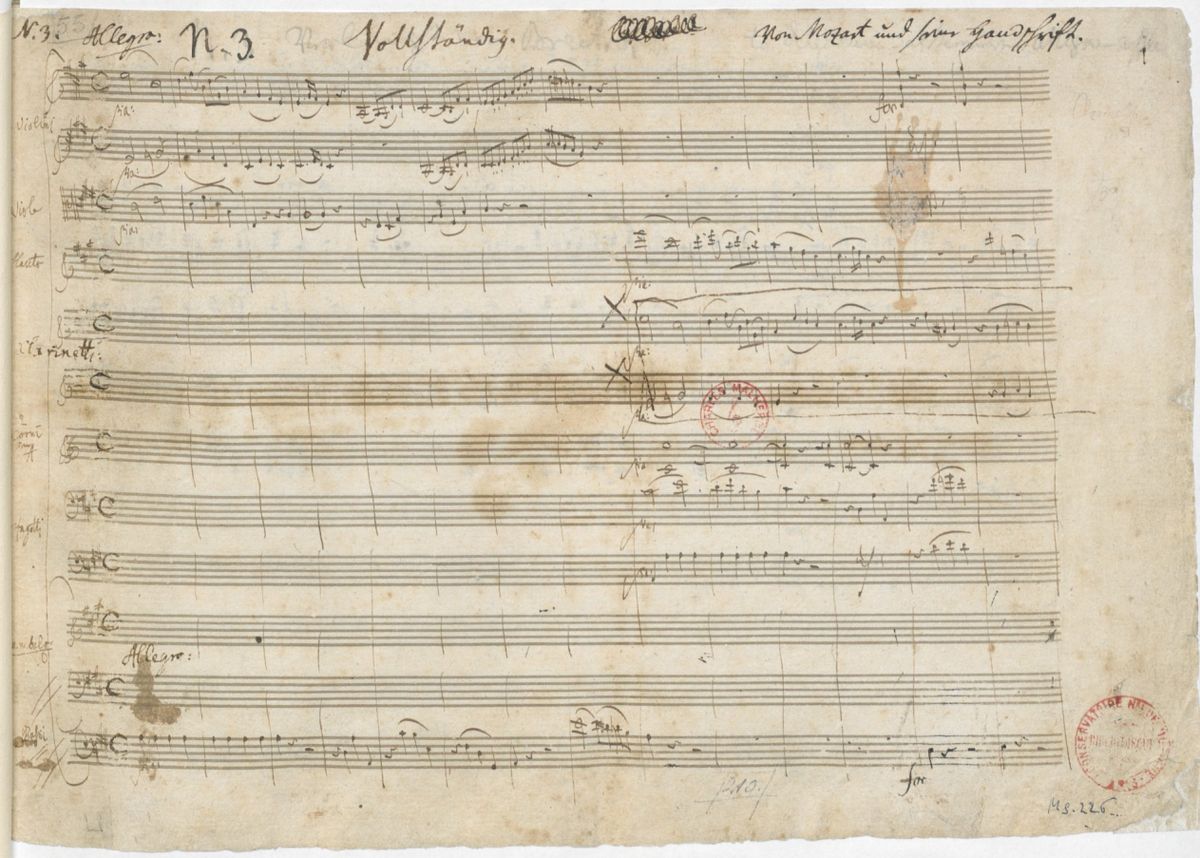
One striking aspect of K. 488 is its mellow, chamber-like orchestration. Mozart scored the concerto for solo piano and an orchestra consisting of:
Flute (1)
Clarinets (2)
Bassoons (2)
Horns (2)
Strings (violins, violas, cellos, double basses)
Notably absent are the oboes, trumpets, and timpani that were common in many Classical-era concertos. By replacing the bright oboes with clarinets and omitting trumpets and drums, Mozart achieved a darker, warmer tonal palette than usual[12][13]. In fact, Concertos 22–24 (all from 1786) were the first of Mozart’s piano concerti to incorporate clarinets at all[12] – the instrument was still something of a novelty in Viennese orchestras. Mozart even appended a note in the score allowing the clarinet parts to be played on violin or viola if no clarinets were available[12]. The woodwinds (flute, clarinets, bassoons) have prominent, soloistic passages and often converse with the piano, heightening the intimate, chamber-music feeling of this concerto[14]. This gentle sonority is particularly showcased in the first two movements, where subtle shades of tone color create an atmosphere of warmth and nuance[13].
Form and Musical Character
Like Mozart’s other concertos, No. 23 follows a three-movement Classical form (fast–slow–fast), with an overall duration of about 25–26 minutes[15]. Each movement has its own character and showcases Mozart’s blend of elegance, expressiveness, and wit:
I. Allegro (A major): The opening movement is an Allegro in A major, written in sonata form with a typical double exposition structure[16]. First the orchestra introduces the principal themes, then the piano enters and presents the themes again with embellishments and modulations. The music is graceful and lyrical, reflecting the “calming” quality Mozart often associated with the key of A major (a key he also chose for his warmly melodic Clarinet Concerto and Quintet)[17]. Despite its generally bright and gallant tone, the movement contains rich thematic development – Mozart even saves a third, new theme for the piano’s solo exposition – and employs chromatic harmonies to add moments of tension and color within the elegant Classical texture[18]. Overall, the first movement balances poise and playfulness, setting a poised yet joyful mood.
II. Adagio (F♯ minor): The second movement provides a profound contrast: it is a slow Adagio in F♯ minor, a very rare key for the 18th century and the only movement Mozart ever wrote in F♯ minor[19]. In fact, this was the last time Mozart used a minor key for a slow movement in any of his instrumental works[19]. The piano begins alone, spinning a plaintive melody in a gentle Siciliano rhythm characterized by unusually wide leaps[20]. The atmosphere is hushed and operatic in tone, as if the piano is singing an aria of sorrow. Throughout this ternary (A–B–A) form movement, the dynamics remain mostly soft, and the interplay between the piano and the muted orchestral accompaniment (especially the clarinets and bassoons) is exquisitely intimate[21]. Commentators often describe this Adagio as one of Mozart’s most poignant and expressive creations, its “poignant and pensive” phrases conveying an almost heart-breaking beauty[22]. In the middle section, the music shifts to A major – a brighter ray of hope introduced by a duet of flute and clarinet[20]. (Interestingly, Mozart later re-used the theme of this A-major interlude to open the trio “Ah! taci ingiusto core!” in his 1787 opera Don Giovanni[20].) After this brief respite, the somber F♯ minor theme returns, and the Adagio closes quietly. The movement’s sustained mood of melancholy lyricism and its richness of feeling were unusual for Mozart’s time, foreshadowing the Romantic era’s expressive depth – one author calls the orchestra’s entrance here “the classical style at its most romantic”[23].
Hélène Grimaud describes Mozart’s A-major concerto as “probably the most sublime concerto Mozart ever wrote,” with the Adagio as “an extremely deep and painful expression of longing, where you find the real Mozart.” Her view has made this concerto one of her signature works. In the video below, Grimaud performs this very Adagio, recorded for her first Mozart album—an interpretation that highlights the intimate, vulnerable character that has made this movement so universally admired.
III. Allegro assai (A major): The finale is a lively Allegro assai in A major, cast as a spirited rondo (specifically a sonata-rondo form)[24]. Its main theme is buoyant and catchy, and it keeps returning, interwoven with contrasting episodes that dart into unexpected keys (at one point even a brief F♯ minor appearance, promptly brightened by a playful clarinet tune in D major[25]). Mozart’s mercurial wit is on full display – the piano and orchestra toss themes back and forth in a game of musical tag, chasing each other through swift changes of mood and key[26]. Despite the movement’s jocular, “send-’em-home-smiling” energy, Mozart still inserts touches of pathos amid the merriment[27]. These fleeting bittersweet moments ensure emotional balance and remind us whose hand is at work – “without which Mozart simply wouldn’t be Mozart,” as one analyst quips[27]. In the end, the rondo races to a joyful conclusion back in A major, eliciting delight from the listener with its brilliant, upbeat finish[26].
Reception and Legacy
Contemporary Reception: Mozart likely premiered the A-major concerto himself in 1786, as part of his Vienna concerts, though specific eyewitness accounts are scarce[28]. There is no record of immediate critical reaction, but the lack of publication during Mozart’s lifetime suggests these late concertos were intended for his personal use and perhaps were not widely circulated at first[8]. By the mid-1780s, Viennese aristocratic audiences had become more interested in opera and other novelty entertainments, so Mozart’s piano concertos (a genre he had practically reinvented in 1784) faced a somewhat muted public appetite[5]. Nonetheless, No. 23 in A major was appreciated by connoisseurs as a work of great beauty and subtleties, even if it did not immediately achieve the popular acclaim of some earlier pieces.
Publication and 19th-Century Revival: The concerto was finally published in 1800[9], and over the 19th century Mozart’s piano concertos gained recognition as foundational masterpieces of the repertoire. Musicians like Hummel and later 19th-century pianists championed these works in concerts. By the late 1800s, artists such as Carl Reinecke were studying and teaching the performance practices of Mozart concertos (for example, how to properly phrase the Adagio)[29]. The A-major concerto’s lyrical Adagio especially drew admiration for its expressive depth – a quality that Romantic-era musicians cherished.
Modern Status: Today, Piano Concerto No. 23 is universally regarded as one of Mozart’s finest concertos, admired for its lyricism, emotional range, and formal perfection[11]. It is a staple of the classical piano repertoire, frequently performed by major pianists and orchestras worldwide. Critics often single out the second movement as a sublime exemplar of Mozart’s genius for expressing deep feeling with utmost simplicity and grace. As one program note put it, each of Mozart’s final Vienna concertos has become “a regular fixture in the classical canon,” and No. 23 in A in particular “stands out as one of the composer’s most intimate and expressive works.”[10] Its blending of concerto brilliance with chamber-music intimacy and operatic warmth continues to enchant audiences.
The enduring impact of this concerto is illustrated by a famous 20th-century anecdote involving Soviet leader Joseph Stalin. In his later years, Stalin heard a live radio broadcast of Mozart’s K.488 (reportedly the Adagio movement played by pianist Maria Yudina) and was so captivated that he demanded a recording of it[30]. Since no recording existed (it had been a live performance), an orchestra was urgently assembled overnight in a studio to record the piece, and the next day a copy was delivered to Stalin[31]. Stalin reputedly rewarded Yudina with a large sum of money for this performance – an ironic twist, as the devoutly religious pianist donated the money to her church and was an outspoken critic of the regime. Apocryphal or not, the story (recounted by composer Dmitri Shostakovich among others) claims that this Mozart concerto was “the last thing [Stalin] had listened to” before he died in 1953[32]. Such legends underscore the almost universal appeal of Mozart’s music: even a dictator known for brutality could be moved by the gentle poignancy of the A-major concerto.
Hélène Grimaud • Mozart: Piano Concerto No. 23 (Adagio) • Radoslaw Szulc & Chamber Orchestra of the Bavarian Radio
Distinctive Features and Interpretive Notes
Piano Concerto No. 23 possesses several unique features that distinguish it within Mozart’s output and the Classical repertoire:
- Unique Key and Emotion: The Adagio’s key of F♯ minor is singular in Mozart’s works – he never wrote another piece in this key[19]. This movement’s depth of feeling, with its sighing motifs and “gothic” passion, challenges the cliché of Mozart’s music as merely light or decorative[33]. In fact, the Adagio’s introspective melancholy has been viewed as proto-Romantic, pointing toward the expressive style of a later era. As one commentator noted, when the full orchestra enters in this movement, it is “the classical style at its most romantic,” creating an “achingly beautiful tapestry” of sound[23][34]. Many listeners find that this concerto, especially the slow movement, reveals a side of Mozart that is heartfelt and profound, disproving any notion that his music lacks emotional depth.
- Woodwind Color and Intimacy: Mozart’s use of clarinets (in place of oboes) and the omission of trumpets/timpani give K.488 a distinct sonic character. The darker, rounder tone of clarinets, combined with intimate exchanges among flute, clarinet, bassoon, and piano, impart a chamber-music intimacy to the work[13]. This was an innovative choice in an era when concertos were often orchestrally extroverted. In K.488, Mozart shows that a concerto can be delicate and conversational rather than purely virtuosic; the winds are true partners to the piano, not mere accompaniment. This balance of instruments creates what one scholar called the “chamber-music feeling” of the piece[13], setting No. 23 apart from Mozart’s earlier concertos.
- Comparative Context: The gentle A-major warmth of this concerto can be contrasted with its famous neighbors. Just weeks after finishing No. 23, Mozart wrote the dramatic C-minor Piano Concerto No. 24, K. 491 (one of only two minor-key piano concertos he composed). The stark difference between the sunny, lyrical No. 23 and the stormy, passionate No. 24 highlights Mozart’s astonishing versatility[7]. Furthermore, Mozart returned to the key of A major in 1791 for his Clarinet Concerto – his last completed instrumental work – which shares a similarly mellow, autumnal quality with Piano Concerto No. 23[7]. It seems Mozart associated A major with a certain tenderness and tranquility, and K. 488 fully embodies that spirit.
- “Wise Old Master” at 30: Although Mozart was still a young man when he wrote this concerto, analysts have often remarked on the maturity of its musical language. The A-major concerto has “all the characteristics of the work of a wise old master, giving the impression of having seen and heard everything and having no regrets,” observes one annotator[35]. Indeed, by 1786 Mozart had assimilated a world of musical influences – from Baroque counterpoint to Italian opera – and in this concerto he displays a masterful control of form, texture, and emotion. There is a sense of effortless wisdom in K. 488: the music speaks with clarity and nuance, never forcing its effects, yet leaving a profound and satisfying impression. Mozart, only 30, managed to channel a lifetime’s worth of artistry into this “gracious” concerto, bridging grace and complexity with apparent ease.
In summary, Mozart’s Piano Concerto No. 23 in A major stands as a gem of the Classical era, blending Mozart’s melodic genius and formal elegance with touches of daring innovation and deep feeling. From its historical context in Mozart’s Vienna to its lasting legacy on concert stages and even in unexpected cultural anecdotes, this concerto offers a fascinating study of Mozart’s art. It was born in a time of personal creativity amid public unpredictability, yet it has transcended its era to become a timeless masterwork – equally appreciated for its intimate beauty and its brilliant craftsmanship. Mozart’s ability to “come up with something new and tantalizing” for the public[6] is vividly affirmed in this concerto, which continues to seduce and delight listeners over two centuries later.
Sources:
Sheet Music
Download and print sheet music for Piano Concerto No. 23 in A from Virtual Sheet Music®.
Sources
Mozart’s autograph and letters; Program notes by Argyle Arts (Chris Myers, 2015)[2][22]; LA Philharmonic program note (Herbert Glass)[36][13]; Wikipedia (Piano Concerto No. 23)[37][20]; Classic FM[11]; New Jersey Symphony insight (M. Rosin, 2019)[23], etc.
[1][4][9][15][18][20][24][25][28][29][37] Piano Concerto No. 23 (Mozart) - Wikipedia
https://en.wikipedia.org/wiki/Piano_Concerto_No._23_(Mozart)
[2][3][10][12][14][16][17][19][21][22][26] Mozart's Piano Concerto No. 23 in A major, K. 488 — Argyle Arts
https://www.argylearts.com/program-notes-synopses/mozart-piano-concerto-23
[5][6][7][8][13][27][30][31][32][35][36] Piano Concerto No. 23 in A, K. 488, Wolfgang Amadeus Mozart
https://www.laphil.com/musicdb/pieces/2762/piano-concerto-no-23-in-a-k-488
[11] Mozart - Piano Concerto No. 23 in A - Classic FM
https://www.classicfm.com/composers/mozart/music/wolfgang-amadeus-mozart-piano-concerto-no23/
[23][33][34] A Unique Side of Mozart: Piano Concerto No. 23 | New Jersey Symphony
https://www.njsymphony.org/news/detail/a-unique-side-of-mozart-piano-concerto-no-23