- Köchel Number
- K9 467 | K6 467
- Genre
- Concertos
- Form
- Piano Concertos
- Key
- C Major
- Date
- 9 March 1785
- Place
- Vienna
- Age
- 29
Mozart’s Piano Concerto No. 21 in C major, K. 467, was completed on 9 March 1785. Its lyrical Andante became associated with the film Elvira Madigan. Explore the concerto’s three movements, orchestral sound and Viennese origins.
Background and Composition Context
Mozart composed his Piano Concerto No. 21 in C major, K. 467, in early 1785 during his highly productive Viennese period. He entered this concerto into his personal catalog on 9 March 1785, just four weeks after finishing the dramatic D minor Concerto (No. 20, K. 466)[1]. The new concerto was written to be performed by Mozart himself at a Lenten season subscription concert in Vienna – a series of public concerts given during the winter of 1785[2]. It was premiered the very next day, 10 March 1785, at the Imperial Burgtheater in a benefit concert for the composer[3].
This period marked the height of Mozart’s fame as a piano virtuoso and composer in Vienna. His father Leopold was visiting the city at the time and witnessed Wolfgang’s intense concert schedule and popularity. Leopold described the “rush and bustle” of daily life: constant teaching, composing, and nightly performances – “every day there are concerts… your brother’s fortepiano has been taken at least a dozen times to the theater or some other house”[4]. The concert at which the C-major Concerto debuted was a major social event, reportedly “well-attended” by Viennese high society[5]. Mozart’s performance “captivated every listener,” establishing him as “the greatest keyboard player of his day,” according to one contemporary account by biographer Franz Niemetschek[6]. The new concerto was also financially successful – Leopold wrote that the concert brought in 559 florins for Mozart[7], a considerable sum. Notably, Mozart was still proofreading and copying parts on the day of the premiere, finishing the score at the last minute[7]. Contemporary reports also mention Mozart using a special fortepiano with an extended pedal-board for added effect in these concerts[8], highlighting his innovative spirit in both composition and performance.
Politically and culturally, Vienna in 1785 was a vibrant center under Emperor Joseph II’s enlightened reforms. Public concerts were flourishing beyond the aristocratic salons, giving freelance composers like Mozart new opportunities[9][10]. In this environment, Mozart produced a series of masterful piano concertos that pushed the genre’s boundaries. Piano Concerto No. 21 in C major is one of several “symphonic” concertos Mozart wrote in 1785–1786, works in which he redefined the piano concerto by treating the soloist and orchestra as more equal partners[11]. This C-major Concerto, coming on the heels of the dark, passionate D minor Concerto, offers a contrasting mood of grandeur and luminosity. As one Mozart scholar (Cuthbert Girdlestone) observed, “the luminous C major exorcises the sombre and daimonisch D minor”, underscoring how Mozart often paired works of opposing character in close succession[12].
Instrumentation
Mozart scored the concerto for a full Classical-era orchestra to accompany the solo piano. The complete instrumentation includes:
Solo piano – written for Mozart’s own fortepiano (with Mozart even employing a special pedal attachment in performance[8])
Strings: first and second violins, violas, cellos, and double basses
Woodwinds: one flute, two oboes, two bassoons
Brass: two horns in C, two trumpets in C (natural trumpets)
Percussion: timpani (in C and G, to reinforce the tonic–dominant axis)
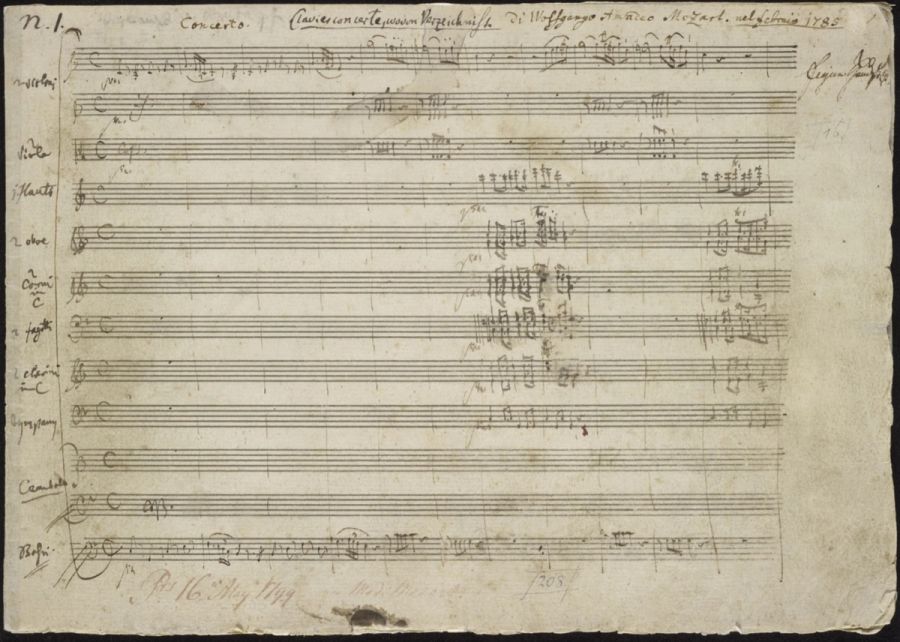
Notably, Mozart did not include clarinets in this work – the first appearance of clarinets in his piano concertos would come in a later concerto (No. 22, K. 482, in E♭)[13]. The choice of C major, plus the use of trumpets and timpani, gives this concerto a bright, ceremonial sonority typical of Mozart’s grand C-major works. The autograph manuscript of K.467 (now held at the Morgan Library in New York) shows Mozart’s own detailed notation of these forces[14].
This video features Yeol Eum Son performing Mozart’s Piano Concerto No. 21 in C major, K.467 during Round II, Phase II of the 2011 Tchaikovsky Competition:
Form and Musical Character
Like most of Mozart’s concertos, No. 21 in C major is in three movements (fast–slow–fast), each with its own character and thematic material[15][16]. Mozart’s piano concertos of this period were groundbreaking in their fusion of concerto brilliance with symphonic depth – the solo piano and orchestra engage in a dynamic dialogue rather than a simple accompaniment relationship[11][17]. The movements are:
- Allegro maestoso (C major) – The first movement opens in restrained C major grandeur. The orchestra introduces a quietly martial march-like theme in unison strings, “whispered” softly by violins and violas[18]. This stately theme soon grows into a vigorous tutti, as woodwinds and brass join to play fanfare figures in a fuller, forte repeat of the march idea[18][19]. The orchestral introduction is notably expansive and symphonic in scope, presenting several thematic ideas: for example, a graceful secondary motif is stated by the woodwinds (a theme that intriguingly “does not emerge again until the end” of the movement)[20]. Instead of a routine outline, Mozart extends the opening tutti – the march theme even returns in a new key and builds again before the soloist enters[21]. When the piano finally enters (after this long buildup), it does so gently, almost “reluctantly,” with delicate new melodic ideas[22]. The piano’s entrance initiates the usual dialogue of exposition, development, and recapitulation as expected in concerto-sonata form. Yet Mozart carries the independence of the two forces remarkably far: the pianist introduces fresh themes and elaborations, while the orchestra responds with its own material, at times giving the sense that “both forces seem concerned with their own material” in parallel[23]. Midway through, Mozart veers into a shadowy G minor passage that foreshadows the theme of his later G minor symphony (No. 40)[24] – an unusually dark detour in an otherwise sunny movement. Ultimately the music finds its way back to C major, and the movement concludes quietly. A short cadenza would be played near the end (Mozart’s original cadenza is lost, so modern performers use later cadenzas or their own)[25]. Overall, this Allegro maestoso balances stately pomp and lyrical playfulness: as one commentator noted, its opening has an “opera buffa-like” comic touch under the surface grandeur[26], yet the structure and scale of the movement are impressively symphonic for its time[27].
- Andante (F major) – The second movement provides a calm, lyrical interlude in the subdominant key of F major. Mozart creates a dreamy nocturne-like atmosphere here[28]. The movement opens with the orchestra (no solo piano yet) playing with muted strings; the violins present a tender melody over a gently pulsing triplet accompaniment in the lower strings[28]. This sublime theme – with its sighing contours and steady heartbeat of triplets – later became famous as the “Elvira Madigan” theme, after its memorable use in a 1967 Swedish film by that name[28][29]. When the piano enters, it picks up the singing melody with “luxuriant ease,” playing expressive arabesques and variations on the theme[28]. The coloristic interplay between piano and orchestra is exquisite: the piano’s line weaves in and around the orchestra, creating “rich and enchanting tints” of sound (in the words of critic Donald Tovey)[30]. Mozart also explores some surprising harmonies in this Andante. At one point the music drifts into an unexpected minor-key tension with dissonant suspensions, so novel that Leopold Mozart thought perhaps the copyist had made mistakes, hearing “wrong notes” that turned out to be intentionally expressive[31]. The overall mood, however, remains serene and heartfelt. The gentle F-major lullaby returns to dispel any darkness, ending the movement in a poised, delicate reverie. (This Andante’s enduring appeal is further shown by its influence on popular culture: for instance, the 1972 pop song “Song Sung Blue” by Neil Diamond was directly based on this melody[32].)
- Allegro vivace assai (C major) – The finale is a brisk rondo, returning to the home key of C major with jubilant energy. It starts without introduction: the solo piano jumps in immediately with a bright, playful theme, which the orchestra then answers in turn[33]. (Mozart actually borrowed this jaunty main theme from one of his earlier works – the Concerto for Two Pianos in E♭, K. 365 – cleverly repurposing it in a new context[34].) The music is spirited and good-humored, maintaining an “opera buffa” feel of comedy and spontaneity[33]. The rondo’s episodes showcase the pianist’s agility with rapid passagework and the orchestra’s lively responses, including fanfare-like tutti outbursts and witty back-and-forth exchanges. There is a carefree, “devil-may-care rambunctiousness” to this finale, with the cheeky main motif always returning to propel the music forward[35]. Despite the movement’s lighthearted, virtuosic surface, Mozart’s craftsmanship is evident in how neatly the rondo is structured and how the themes from piano and orchestra interlock. The concerto concludes with a brilliant coda – a final dazzling run from the soloist and a triumphant closing chord from the full orchestra, bringing this C-major masterpiece to an exuberant close[33].
Reception and Legacy
Mozart’s Piano Concerto No. 21 was warmly received from its very first performance. The premiere on March 10, 1785 – part of one of Mozart’s own sold-out subscription concerts – was a highlight of Vienna’s musical season[5]. The Viennese press and audiences were impressed by Mozart’s dual role as composer and performer. Niemetschek, a Prague-based biographer who documented Mozart’s life shortly thereafter, reported that Mozart’s playing “captivated every listener and established Mozart as the greatest keyboard player of his day.”[6] Leopold Mozart also praised his son’s new concerto, though he remarked that it was “astonishingly difficult” to play[36] – a comment that reflects the work’s technical demands, especially in the quick outer movements. Indeed, No. 21 is considered one of Mozart’s more challenging concertos, requiring a refined balance of virtuosity and elegant restraint. Leopold’s 1785 visit to Vienna, during which he heard this concerto, turned out to be the last time father and son saw each other in person[36], lending a special poignancy to the occasion.
In the years and centuries since its debut, the C-major Concerto K.467 has remained a cornerstone of the piano concerto repertoire. Pianists and scholars often hail it for its perfect blend of sparkling Classical form and deep expressiveness. The piece showcases Mozart’s mature concerto style at its height – a model that would influence later composers (Beethoven, for example, built on Mozart’s concept of an equal partnership between piano and orchestra in his own concertos)[17][37]. The Andante second movement, in particular, attained iconic popularity in the 20th century. Its use in the film Elvira Madigan (1967) introduced this graceful movement to a wide public, to the point that the entire concerto acquired the nickname “Elvira Madigan Concerto.”[29] This nickname, though unofficial, reflects how strongly that lyrical F-major melody has resonated with audiences. Beyond the film, the concerto’s melodies have inspired countless performances, recordings, and even adaptations in other genres (as noted, a pop song and other references).
Critics from the 19th century onward have admired the No. 21 Concerto’s polished beauty – the famed pianist Arthur Schnabel, who recorded it in the 1930s, called it an example of music that is “too simple for children, but too difficult for adults” (highlighting the transparent perfection of Mozart’s writing). Today, Piano Concerto No. 21 in C major is frequently programmed by orchestras worldwide and cherished by performers for its singing lines and virtuosic interplay. Its legacy endures not only as one of Mozart’s most celebrated concertos, but also as a defining work of the Classical era – a piece in which Mozart’s genius for drama, melody, and innovative form shines brightly for all to hear[38][11].
Sources:
Sheet Music
Download and print sheet music for Piano Concerto No. 21 in C from Virtual Sheet Music®.
Sources
Mozart’s own catalogue entry and letters (1785); Program notes from the Indianapolis Symphony Orchestra[5][39]; Sofia Philharmonic program note[40][41]; Los Angeles Philharmonic essay by Orrin Howard[42][43]; Mozart’s Children blog (mozartschildren.wordpress.com)[2][4]; Elbphilharmonie Mediatheque (Juliane Weigel-Krämer)[11][17]; and other historical musicology sources.
[1][15][16][25] Piano Concerto No. 21 (Mozart) - Wikipedia
https://en.wikipedia.org/wiki/Piano_Concerto_No._21_(Mozart)
[2][3][4][8][12][14][19][21] 9 March 1785: the Majestic C Major Piano Concerto | Mozart's Children
https://mozartschildren.wordpress.com/2016/03/09/9-march-1785-the-majestic-c-major-piano-concerto/
[5][6][18][20][23][28][30][31][33][34][36][39] Mozart: Symphony No 21 | Indianapolis Symphony Orchestra
https://www.indianapolissymphony.org/backstage/program-notes/mozart-symphony-no-21/
[7][27][32][38][40][41] Wolfgang Amadeus Mozart – Concerto for Piano and Orchestra No. 21 K.467 – Sofia Philharmonic
[9][10][11][17][37] Mozart's moment - Elbphilharmonie Mediatheque
https://www.elbphilharmonie.de/en/mediatheque/mozarts-moment/624
[13][22][24][26][29][35][42][43] Piano Concerto No. 21, K. 467, Wolfgang Amadeus Mozart
https://www.laphil.com/musicdb/pieces/2760/piano-concerto-no-21-k-467