- Köchel Number
- K9 62 | K6 62
- Genre
- Orchestral Music
- Form
- Dances & Marches
- Key
- D Major
- Date
- Summer 1769
- Place
- Salzburg
- Age
- 13
Mozart’s March in D major, K. 62 is a brief ceremonial procession piece likely intended for Salzburg court or university festivities. This article outlines its scoring and ternary form, its role as an introductory march to a D-major serenade/cassation, and its later reuse with small adaptations in the opera Mitridate, re di Ponto.
Historical Context
In the summer of 1769, Wolfgang Amadeus Mozart – only 13 years old – composed the March in D major, K. 62 in his hometown of Salzburg. This short processional piece, catalogued as KV 62 in the Köchel-Verzeichnis, may at first seem like a minor footnote among Mozart’s works. Yet it offers a vivid window into his early genius and the world he lived in. The march’s bright D-major fanfares and stately rhythms capture the ceremonial atmosphere of its origin, while subtle touches in the music hint at the young composer’s creativity and charm.
Salzburg Ceremonies and Court Life
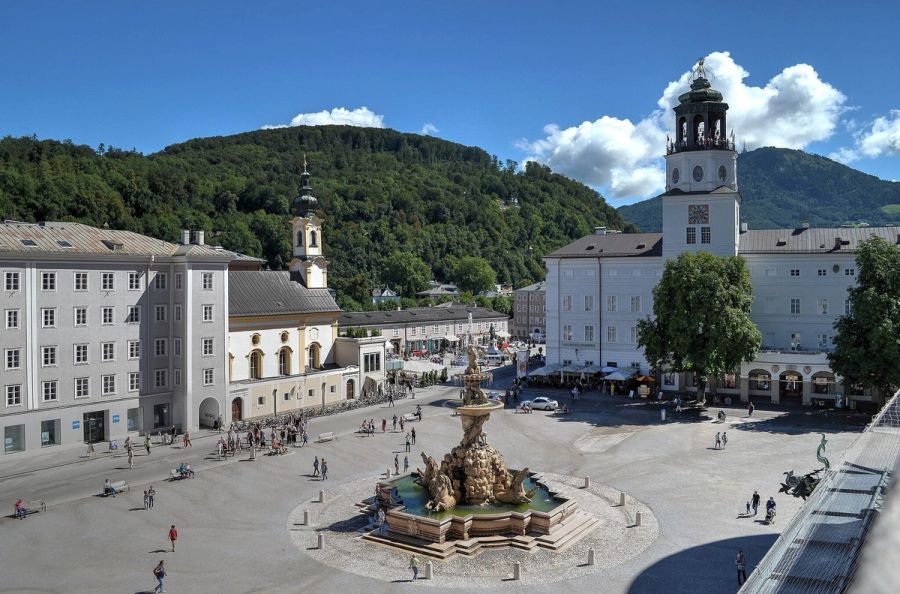
Salzburg in 1769 was a small but vibrant ecclesiastical principality, ruled by Prince-Archbishop Sigismund von Schrattenbach. Music played a central role in court ceremonies, church festivals, and academic celebrations. The March in D, K. 62 was likely created for such an occasion – possibly an outdoor summer ceremony or “Finalmusik” at the University of Salzburg. (In fact, Mozart’s letters and later research suggest that in early August 1769, two of his new serenades were performed to honor graduating students, and this grander D-major work was probably written for a further festivity, perhaps in homage to the Archbishop himself.) In Salzburg tradition, outdoor evening concerts called Cassationen or serenades often began with a marching tune to announce the commencement of the music. Thus, Mozart’s march would have served to literally lead the musicians into the performance space – a musical procession escorting dignitaries and audience to attention. One can easily imagine a summer night in Salzburg, the air filled with the sound of trumpets and drums, as Mozart’s orchestra marched in playing this piece to open the festivities.
(See Cassation in G major, K. 63)
At the time, young Mozart was already employed as the court Concertmaster (he had been appointed concertmaster of the Salzburg chapel in 1769). Composing occasional music like this was part of his duties to the Archbishop’s court. The role of a march in such ceremonies was both practical and symbolic: its steady, proud tread lent a sense of order and splendor to processions, reflecting the disciplined pageantry of court life. Writing a formal march for the Salzburg court was also a learning experience for Mozart, exposing him to the demands of functional yet well-crafted music. Notably, marches and serenades were a family specialty – Mozart’s father, Leopold, had also written similar pieces – so Wolfgang was following in a local tradition even as he began to make it his own.
Musical Analysis: Form, Tonality, and Expression
Mozart’s March in D major, K. 62 is a concise piece scored for a small orchestra of 2 oboes, 2 horns, 2 trumpets, and strings (double-basses likely carrying the bass line, with cellos omitted in outdoor performance). The choice of D major is significant: D major was the traditional key for festive music involving trumpets and drums, due to the natural tuning of those instruments. The march opens with a maestoso character – a bold, ceremonial theme that immediately establishes a confident, jubilant mood. Mozart provides about a minute of this bright opening strain, dominated by regal trumpet fanfares and crisp dotted rhythms in the drums and strings. This main section is repeated in full, underscoring its importance and allowing the listeners to absorb its cheerful grandeur.
Midway, the march turns toward a new minor-key episode – a “trio” or middle section – bringing a slight change in atmosphere. In keeping with classical style, Mozart introduces a hint of drama in this middle section: the key shifts (moving to the relative minor), the texture softens, and the harmony explores darker, “troubled” territory before resolving. This shadowy interlude is brief and tastefully handled, offering contrast without breaking the work’s overall sense of order. Soon the clouds disperse as the march returns to its opening D-major theme, now even more reassuring after the detour through minor. The piece concludes with a confident restatement of the main fanfare, likely capped by a few emphatic chords from the full ensemble (and in the autograph, even timpani were included for extra thunder). The structure thus follows a classic ABA (ternary) form, often found in processional marches and minuets of the period – a bold opening, a contrasting middle, and a return to the beginning, exemplifying clarity and balance.
In terms of expression, the March in D is above all stately and joyous. Its rhythms are steady and martial, designed to keep time for marching feet, yet Mozart infuses the music with melodic charm. The melodic lines (especially in the oboes and first violins) are graceful and hummable, showing the young composer’s knack for catchy themes. Dynamic contrasts – from full tutti outbursts to quieter passages – provide a sense of pageant and drama, appropriate for a ceremony. Compared to some of Mozart’s later marches, K. 62 is relatively simple and straightforward, befitting the light outdoor entertainment genre. Nevertheless, one can already hear Mozart’s touch in the music’s elegant proportions, and the way the minor-key digression adds a gentle emotional depth before a jubilant finish.
When we compare K. 62 to Mozart’s other marches, we see both continuity and growth. Earlier that same year, Mozart had composed a Marche in G major to introduce his Cassation K. 63, which was a smaller piece (without trumpets) and featured busy violin triplet figures and a minor-mode second half. The D-major march K. 62, by contrast, adds the brilliant sonority of trumpets (and drums), making it feel more grand and ceremonial – likely because this was intended for a more high-profile occasion. Mozart would go on to write similar processional marches in later years (for example, the March in D K. 189 in 1773 to open the “Antretter” serenade, and others to precede operas and serenades), each time refining the form. In K. 62 we have one of his earliest essays in this genre: it may lack the fuller complexity of his mature works, but it exemplifies the clarity, balance, and tunefulness of the Classical style that Mozart was already mastering.
(See Cassation in G major, K. 63)
The 13-Year-Old Mozart at Work
In 1769 Mozart was 13 and had just spent much of his childhood touring the courts of Europe as a wunderkind performer. That year marked a return to Salzburg and a period of concentrated composing (he wrote several masses, a German operetta, and his first serenades around this time). It was also the year he received a formal post: in June 1769, the young Mozart was appointed Concertmeister (concertmaster) to the Salzburg court, a position that came with both honor and responsibility. Composing ceremonial music like marches and serenades was part of the training ground for this role. Under the watchful eye of his father Leopold (who was Vice-Kapellmeister), Mozart learned to meet the expectations of his employer – whether writing a solemn mass or a festive march for a graduation ceremony.
Despite his youth, Mozart approached pieces like the March in D with surprising professionalism. The craftsmanship evident in K. 62 – its effective scoring for winds, its confident structure – shows a 13-year-old composer already writing with maturity beyond his years. This was also a time of learning from Salzburg’s musical environment. For instance, the march and its accompanying serenade feature prominent parts for oboe and horn soloists in some movements. It has been suggested that this serenade was Mozart’s first opportunity to write for the virtuoso horn player Joseph Leutgeb, who had recently joined the Salzburg court. (Leutgeb would later become a close friend of Mozart’s in Vienna and inspire his four great horn concertos.) One can imagine young Wolfgang’s excitement at writing music for a talented player like Leutgeb – a challenge that helped him grow as a composer. Likewise, exposure to the works of local composers such as Michael Haydn provided models of how to handle orchestration and form in such light orchestral pieces, which Mozart absorbed rapidly.
(See Serenade No. 1 (Mozart))
Balancing Discipline and Freedom
The March in D, K. 62 mirrors the disciplined world of Salzburg’s court and Mozart’s strict upbringing under his father. Its steady rhythm and formal precision reflect obedience and order—music crafted to serve ceremony and authority. Yet within that structure, Mozart finds space for personal expression and creativity: a graceful melody, an unexpected minor-key turn, a moment of individuality within form. In this balance between discipline and imagination lies the essence of his art. The march embodies Enlightenment ideals of clarity and restraint while quietly revealing a composer already reaching beyond them—a 13-year-old poised between conformity and freedom. The march also embodies the Enlightenment ideals of rationality and balance that shaped Salzburg’s academic and artistic life. For audiences of the time, it projected stability and pride; for Mozart, it was likely a declaration of identity—proof that he could meet official expectations while hinting at a broader, freer musical world.
Reuse in Mitridate
Though brief, the March in D, K. 62 has intriguing links to Mozart’s other compositions, illuminating how he reused and developed musical ideas. Firstly, K. 62 was not an isolated piece – it served as the introductory march to a larger work, the Cassation (Serenade) in D major, of which it was originally a part. This eight-movement serenade (sometimes referred to as Serenade No. 1) is catalogued as K. 100 in older Köchel listings and K. 62a in revised ones[4][5]. Essentially, the march was composed as a preface to this serenade, to be played as the musicians assembled and before the first Allegro movement began. In some versions of the work (when played purely as an indoor serenade or published later), the march was omitted, but in the original outdoor context it was integral – setting the stage with its trumpets and drums. This practice of prefixing a serenade with a march was something Mozart did in other serenades as well, and it underscores how these pieces were intended for open-air celebrations or processions.
A remarkable connection is that Mozart later recycled the March in D for his opera Mitridate, re di Ponto. The opera Mitridate was composed in late 1770 (Mozart was 14) and premiered in Milan that December. In Act I of this opera, there is a regal march used for a ceremonial scene, and Mozart simply borrowed his Salzburg march K. 62 for the purpose. In fact, for many years the score of this standalone march was presumed lost, until scholars realized that the march played in Mitridate was identical to K. 62 from 1769[6]. Mozart made slight adaptations for the opera: the autograph manuscript for the march in Mitridate includes parts for cellos and timpani, instruments that hadn’t been used in the outdoor serenade version (adding cellos enriched the texture for indoor performance, and timpani added theatrical impact)[7]. This clever reuse tells us several things. It shows Mozart’s pragmatism and efficiency – even as a teenager, he was not above repurposing a good piece of music in a new context when time was short. It also speaks to the quality of the march: evidently, he found it fitting for the entrance of a king on the opera stage, meaning K. 62 had the right martial grandeur for a dramatic context beyond its original life. Listeners in Milan, unaware of its Salzburg origin, would have heard it as an effective new composition for the opera. For us today, the double life of this march links Mozart’s early Salzburg output to his burgeoning operatic career in Italy, a bridge between a provincial court and the international opera scene.