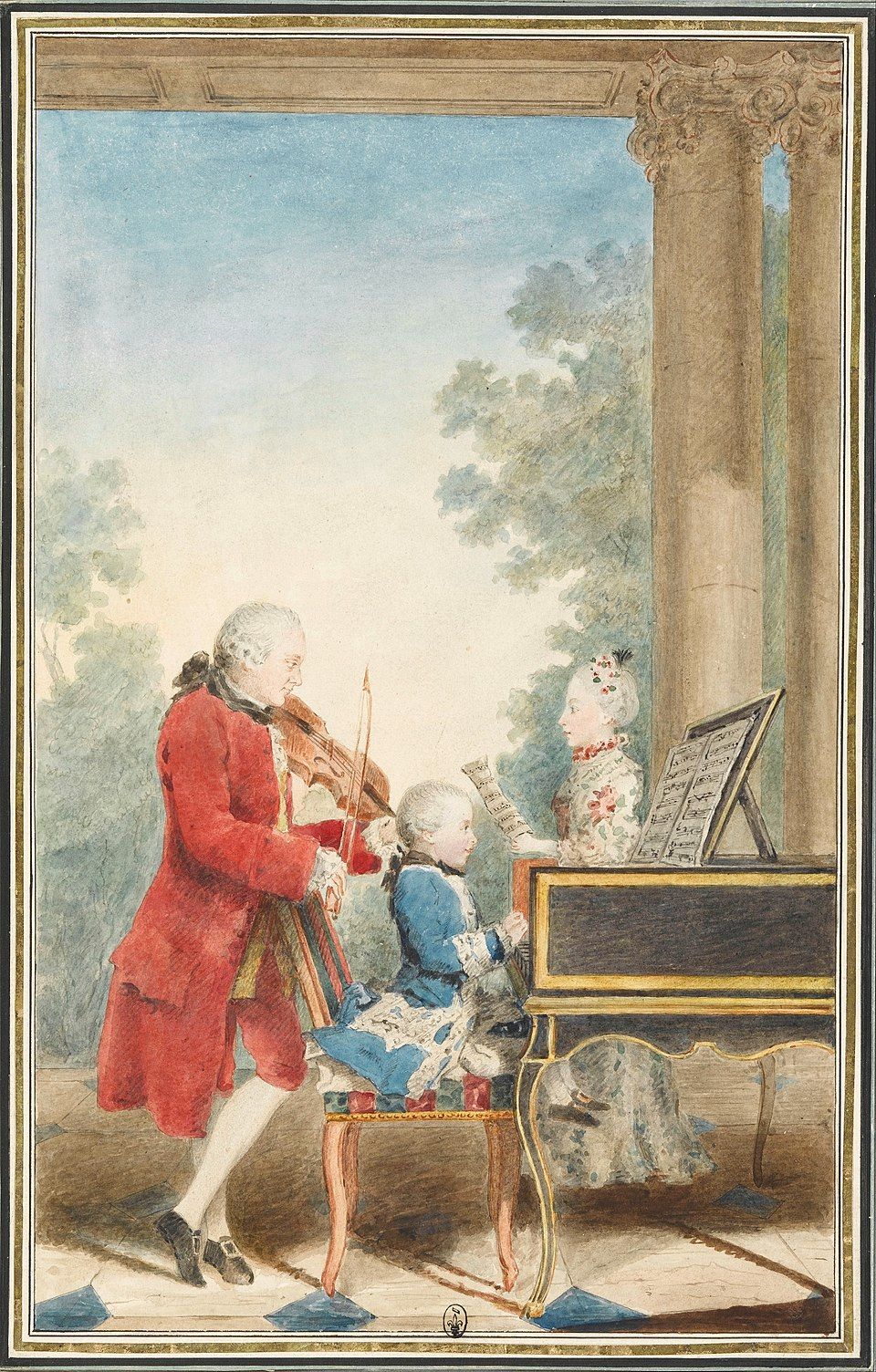
Artur Schnabel, one of the twentieth century's greatest pianists, once said that Mozart's sonatas are "too easy for children, too difficult for artists."¹ He wasn't joking. Mozart's simplest-looking pages are also some of the most mercilessly exposing music ever written. Every note sits in the open — no thick chords to hide behind, no walls of sound to mask a wobbly phrase. And yet: you have to start somewhere. The good news is that Mozart himself left us a trail of breadcrumbs, beginning with music he wrote when he was barely old enough to hold a quill.
A five-year-old's first compositions are now yours to learn
The very first notes Mozart ever composed survive in the Nannerl Notenbuch, a music notebook his father Leopold assembled around 1759 for Wolfgang's older sister, Maria Anna. The young Wolfgang learned from it, then started writing in it — and Leopold, astonished, copied out the boy's earliest efforts in his own hand. Those pieces, catalogued today as K. 1a through K. 5, date from 1761–1762, when Mozart was five and six years old. They are tiny — K. 1a is just ten bars of C major in 3/4 time — but unmistakably musical. The Henle Urtext edition (HN 1236) gathers seventeen of these miniatures at a difficulty level of 1–2 on Henle's nine-point scale, and the ABRSM places several of the early minuets at Grade 1. If you want to play something Mozart actually composed as a child, start here. Read more about the Nannerl Notenbuch
The sonata Mozart called "for beginners"
In June 1788, while simultaneously finishing his Symphony No. 39, Mozart entered a new keyboard work into his personal catalogue with a disarmingly modest label: "Eine kleine Klavier-Sonate für Anfänger" — "a little piano sonata for beginners." That piece is the Piano Sonata in C major, K. 545, now one of the most played sonatas on earth. It wasn't published until 1805, fourteen years after his death, when it appeared under the title Sonate facile. Don't let the name fool you. Henle rates it a level 4–5, and the ABRSM lists it at Grade 6 — firmly intermediate territory. The crystalline scales and Alberti bass patterns demand a poised, even touch, and Mozart sneaks in a sly harmonic trick, opening the recapitulation in the subdominant rather than the expected tonic, that still catches experienced players off guard.² Read more about K. 545
Twinkle, Twinkle — then things get serious
Nearly everyone recognises the melody of K. 265: twelve variations on "Ah, vous dirai-je, Maman," the French folk tune we call "Twinkle, Twinkle, Little Star." Mozart composed it in Vienna around 1781, likely with his own piano students in mind. The theme and opening variations sit comfortably at an intermediate level — Henle rates the set at level 5, and ABRSM includes it at Grade 5. But beware: by the later variations Mozart is in full flight, and the closing Allegro is a genuine showpiece. It's a brilliant piece to grow into. Read more about K. 265
Beyond the keyboard
Pianists don't have a monopoly on approachable Mozart. Violinists traditionally begin with the Concerto No. 3 in G major, K. 216, widely regarded as the most accessible of the five concertos, though "accessible" still means positions one through five and a great deal of musical poise. Clarinettists can look to the Five Divertimenti, K. 439b, whose individual movements appear in the ABRSM syllabus at Grade 5. And flautists will find arrangements of the Menuetto from Eine kleine Nachtmusik (K. 525) at a similar level. In every case, the same paradox applies: the notes may be manageable, but making them sing is another matter entirely.
Where to find the music
For scholarly accuracy, the Neue Mozart-Ausgabe — the critical edition overseen by the Mozarteum Foundation in Salzburg — is freely available online at dme.mozarteum.at. Print players will want the Henle Urtext editions or the approachable Alfred Masterwork volumes, particularly Mozart: First Book for Pianists (edited by Willard A. Palmer), which collects twelve of the easiest original works with helpful editorial notes in grey print. You can explore every piece by its Köchel number in our own Köchel catalogue on Mozart Portal.
The transparency that makes Mozart Mozart
Here is the central truth about "easy" Mozart: the simplicity is the difficulty. Nadia Boulanger put it perfectly — "His admirable clarity exacts absolute cleanness: the slightest mistake stands out like black on white." A Liszt étude can dazzle through sheer velocity; a Mozart minuet has to dazzle through tone, timing, and taste. That's why a ten-bar piece by a five-year-old can still teach you something at any stage of your playing life. Start with the Nannerl Notenbuch. Move to K. 545. Try your hand at the "Twinkle" variations. The notes will come quickly. Making them sound like Mozart — that's the work of a lifetime, and the best reason to begin.
Sources
¹ Artur Schnabel, quoted in Nat Shapiro (ed.), *An Encyclopedia of Quotations About Music* (New York: Da Capo Press, 1978). The remark is also recorded by Oxford Reference.
² The subdominant recapitulation in K. 545 is discussed in Charles Rosen, *The Classical Style* (New York: W. W. Norton, rev. ed. 1997), p. 52, and in the critical notes of the Henle Urtext edition (HN 164, ed. Ernst Herttrich).