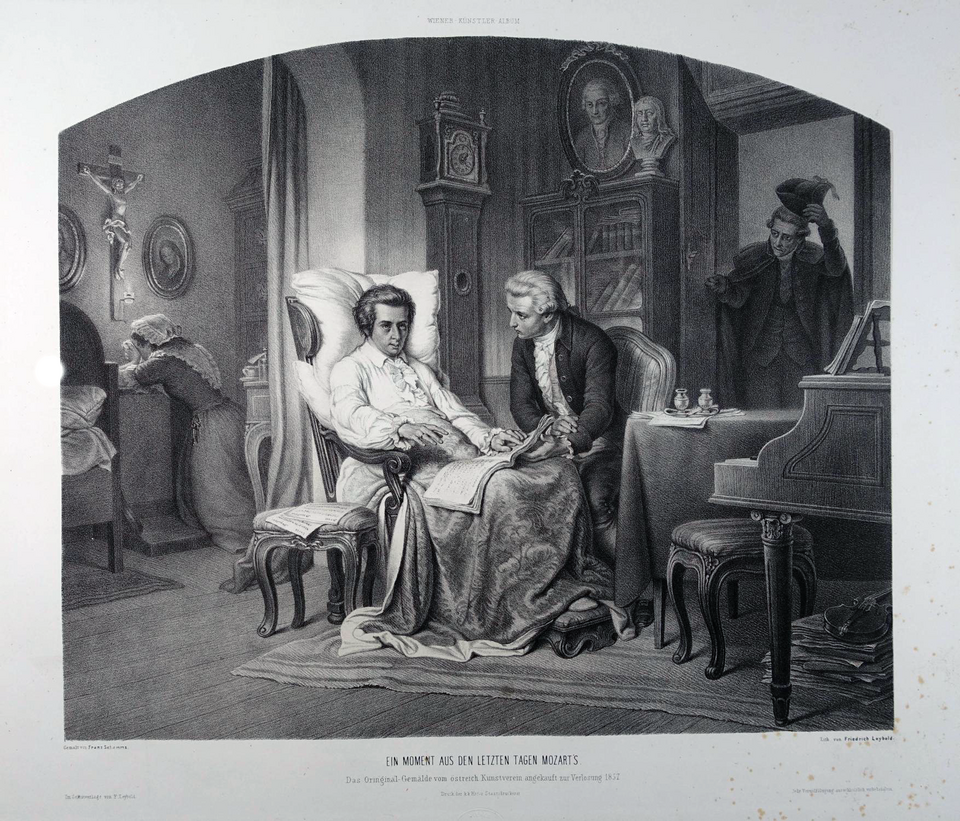
Wolfgang Amadeus Mozart wrote his first piece at age five — a tiny Andante scribbled into his sister Nannerl's music book by his father Leopold, because the boy hadn't yet learned to write notation himself. Thirty years and over 600 compositions later, he died mid-sentence in the Requiem, K. 626, quill practically still in hand. Everything in between — the operas, the symphonies, the sonatas, the concertos — lives on today as sheet music played by millions, from conservatory students to weekend hobbyists sight-reading at the kitchen piano.
He composed in his head, then simply hit "print"
Mozart's original manuscripts are shockingly clean. Where Beethoven's scores look like a crime scene — crossed-out bars, ripped pages glued back together, ink blots of pure rage — Mozart's pages are neat, precise, and virtually free of corrections. He reportedly told those who asked that music was already complete in his mind before he wrote a single note; the manuscript was merely the final step.
The Don Giovanni overture captures this gift at its most extreme. Mozart recorded the completion of the full opera on October 28, 1787 — the night before the Prague premiere.¹ He composed the overture through the night while his wife Constanze kept him awake with stories, and the orchestra sight-read the whole thing at the Estates Theatre the following evening. The audience loved it.
From subscription concerts to your music stand
During his lifetime, Mozart didn't wait for royalties — they barely existed yet. Instead, he hustled. He sold subscriptions to his own concert series in Vienna, premiering new piano concertos and pocketing the proceeds directly. He struck deals with the Viennese publisher Artaria & Co. and wrote pieces specifically for wealthy piano students — at least two concertos were tailored for his pupil Barbara Ployer.
Navigating his vast output today is straightforward thanks to Ludwig von Köchel, who in 1862 published the first scholarly catalogue of Mozart's works. That is why every piece carries a "K." number. Browse all 600+ works in our Köchel catalogue
Why it looks easy but isn't
The pianist Artur Schnabel captured the central paradox: "The sonatas of Mozart are unique; they are too easy for children, and too difficult for artists."² The notes on the page look sparse compared to a Beethoven or Brahms score. But that transparency is exactly the problem — there is nowhere to hide a fumbled note or a lazy phrase. Every scale must shimmer, every melody must sing, and you cannot bury mistakes in sustain pedal. Pianist Alfred Brendel put it simply: in Mozart, "everything counts."
Finding the right edition
Serious players generally choose between two Urtext publishers: Henle, known for clean engraving and practical fingerings, and Bärenreiter, publisher of the authoritative Neue Mozart-Ausgabe. Both go back to Mozart's original manuscripts rather than adding editorial markings of their own. Read our full guide: Henle vs. Bärenreiter — Which Mozart Edition Should You Buy?
For beginners, the Piano Sonata in C major, K. 545 — which Mozart himself labelled "for beginners" — is the classic starting point. The Rondo alla Turca from Sonata K. 331 is the eternal crowd-pleaser. And Mozart wrote landmark repertoire for nearly every instrument: five violin concertos, a celebrated Clarinet Concerto (K. 622) written for his friend Anton Stadler, two flute concertos, and 27 piano concertos that form the backbone of the instrument's repertoire.
His music started in a child's notebook. It ended in an unfinished prayer for the dead. In between, Mozart filled more pages with more invention per measure than almost any composer in history — and every one of those pages is still waiting to be played.
Explore further
Sources
¹ Mozart's own thematic catalogue, as cited in Otto Erich Deutsch, *Mozart: A Documentary Biography* (1965), pp. 302–303.
² Artur Schnabel, quoted in Nat Shapiro (ed.), *An Encyclopaedia of Quotations About Music* (1978); also cited in *Oxford Reference* (Oxford University Press).