Piano Concerto No. 1 in F
볼프강 아마데우스 모차르트 작
Background and Composition Context
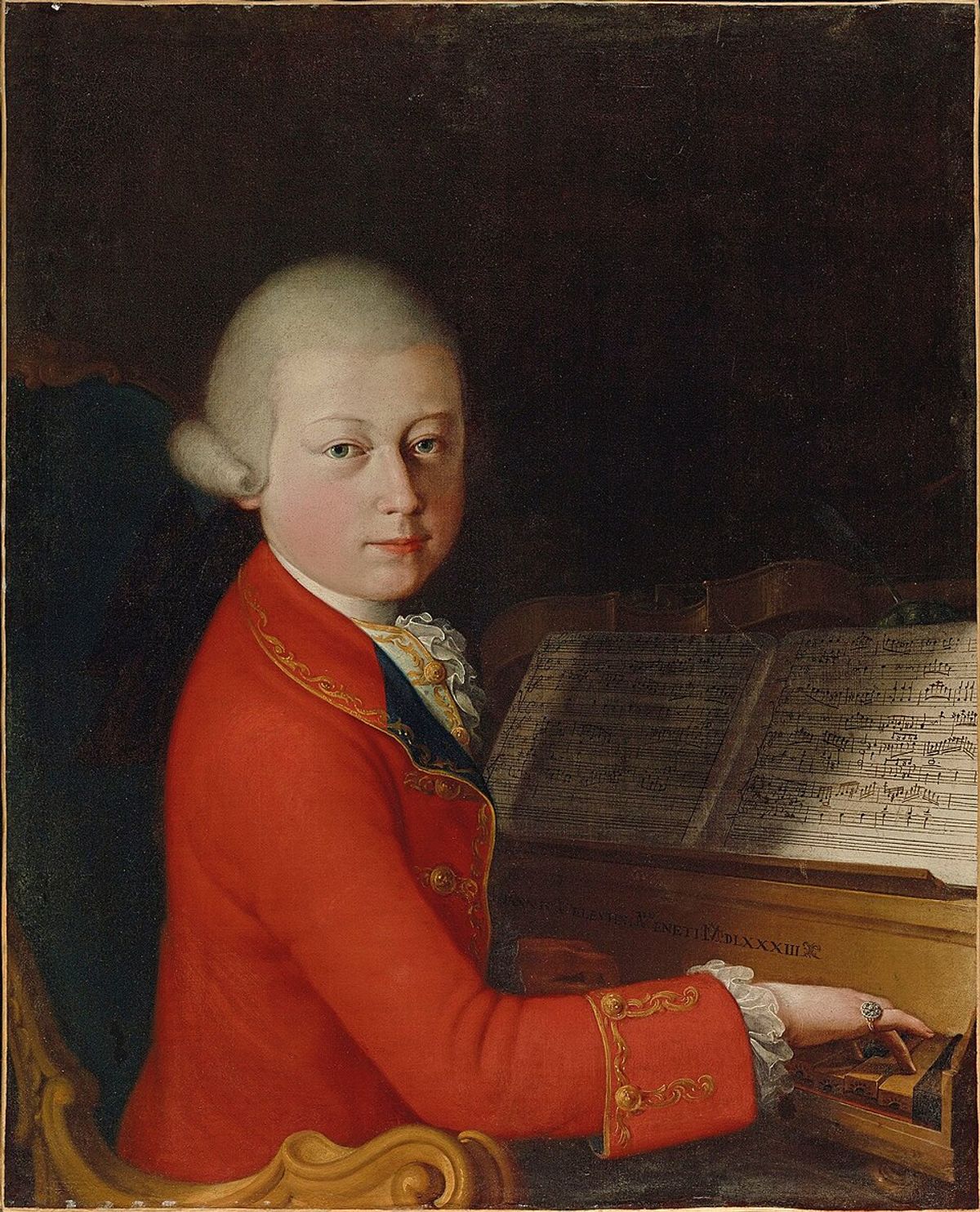
Wolfgang Amadeus Mozart composed his first keyboard concerto – Piano Concerto No. 1 in F major, K. 37 – in 1767 at the age of 11. His family had just returned to their hometown of Salzburg in late 1766 after a grand tour of Europe that lasted over three years[1]. In Salzburg, young Mozart was immersing himself in composing larger works; 1767 saw him produce his first oratorio and a Latin opera for school, alongside a set of four keyboard concertos (K. 37, 39, 40, 41)[2]. These concertos were not entirely original creations, but rather pasticcios – arrangements of movements from other composers’ sonatas that the Mozart family had encountered during their European travels[3][4]. Leopold Mozart, Wolfgang’s father, likely devised this project as a teaching exercise to help the prodigy learn the structure of concertos[5]. In fact, Leopold did not include K. 37 and its sibling works in his 1768 catalog of Wolfgang’s works, suggesting he did not count them as fully independent compositions by his son[6]. Surviving manuscripts confirm that father and son both had a hand in writing down these concertos[6]. The first concerto’s autograph was completed in April 1767[7], and Mozart probably intended it for his own performance on the harpsichord (the instrument he was famed for as a child prodigy). At that time, Europe was in the midst of the Enlightenment and the Classical era in music. The keyboard concerto was rising in popularity as a vehicle for composer-performers, evolving from Baroque models into the lighter Galant style championed by composers like Johann Christian Bach and Carl Philipp Emanuel Bach[8]. Young Mozart’s family had met J. C. Bach in London years earlier, and they had collected published sonatas by various German composers during their Paris visit in 1763–64[9] – sources that now provided the thematic material for K. 37. Thus, Mozart’s first concerto emerged from a cosmopolitan musical backdrop, even as everyday life had its perils: in late 1767, a smallpox epidemic struck the region, and the 11-year-old Mozart himself contracted the disease (he fortunately survived)[10]. Despite such turbulence in the wider world, the young composer pressed on with music, using this concerto to bridge his early experiences as a performer with his budding skills as a composer.



As an Amazon Associate we earn from qualifying purchases.
Instrumentation and Orchestration
Mozart scored Piano Concerto No. 1 for a small Classical-era orchestra suitable for an intimate court or salon performance. The score calls for two oboes, two horns in F, a solo keyboard (piano or harpsichord), and a string section[11]. (The oboes are tacet in the slow middle movement, a common practice of the time to soften the texture)[11]. In Mozart’s day the term “piano” concerto was often realized on the harpsichord, since the fortepiano was only gradually coming into use; indeed, contemporary records label K. 37 as a concerto for harpsichord and orchestra[2]. The inclusion of horns and oboes provided harmonic depth and reinforcement of the strings, but the overall ensemble is modest compared to Mozart’s later concertos. Notably, there are no clarinets, trumpets, or timpani – these would appear in Mozart’s more mature works. The continuo practice of the 1760s meant the solo keyboard likely played along with the ensemble in accompanying sections (acting as a continuo instrument) and then emerged prominently during solo passages. Modern scholarship has shown interesting details of Salzburg performance practice: for example, original performing parts suggest that cellos were not always used as a separate voice (bass lines were often covered by double basses and harpsichord)[12]. Overall, the orchestration of K. 37 is typical of the galant style – simple and elegant, supporting the keyboard without overwhelming it, and well-suited to the light, transparent sound of period instruments.
Form and Musical Character
Structure: Piano Concerto No. 1 follows the standard three-movement fast–slow–fast format that Mozart would use in all his concertos. The movements are:
Allegro (F major, 4/4 time) – a bright opening movement in sonata-allegro form[13]
Andante (C major, 3/4 time) – a gentle slow movement[13]
Allegro (F major, 3/4 time) – a light, quick finale[13]
Each movement of K. 37 is based on pre-existing music. The first movement borrows its thematic material from a 1756 Paris-published sonata by Hermann Friedrich Raupach (Op. 1, No. 5), originally a keyboard and violin piece[4]. Mozart (with Leopold’s guidance) adapted this sonata movement into concerto form – likely adding an orchestral introduction (tutti) and brief transitions to accommodate dialogue between soloist and orchestra. The second movement’s origin is unknown; it does not match any identified work by other composers. Interestingly, musicologist Eric Blom long ago speculated that this Andante might actually be an original Mozart creation[4]. Modern scholars tend to agree that the slow movement is possibly Mozart’s own, making it one of the earliest examples of his melodic voice[14]. The finale draws from another contemporary composer: it uses the first movement of Leontzi Honauer’s Op. 2, No. 3 sonata as its basis[4]. By stitching these sources together, the concerto exhibits a patchwork of mid-18th-century musical ideas.
Musical style: The character of K. 37 is firmly rooted in the mid-1760s galant/classical idiom. The music is pleasant and balanced, with clear two- and four-bar phrases and straightforward harmonies. Because Mozart was arranging others’ themes rather than inventing his own, the concerto lacks the profusion of thematic ideas that we associate with his later works. In fact, compared to Mozart’s mature concertos – or even to the contemporary concertos of J. C. Bach – No. 1 in F major is a slight work in terms of substance[15]. The orchestral ritornellos (the orchestral introductions and interludes) that Mozart added are simple and don’t introduce many new melodies[16]. Likewise, the development sections remain brief and do not venture far afield; the young composer at this stage did not elaborate on themes or modulate as adventurously as he would later. The boundary between the keyboard’s role as soloist and as continuo accompaniment is sometimes blurry in this concerto[16] – a reflection of Mozart learning how to handle the interplay. Nevertheless, listeners can detect hints of Mozart’s budding craftsmanship. The overall proportions of the movements (how long each section lasts relative to others) are roughly in line with the formal balance he would later master, just on a smaller scale[17]. The first movement Allegro, for example, presents a cheerful principal theme in F major followed by a graceful secondary theme, and follows the expected sonata-concerto pattern albeit in miniature. The Andante in C major provides a charming contrast, with a singing, simple melody (possibly Mozart’s own) that foreshadows the lyrical slow movements he would excel at. The final Allegro, in a sprightly 3/4 meter, has a carefree, dance-like quality – one might even hear echoes of a minuet or contredanse in its rhythm – bringing the concerto to a polite close. In sum, the musical character is youthful, tuneful, and unpretentious, offering a snapshot of Mozart assimilating the styles of his day.


As an Amazon Associate we earn from qualifying purchases.
Comparisons with Later Concertos and Contemporary Works
Mozart’s First Piano Concerto stands in stark contrast to the great piano concertos he would compose in his late teens and especially in the 1780s. K. 37 and the other Salzburg “apprentice” concertos (Nos. 1–4) were essentially training pieces; by comparison, Mozart’s first fully original piano concerto came five years later with the Concerto No. 5 in D major, K. 175 (written in 1773 when he was 17)[18]. That later concerto – and others that followed – show far more originality and complexity. For instance, in K. 37 the orchestration is sparse and the keyboard predominantly outlines the borrowed themes, whereas in Mozart’s Viennese concertos (such as the famous No. 20 in D minor or No. 21 in C major) the piano engages in a rich dialogue with a full orchestra (including woodwinds, and often trumpets and drums)[8][19]. The early F-major Concerto uses only a couple of simple themes per movement, while Mozart’s later concertos typically offer a wealth of thematic material – multiple contrasting melodies, inventive developments, and virtuosic cadenzas[16]. In K. 37 the form is straightforward and the solo part is relatively uncomplicated (suitable for an 11-year-old’s technique), lacking the brilliant passagework and dramatic contrasts of his mature style.
It is also insightful to compare K. 37 with works by Mozart’s contemporaries. The overall form of K. 37 mirrors the standard practiced by composers like Johann Christian Bach, whom Mozart knew and admired. J. C. Bach’s own keyboard concertos of the 1760s (and the sonatas upon which some early Mozart concertos are based) were models of the galant concerto style – elegant and melodious, but generally richer in original content than Mozart’s derivative first efforts[15]. In fact, Mozart would later arrange three sonatas by J. C. Bach as keyboard concertos (K. 107 in 1772) as a further exercise in assimilating that style. Compared to C.P.E. Bach’s expressive and bold keyboard concertos or Haydn’s concertos, Mozart’s K. 37 is more modest and conservative, sticking to pleasant musical ideas from his sources. This is not to say it lacks charm – the concerto reflects the taste of its era well – but it does underscore how far Mozart’s artistry evolved in the ensuing years. By the time he wrote his celebrated Piano Concerto No. 9 “Jeunehomme” in 1777 (K. 271) or the dozen masterful concertos in Vienna (1784–1786), he had transformed the genre, making the piano concerto a vehicle for deep expression and innovation that goes well beyond the polite simplicity of K. 37.
Modern scholarly and performance perspectives help put K. 37 in context. Musicologists now describe Mozart’s first four concertos as “arrangement concertos” or “childhood arrangements,” emphasizing that they were collaborative products of Mozart and his father drawing on pre-existing works[3][20]. As the historian Cliff Eisen notes, “even as an 11-year-old in 1767, the idea of a concerto may have presented a thorny problem for him… It is fair to say that these are not Mozart’s concertos exclusively but rather a joint effort by father and son”[14][20]. Performers have likewise treated these juvenilia differently. Some historically-informed orchestras and pianists long bypassed K. 37–41 entirely in Mozart concerto cycles, effectively beginning with the first original concerto K. 175[21]. (For example, certain recordings by Jos van Immerseel or Malcolm Bilson omit the pasticcio concertos, starting at No. 5[21].) However, recent decades have seen renewed interest in these early works. Scholars prepared critical editions that tease apart the contributions of Mozart versus the source composers, and performers have recorded K. 37 using period instruments to approximate its original sound. A notable example is pianist-scholar Robert Levin, who recorded Concertos 1–4 with Christopher Hogwood’s Academy of Ancient Music: Levin even chose a two-manual harpsichord as the solo instrument to match what Mozart himself likely used in Salzburg[22]. Such performances, with their historically-informed tempi, embellishments, and improvised cadenzas, cast new light on the concerto’s delicate charm. Listeners and critics have found that when approached on its own terms, this little F-major concerto can be “delivered in breathtakingly vibrant, natural sound” and offer a satisfying musical experience, even if it remains more apprentice-work than masterpiece[22][23].

As an Amazon Associate we earn from qualifying purchases.
Reception and Legacy
Because of its nature as a reworking of others’ music, Mozart’s Piano Concerto No. 1 in F major was not widely circulated or celebrated in the years immediately after its creation. There is no record of a high-profile premiere; it was likely performed by the young Mozart either in private salons or informal court settings in Salzburg (possibly for his patron, Archbishop Sigismund Schrattenbach). Leopold Mozart’s omission of K. 37 from his son’s official work list in 1768 implies that even the Mozarts regarded it more as a learning tool than as a significant opus[6]. Throughout the 19th and early 20th centuries, these early concertos remained relatively obscure. For a long time, scholars actually believed K. 37 was an original composition by Mozart, albeit a juvenile one. It was only in the mid-20th century that research identified the concerto’s true sources and clarified its pasticcio nature[3]. This reclassification slightly diminished the work’s stature in the Mozart canon – it’s now understood as a curious stepping stone in his development rather than an independent stroke of genius.
In modern times, K. 37 is rarely performed in concert compared to Mozart’s mature concertos, which are staples of the repertoire. When the early F-major concerto is heard, it is often in the context of complete recordings of Mozart’s concertos or special programs focusing on Mozart’s childhood. That said, K. 37 has found its champions. Historically informed performance groups have shown that, with the right approach, the piece can sound graceful and charming. Critics have noted that Robert Levin’s harpsichord rendition, for example, brought out the music’s authentic character and made a strong case for its musical validity[22]. The concerto’s legacy ultimately lies in what it taught Mozart: by grappling with the structure of a concerto at age 11, he laid the groundwork for the groundbreaking piano concertos he would compose later. Music historians often point to these first four concertos as evidence of Mozart’s extraordinary learning curve – one can trace the path from the simplistic elegance of K. 37 to the confident originality of works like the Piano Concerto No. 9 in E♭ major (K. 271) in just a decade. Thus, while Piano Concerto No. 1 in F major, K. 37 may not stand among Mozart’s great masterpieces, it is valued for its historical significance. It provides a window into Mozart’s childhood environment: a world of Enlightenment-era tastes, of a talented boy absorbing the musical language of his elders, and of a father guiding his prodigious son through compositional exercises. Today, K. 37 is appreciated as a delightful early-classical concerto in its own right and as the first milestone in Mozart’s long and legendary journey as a composer[15][24].


As an Amazon Associate we earn from qualifying purchases.
Sources
Mozart’s Piano Concertos Nos. 1–4 (background and analysis)[3][4][25]
AllAboutMozart – “Mozart in 1767” (context of Mozart’s life and works that year)[26]
Naxos & ProperMusic notes (Mozart’s early concertos and instruments)[8][19]
ClassicsToday review of Robert Levin recording (scholarly insights and performance practice)[14][24]
PragueClassic (Mozart’s 1767 smallpox and travel)[27]
Juilliard Music Store (K.175 as first original concerto)[18]
Wikipedia: Mozart and smallpox[10], Piano Concerto No.1, K.37 (details of scoring and sources)[11][4]
[1][2][26] Mozart in 1767 : a playlist | All About Mozart
https://allaboutmozart.com/mozart-1767/
[3][4][5][6][7][9][11][13][15][16][17][25] Piano Concertos Nos. 1–4 (Mozart) - Wikipedia
https://en.wikipedia.org/wiki/Piano_Concertos_Nos._1%E2%80%934_(Mozart)
[8][19] Jando Co: MOZART: Piano Concertos Nos. 12, 14 and 21 – Proper Music
[10] Mozart and smallpox - Wikipedia
https://en.wikipedia.org/wiki/Mozart_and_smallpox
[12][14][20][21][22][23][24] Mozart: Piano concertos 1-4/Levin - Classics Today
https://www.classicstoday.com/review/review-6112/
[18] Mozart Concerto for Piano and Orchestra Nr. 5 D major K. 175, K. 382 R
[27] Wolfgang Amadeus Mozart | Prague Classic