- Köchel Number
- K9 49 | K6 47d
- Genre
- Sacred Music
- Form
- Masses & Requiem
- Key
- G Major
- Date
- October–November 1768
- Place
- Vienna
- Age
- 12
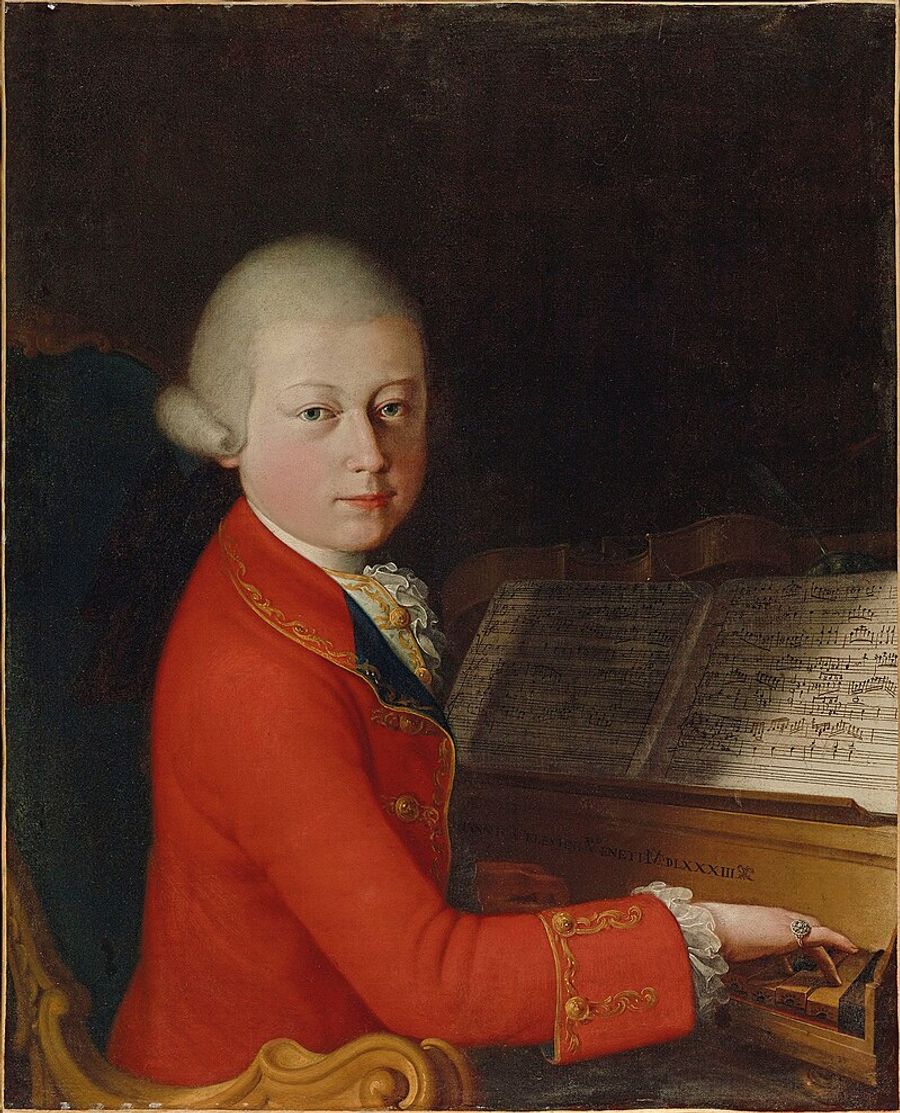
Mozart’s Missa brevis in G major (K. 49) was composed in Vienna in late 1768, when the composer was just twelve years old. Often overshadowed by later Salzburg masses, it nonetheless offers a remarkably concentrated glimpse of Mozart learning to write for the liturgy—succinct, practical, and already theatrically alert.
Mozart’s Life at the Time
In 1768 Wolfgang Amadeus Mozart (1756–1791) was living with his family in Vienna, a city whose ecclesiastical and theatrical musical worlds stood in close proximity. At twelve he was no longer merely the “wonder child” displayed at courts, but a rapidly maturing composer trying on adult genres—sacred music included. The Missa brevis in G major, K. 49 belongs to this Viennese period in which Mozart also produced other substantial church works, and it stands as his first complete setting of the Mass Ordinary [1].
The work’s modest scale is not a sign of modest ambition: rather, it reflects the practical constraints of Catholic worship, where a missa brevis (“short mass”) was valued for textual clarity and manageable duration. What makes K. 49 worth attention today is precisely this discipline—Mozart compresses a multi-movement liturgical form into a fluent, youthful argument that rarely wastes a bar.
Composition and Manuscript
The Köchel-Verzeichnis places the Mass in G (K. 49) in Vienna, dated to November–December 1768 [2]. It survives as a securely transmitted early mass, and it is routinely treated as part of Mozart’s authentic juvenile sacred output.
Performing materials circulate widely, not least because the score has long been available in public-domain editions and modern reprints (including scans accessible through IMSLP) 3(https://imslp.org/wiki/Missa_brevis_in_G_major%2C_K.49/47d_%28Mozart%2C_Wolfgang_Amadeus%29. For choirs, K. 49 is attractive in a practical sense: it is a complete Mass with relatively economical demands, yet it still offers distinct soloistic moments and sharply characterized contrasts.
A small but telling scoring detail has drawn repeated comment: this is Mozart’s only missa brevis to include a separate viola part, enriching the inner texture beyond the more typical “church trio” string disposition of two violins and bass line [1].
Musical Character
K. 49 sets the customary Mass Ordinary sections (Kyrie, Gloria, Credo, Sanctus, Benedictus, Agnus Dei) in a style that mixes liturgical directness with flashes of theatrical instinct. One hears Mozart negotiating an 18th-century tension: sacred music was increasingly influenced by operatic and late-Baroque instrumental color, yet church authorities and local custom often preferred restraint. Commentators have even read Mozart’s earliest masses, including K. 49, as leaning toward a comparatively “austere” approach relative to more flamboyant contemporary church writing [1].
Musically, the work’s chief distinction lies in how quickly it establishes clear affects and then moves on—especially in the long texts (Gloria and Credo), where the composer must balance comprehensibility with momentum. The inner parts (helped by the viola’s presence) frequently do more than fill harmony: they stabilize cadence points and give the choral writing a slightly weightier, more “architectural” profile than one might expect from a twelve-year-old.
In sum, the Missa brevis in G, K. 49 deserves a place in Mozart’s story not as a miniature of later achievements, but as an early proof of professional competence: a child composer writing “to time,” to text, and to function—while still allowing musical personality to show through.
Sources
[1] Wikipedia: overview, dating, movements, and the often-cited note that K. 49 is Mozart’s only missa brevis with an independent viola part
[2] Köchel-Verzeichnis (Mozarteum): catalog entry for KV 49 with place, date range, and key
[3] IMSLP: score/parts availability and publication details for Missa brevis in G major, K. 49/47d