- Köchel Number
- K9 47b | K6 47b
- Genre
- Sacred Music
- Form
- Smaller Church Works
- Key
- C Major
- Date
- October–November 1768
- Place
- Vienna
- Age
- 12
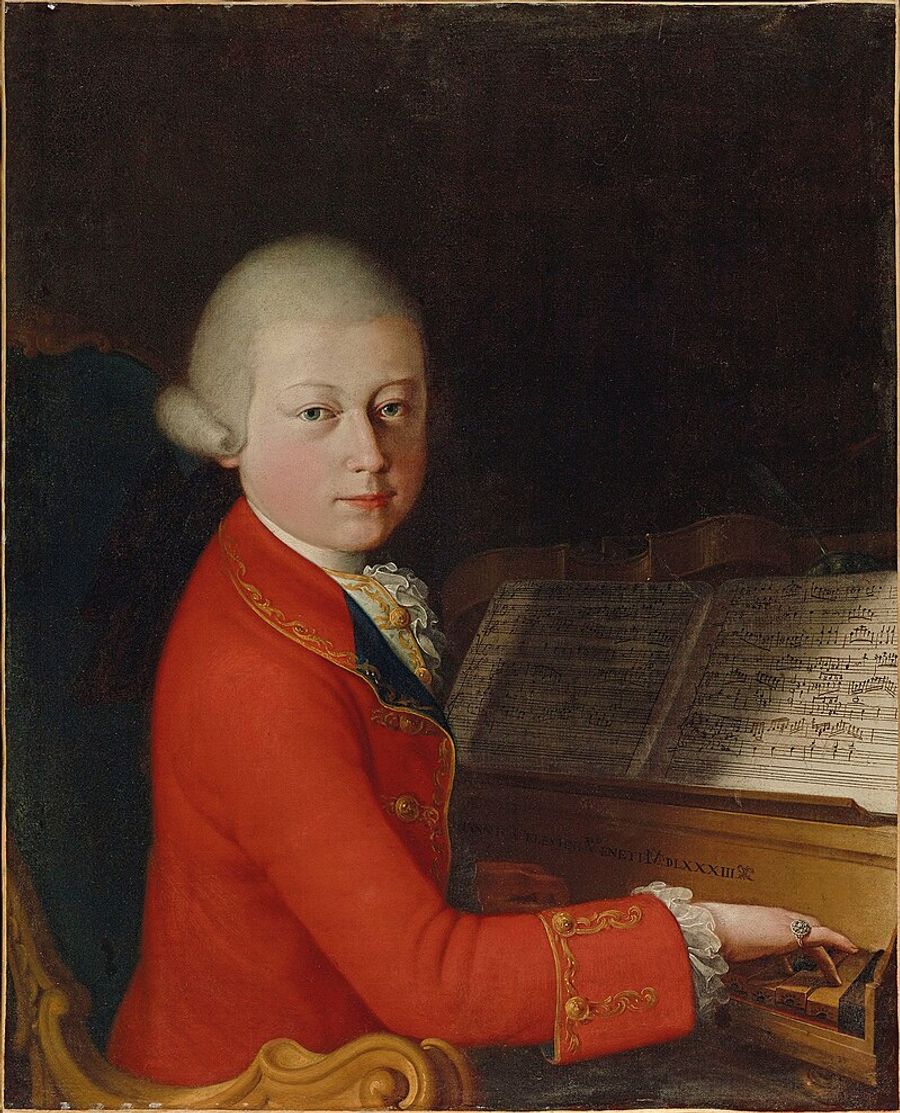
Mozart’s Offertorium “Benedictus sit Deus” (K. 47b) is traditionally placed in Vienna in 1768, when the composer was twelve, but it survives in an uncertain documentary state and has long been treated as a lost work of doubtful authenticity. Some later research has proposed that K. 47b may in fact be identical with an extant offertory transmitted as K. 117 (66a), complicating both dating and attribution.[1]
Background and Context
Wolfgang Amadeus Mozart (1756–1791) spent much of 1768 in Vienna with his family, a period that also produced several substantial sacred works, including the Waisenhausmesse (Missa solemnis in C minor, K. 139/47a) and the Offertory Veni Sancte Spiritus, K. 47.[2][3] Within that Viennese context, catalogues record an Offertory in C major titled “Benedictus sit Deus,” K. 47b—yet without a surviving score in the traditional sense, and with the additional complication that its authenticity is often regarded as doubtful.
One strand of modern editorial and performance tradition connects this “lost” K. 47b to the extant Benedictus sit Deus transmitted as K. 117 (66a), which survives with an autograph source in the Staatsbibliothek zu Berlin and is published in the Neue Mozart-Ausgabe.[4] On this view, K. 47b is less an unknowable fragment than a shadow-entry for a work otherwise preserved under another Köchel number—though scholars have continued to disagree about whether the composition belongs in Vienna (1768) or Salzburg (1769).[5]
Musical Character
If K. 47b is taken as identical with the extant Benedictus sit Deus (K. 117/66a), it is a compact offertory in C major for soprano solo and mixed choir (SATB) with orchestra and organ—essentially a festive expansion of the church “trio” texture with added color (notably flute).[5][6] The genre’s liturgical function is direct: an Offertory is designed to accompany the preparation of the altar, typically favoring clear declamation, concise formal spans, and a bright, affirmative affect suited to its benedictory text.
Beyond those generalities, confident description of K. 47b’s musical “page” depends on accepting the K. 117/66a concordance; without that identification, K. 47b remains effectively undescribable in musical terms. Even under the concordance hypothesis, the work’s contested dating and transmission history means it should be heard cautiously: as a plausible specimen of Mozart’s youthful sacred style, rather than a securely documented milestone.
Sources
[1] Juilliard Store product note stating that recent research identifies the offertory “Benedictus sit Deus” K. 117 (66a) as identical to the previously lost “Offertory” K. 47b.
[2] Wikipedia: Mass in C minor, K. 139 “Waisenhaus” (context for Vienna 1768 sacred works).
[3] Wikipedia: Veni Sancte Spiritus, K. 47 (Vienna 1768 offertory context).
[4] Digital Mozart Edition (Mozarteum): NMA Minor Sacred Works PDF mentioning the autograph of “Benedictus sit Deus” KV 117 (66a = 47b) in the Berlin State Library.
[5] Edition Kainhofer page summarizing scholarly disagreement (Vienna 1768 vs Salzburg 1769) and giving scoring for Benedictus sit Deus, K. 117.
[6] IMSLP work page for Benedictus sit Deus, K. 117/66a, including basic instrumentation and note about possible Vienna 1768 occasion.