- Köchel Number
- K9 19 | K6 19
- Genre
- Orchestral Music
- Form
- Symphonies
- Key
- D Major
- Date
- 1765
- Place
- London
- Age
- 9
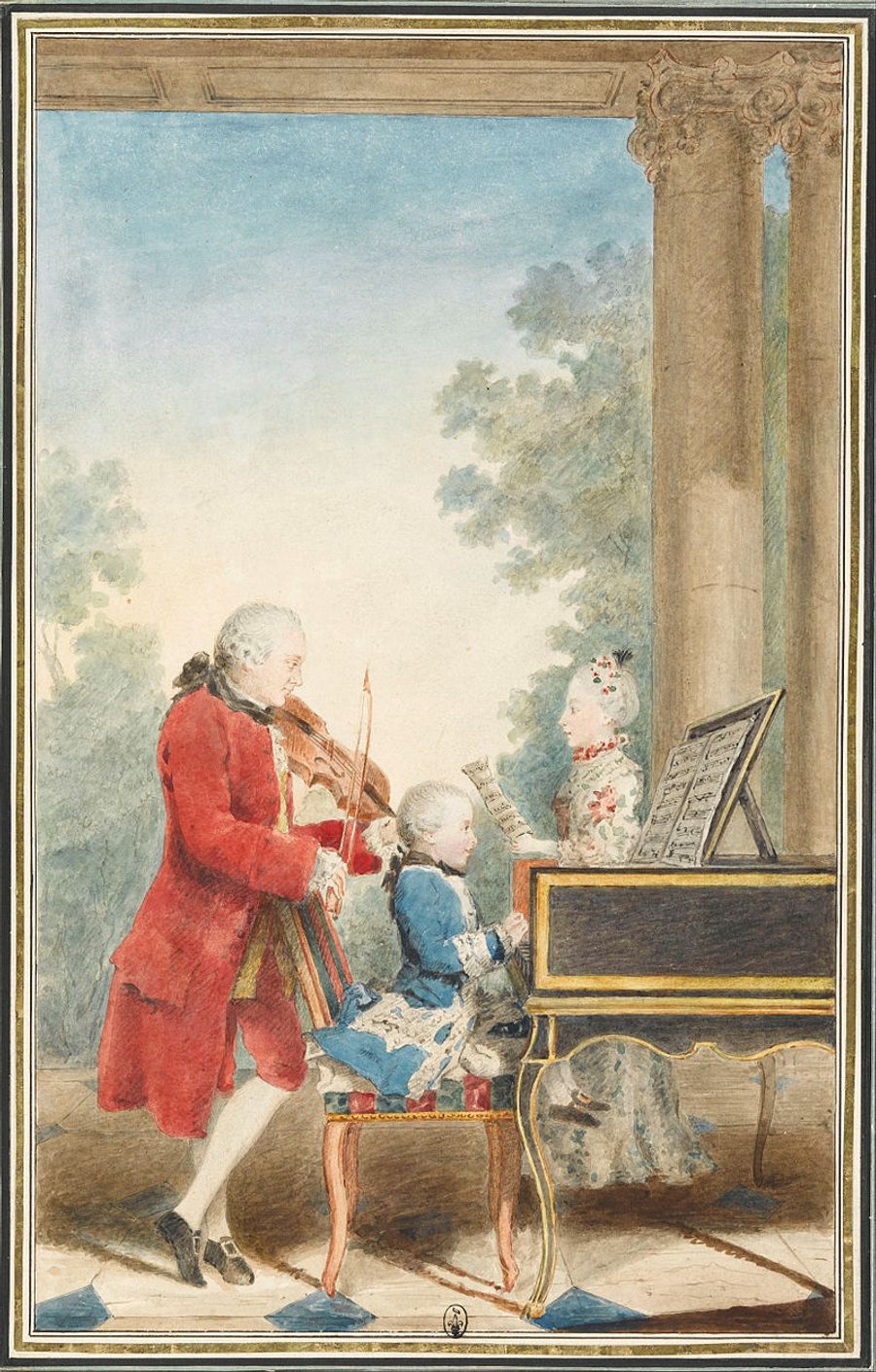
Mozart’s Symphony No. 4 in D major, K. 19 is an early London symphony from 1765, written when he was nine years old. Modest in scale yet vivid in gesture, it shows the child composer absorbing the fashionable three-movement symphony (or sinfonia) style then current in England—and already learning how to make a small orchestra sound dramatically alive.
Mozart’s Life at the Time
In 1765, Wolfgang Amadeus Mozart (1756–1791) was in the midst of the family’s Grand Tour of Western Europe (1763–1766), a formative journey that brought him into direct contact with the latest orchestral styles and leading musical centers. The Köchel-Verzeichnis entry for K. 19 places the work in London in 1765, within the cluster of early symphonies associated with this tour and the musical “tastes in England and the Netherlands” that Mozart encountered as a child prodigy on the road.[1]
It is easy to treat these London symphonies as mere juvenilia—pleasant, short, and outwardly conventional. Yet K. 19 deserves attention precisely because it documents Mozart learning the public language of the symphony: concise themes, quick harmonic direction, and a theatrical sense of contrast that anticipates his later ease with large forms. Even at nine, he is not simply “writing notes,” but testing how orchestral rhetoric works.
Composition and Manuscript
K. 19 is a London work of 1765, and the Mozarteum catalogue confirms an autograph source from that year.[1] The same entry preserves a telling early title/heading that spells out the intended forces—“2 violins, 2 oboes, 2 horns, viola and bass”—a practical, standard-issue symphonic orchestra for the mid-1760s.[1]
The scoring aligns with what we expect from Mozart’s earliest symphonic practice: winds used for brilliance and reinforcement rather than as independent coloristic partners, with strings carrying the primary discourse. In modern reference terms, the work is typically given as scored for two oboes, two horns (in D), and strings.[2]
The symphony follows the prevalent early-Classical three-movement plan—fast, slow, fast—rather than the later four-movement design standardized by Haydn’s mature symphonic practice and embraced by Mozart in Salzburg and Vienna.[2] The movement headings transmitted in common cataloguing are:
- I. Allegro
- II. Andante
- III. Presto[3]
Musical Character
K. 19 speaks the dialect of the mid-1760s sinfonia: brisk outer movements with bright, affirmative D-major sonorities, and a central Andante that offers contrast without expanding into the later, more psychologically searching slow-movement world of Mozart’s Salzburg and Viennese symphonies.
What makes this small symphony distinctive—and worth hearing beyond mere curiosity—is the clarity of its orchestral “stagecraft.” With limited forces, Mozart must rely on essentials: clean thematic profiles, quick turns between tutti emphasis and lighter textures, and the energizing lift provided by oboes and horns at structural points. In other words, K. 19 is a lesson in how an early symphony persuades: not by grand architecture, but by momentum, cadence, and timbral punctuation.
Placed within Mozart’s output, K. 19 also reminds listeners that his mature mastery did not appear fully formed in Vienna. The London symphonies show a child composer absorbing international models and learning to write for real players in real public contexts. Heard alongside the later D-major symphonies—especially the expansive “Prague” Symphony, K. 504—this compact nine-year-old’s work becomes more than an apprentice piece: it is a snapshot of Mozart acquiring the symphonic voice that he would eventually transform into something unmistakably his own.
Sources
[1] Mozarteum Köchel-Verzeichnis entry for KV 19 (London 1765; autograph; historical notes; early scoring/heading; links to NMA movement pages).
[2] Wikipedia overview: Symphony No. 4 in D major, K. 19 (London 1765; typical scoring; three-movement fast–slow–fast plan).
[3] IMSLP work page: Symphony No. 4, K. 19 (catalog data; movement list; basic scoring summary; publication info).