- Köchel Number
- K9 504 | K6 504
- Genre
- Orchestral Music
- Form
- Symphonies
- Key
- D Major
- Date
- 6 December 1786
- Place
- Vienna
- Age
- 30
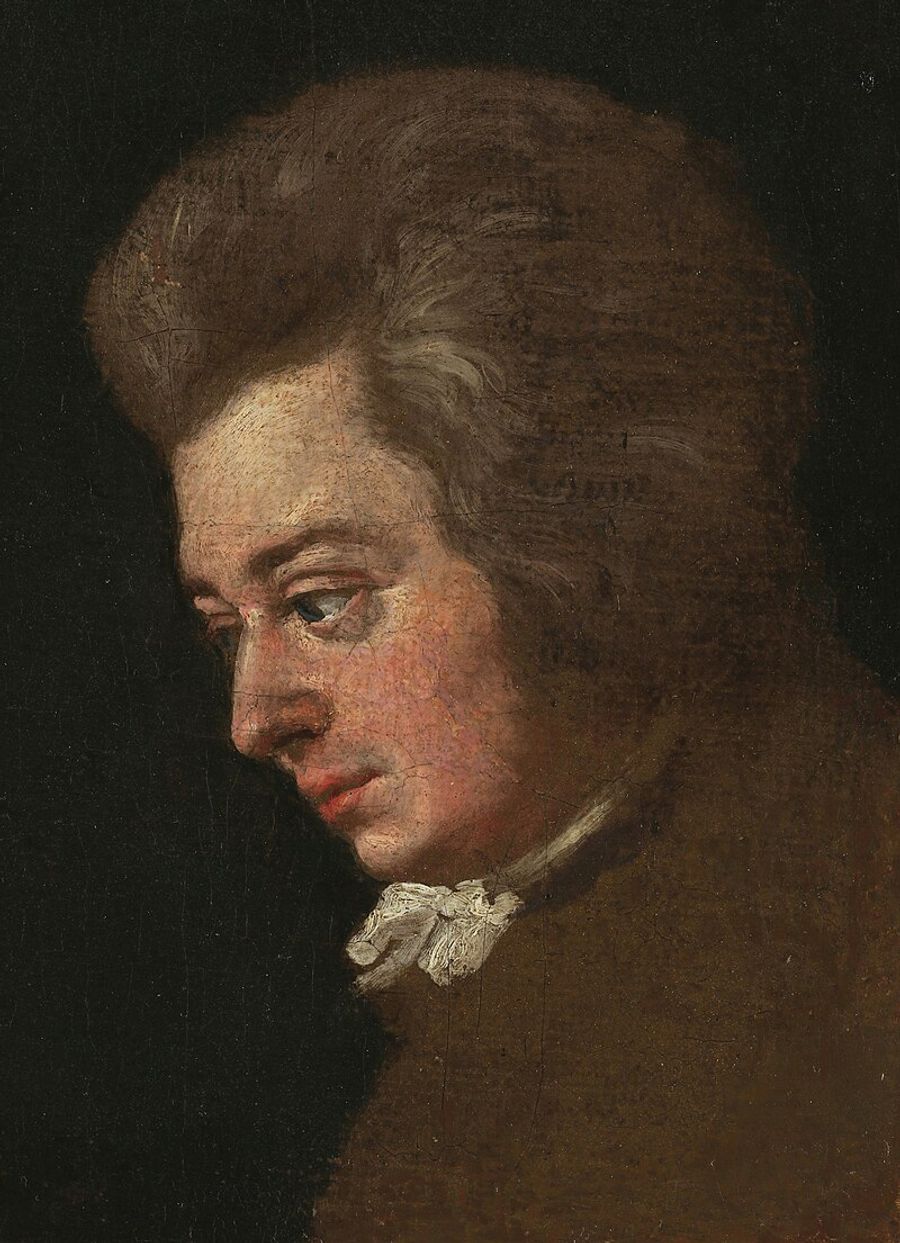
Mozart’s Symphony No. 38 in D major, “Prague” (K. 504) was completed in Vienna on 6 December 1786, when the composer was 30, and it stands as one of his most brilliant essays in symphonic theatre without words. Known by a nickname earned through its triumphant early life in Prague, the work couples an unusually expansive slow introduction with a first movement of exceptional contrapuntal density and an almost concertante spotlight on the winds.
Background and Context
By the end of 1786 Wolfgang Amadeus Mozart (1756–1791) was living amid a peculiar contradiction: in Vienna he remained admired but not reliably rewarded, while in Prague—thanks above all to the city’s fervent embrace of Le nozze di Figaro—his reputation had become something closer to a civic enthusiasm. Reports from early 1787 capture the scale of this Prague “Mozart fever”: a correspondent writing on 8 February 1787 relayed the oft-quoted impression that in Prague “nothing is played, sung, or whistled” but Figaro—a phrase that, even allowing for rhetorical flourish, speaks to an audience primed to hear instrumental music through an operatic lens.[5]
Against that backdrop, K. 504 can be heard as a symphony that assumes unusually alert listeners and unusually capable players. Modern scholarship often describes the work’s orchestral writing—especially its winds—as approaching a kind of “ensemble concerto” within the symphonic frame, and even basic source commentary notes just how frequently the string band withdraws entirely so that the winds can speak alone.[3] That texture is not merely a coloristic luxury: it is a structural idea. Mozart treats the orchestra less as a single blended organism than as a set of sharply characterized choirs—an approach that suits a city like Prague, famed in the period for its cultivated orchestral culture and for players (particularly winds) trained in the cosmopolitan styles circulating through Central Europe.
Composition and Premiere
Mozart completed the symphony in Vienna on 6 December 1786, a date preserved in his autograph thematic catalogue and reflected in surviving manuscript evidence.[3][2] The proximity of K. 504 to other major works of late 1786—not least the Piano Concerto No. 25 in C major, K. 503 (completed 4 December)—places it in a period when Mozart was thinking simultaneously in symphonic and concerto terms, and K. 504 often feels like the boundary between those categories has been deliberately thinned.[3]
The work’s early performance history is inseparable from Mozart’s first Prague visit in January 1787, prompted by invitations from Prague musical circles closely connected to the theatre orchestra and a broader “society of great music connoisseurs” (as reported in contemporary correspondence).[6] Mozart’s itinerary in Prague is unusually vivid because it is reflected obliquely in his surviving letters. Writing from Prague to his friend Gottfried von Jacquin on 15 January 1787, Mozart describes the bustle of social obligations and cultivated encounters—details that remind us his Prague triumph was not an abstract “tour,” but an intensely scheduled round of visits, dinners, and performances in a city eager to claim him.[7]
The symphony’s nickname “Prague” reflects the fact that its decisive early success belonged to that city; it is commonly dated to 19 January 1787 in modern summaries of Mozart’s stay.[4] Yet a small interpretive debate remains worth keeping in view: was K. 504 actually written *for* Prague, or merely brought there as a new and impressive calling-card? The secure facts are strikingly limited (the Vienna completion date is certain; an earlier Vienna performance is not documented), and that very uncertainty has encouraged scholars and performers to treat the symphony as a deliberately “public” work—crafted to make an immediate impact in a large hall with first-rate winds, regardless of the originally imagined venue.[3]
Instrumentation
Mozart scores the “Prague” Symphony for a festive late-18th-century orchestra, but uses it with an almost chamber-like relish for timbral contrast.
- Winds: 2 flutes, 2 oboes, 2 bassoons
- Brass: 2 horns, 2 trumpets
- Percussion: timpani
- Strings: violins I & II, viola, cello, double bass
(Modern descriptions of the autograph and facsimile editions summarize this scoring and emphasize the paired winds and full ceremonial brass-and-timpani complement.)[1]
What matters is not just what instruments are present, but how Mozart distributes responsibility. The winds in K. 504 do not merely reinforce harmony; they articulate formal boundaries, carry thematic material, and—most memorably—form self-sufficient sonorities that can stand without strings at all.[3]
Form and Musical Character
I. Adagio – Allegro (D major)
The opening Adagio is one of Mozart’s most imposing symphonic introductions: long-breathed, rhetorically charged, and harmonically purposeful rather than merely ceremonial. Instead of functioning as a “curtain-raiser” that yields quickly to the main tempo, it behaves like a prologue that plants motivic and harmonic tensions the Allegro will later exploit. This is one reason conductors often disagree—productively—about its pacing: too broad, and the Adagio can become a separate movement; too quick, and it loses the sense of architectural weight that makes the eventual Allegro feel earned.
When the Allegro arrives, the movement’s reputation for contrapuntal density becomes immediately audible. Mozart writes a first movement in which developmental procedures—imitation, tight motivic working, and orchestral “hand-offs” of figures—feel almost continuous, blurring the border between exposition and development in a way that can sound startlingly modern when articulated with clarity. The movement is also a laboratory for orchestral dialogue: string-driven momentum repeatedly opens into wind-led paragraphs, and those wind paragraphs often carry not only color but argument.
A practical performance issue has also attached itself to this movement: the question of repeats. Reviewers and historically informed performers have long debated how (and whether) to observe the movement’s repeat scheme in ways that align with both the score and 18th-century practice; discussions surrounding recordings by conductors such as Sir Charles Mackerras have kept attention on the structural consequences of repeat decisions—not as pedantry, but as a way of restoring the movement’s intended balance between large-scale symmetry and cumulative drive.[8]
II. Andante (G major)
The slow movement shifts to G major (the subdominant), a choice that softens the work’s public, ceremonial D-major profile into something more intimate.[3] Yet intimacy here is never mere repose. Mozart writes an Andante of poised surface and subtle internal weather: phrases that begin as lyrical can darken through minor-mode inflections, while the winds frequently operate as commentators—echoing, shading, or gently contradicting what the strings propose.
One can also hear this movement as an operatic scene without text. In Prague, where Mozart’s audiences had recently absorbed the emotional grammar of Figaro, such instrumental “character shifts” would not have required explanation. The Andante’s controlled fluctuations—its ability to sound at once gracious and questioning—are a reminder that Mozart’s mature symphonic slow movements often carry dramatic ambiguity rather than simple songfulness.
III. Presto (D major)
Instead of the four-movement plan that later became “standard,” K. 504 concludes with a Presto finale, giving the symphony a three-movement profile whose effect is not lightweight but concentrated. The finale’s speed and brilliance are obvious; less obvious is how carefully Mozart engineers propulsion through texture. Short motives are set in motion and then redistributed across orchestral groups, so that what feels like unbroken velocity is actually a sequence of precisely judged changes in scoring and register.
The Presto also completes the symphony’s broader narrative: after the introduction’s ceremonial gravity and the first movement’s intellectual vigor, the finale’s exuberance can sound like a public celebration—appropriate to a city that, in early 1787, was eager to greet Mozart not merely as a visiting celebrity but as a composer whose music it had already, in a sense, adopted.
Reception and Legacy
The “Prague” Symphony’s early success belongs to a historical moment when Mozart’s standing in Prague outstripped his security in Vienna. Contemporary testimony repeatedly depicts Prague audiences as unusually attentive to his music—an attention strong enough that Mozart could write to Jacquin of being pressed to stay longer and undertake further major projects, offers he found flattering but difficult to accept.[7] That social reality matters for the symphony’s legacy: K. 504 is not simply “a symphony that premiered in Prague,” but a work whose identity was shaped by the experience of a city hearing Mozart as its composer.
In the repertoire, K. 504 has remained a touchstone for what Mozart’s late symphonic style can be when it is both public and intricate: grand sonority without bombast, learned counterpoint without academic dryness, and—perhaps most distinctive—an orchestral palette in which winds are treated as protagonists. The symphony’s continuing fascination for conductors lies precisely there: in the challenge of making its architectural logic audible while preserving its theatrical immediacy, so that the listener experiences not a museum piece but a living drama in D major.
Sheet Music
Download and print sheet music for Symphony No. 38 in D major, “Prague” (K. 504) from Virtual Sheet Music®.
Sources
[1] OMI (Orpheus Music) facsimile brochure for Mozart’s autograph score of Symphony No. 38, K. 504 (completion date and scoring overview).
[2] Wikimedia Commons image and metadata: opening page of Mozart’s autograph manuscript for Symphony No. 38, K. 504, dated 6 December 1786.
[3] Reference overview of Symphony No. 38, K. 504 (“Prague”): composition date, structure, and notable wind-only textures (secondary source).
[4] EUROARTS label note summarizing composition period and Prague premiere date (19 January 1787).
[5] “Letters to Mozart” entry (8 February 1787): contemporary report describing Prague’s intense popularity of *Figaro* and mentions Mozart’s 19 January concert.
[6] National Library of the Czech Republic exhibition page noting the invitation from Prague musical circles and Mozart presenting a new D-major symphony during the January 1787 stay.
[7] Digital Mozart Edition (Mozarteum): Mozart’s letter from Prague to Gottfried von Jacquin, 15 January 1787 (primary-source translation).
[8] ClassicalSource review discussing Mackerras recordings of Mozart Symphonies 38–41, including remarks on repeat practice and tempo characterization in K. 504.