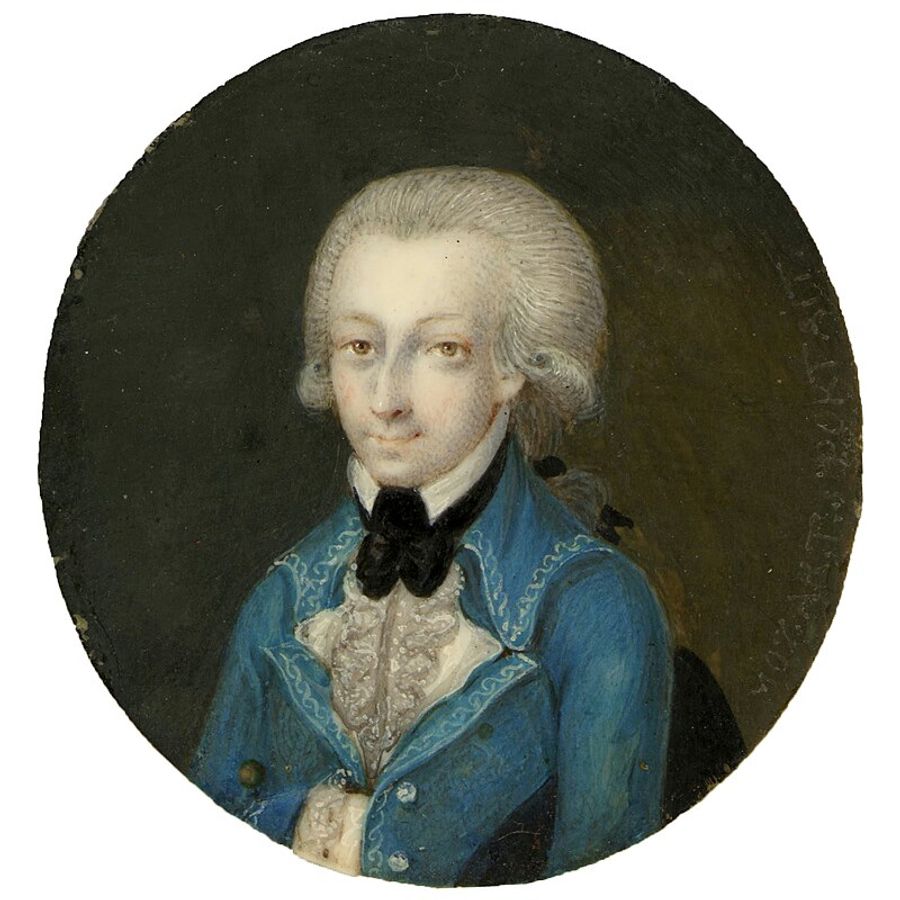
- Köchel Number
- K9 173 | K6 173
- Genre
- Chamber Music
- Form
- String Quartets & Wind Quartets
- Key
- D Minor
- Date
- September 1773
- Place
- Vienna
- Age
- 17
Mozart’s String Quartet No. 13 in D minor, K. 173 was composed in Vienna in August–September 1773, when he was only seventeen. The last of the so-called “Viennese” quartets (K. 168–173), it is also the set’s lone minor-key entry—compact, sharply profiled, and unusually serious in tone for Mozart’s early quartet writing.
Background and Context
Mozart’s six “Viennese” string quartets, K. 168–173, belong to a short, concentrated burst of chamber-music work during his 1773 Vienna stay—months in which the teenage composer absorbed the newest quartet style associated above all with Joseph Haydn [1]. In this sense K. 173 is less an apprentice exercise than a document of fast learning: it shows Mozart thinking in four independent parts, tightening formal argument, and using counterpoint (imitation between voices) as a way of generating momentum rather than as a mere academic garnish.
Within Mozart’s quartet output, D minor is a telling choice. Minor keys are comparatively rare in his string quartets, and D minor in particular often signals heightened drama elsewhere in his catalogue. K. 173 is an early instance of that expressive territory, written not with later “Sturm und Drang” intensity, but with a lean, alert rhetoric that prizes tension and release over sheer lyrical ease.
Composition and Dedication
The quartet is securely authenticated and transmitted, and the International Mozarteum Foundation dates it to Vienna, August–September 1773 [2]. It is scored for the standard quartet ensemble—two violins, viola, and cello—without additional instruments [2].
No dedicatee is associated with K. 173 in the way Mozart later honored Haydn in the published set of six quartets dedicated to him (the “Haydn” quartets of the 1780s). Yet the stylistic dialogue is already audible here, and K. 173’s place as the concluding work of the Viennese group underlines its function as a kind of culminating statement for this 1773 experiment in Haydn’s medium [1].
Form and Musical Character
K. 173 follows the now-standard four-movement plan associated with mature quartet writing—fast movement, slow movement, minuet, and finale [3]. In outline (movement titles as commonly transmitted):
- I. (Allegro moderato) (D minor) [3]
- II. (Andantino grazioso) (often given in D major) [3]
- III. Menuetto (with Trio) [3]
- IV. (Allegro moderato) (D minor) [3]
What makes the quartet especially worth hearing is how decisively Mozart characterizes each movement with minimal material. The opening Allegro moderato is taut and argumentative, favoring motivic work—small ideas that are turned, sequenced, and exchanged between instruments—over extended melody. Even when the first violin comes to the foreground, the texture rarely relaxes into accompaniment-and-tune; instead, the inner voices (viola and second violin) frequently participate in imitation that keeps the musical surface in motion.
The slow movement’s shift toward the major mode functions as more than simple contrast. Its graceful cantabile offers relief, but Mozart does not abandon the quartet’s overall concentration: the writing remains conversational, and cadences often feel “earned,” approached by gentle suspensions and passing dissonances that subtly recall the work’s more serious frame.
The Menuetto and Trio return to a darker profile and remind the listener that this is not a purely divertimento-like quartet. Here Mozart shows a Haydn-like instinct for making a dance movement do double duty: it retains the minuet’s social outline while sharpening it with harmonic turns and tight phrase structure.
The finale, again marked Allegro moderato, completes the distinctive arch of the work: D minor is not merely visited but reaffirmed. Mozart’s craft lies in making the concluding movement feel both inevitable and briskly economical—one hears a young composer learning to close a multi-movement argument without rhetorical excess.
Reception and Legacy
Unlike Mozart’s later quartets—especially the six dedicated to Haydn—K. 173 has never been a universal “gateway” piece, and its leaner, more exploratory rhetoric can make it seem modest beside the mature masterpieces. Yet that is precisely its appeal. As the last of the Viennese quartets, it captures Mozart at a moment of stylistic recalibration: he is measuring himself against Haydn’s model, testing four-movement architecture, and discovering how much expressive weight a quartet can bear with nothing more than four string instruments [1].
The work also has practical afterlife: the score and parts have circulated widely, and modern performers can consult the Neue Mozart-Ausgabe materials (as indexed through IMSLP) alongside other historical editions [3]. In concert programming, K. 173 rewards being placed next to early Haydn quartets or Mozart’s later D minor quartet, K. 421, where one can hear—in the span of a decade—the transformation of a serious minor-key stance into something more expansive and psychologically intricate.
Sources
[1] Wikipedia — overview of Mozart’s “Viennese Quartets” (K. 168–173), composed in Vienna in late 1773 and influenced by Haydn.
[2] Köchel Verzeichnis (International Mozarteum Foundation) — KV 173 work page with authentication status, dating (Vienna, 08–09/1773), key, and instrumentation.
[3] IMSLP — String Quartet No. 13 in D minor, K. 173: movements list, composition year/month (September 1773, Vienna), and links to NMA materials.