- Köchel Number
- K9 15a-ss | K6 15a - 15ss
- Genre
- Piano Music
- Form
- Piano Pieces
- Date
- 1764
- Place
- London
- Age
- 8
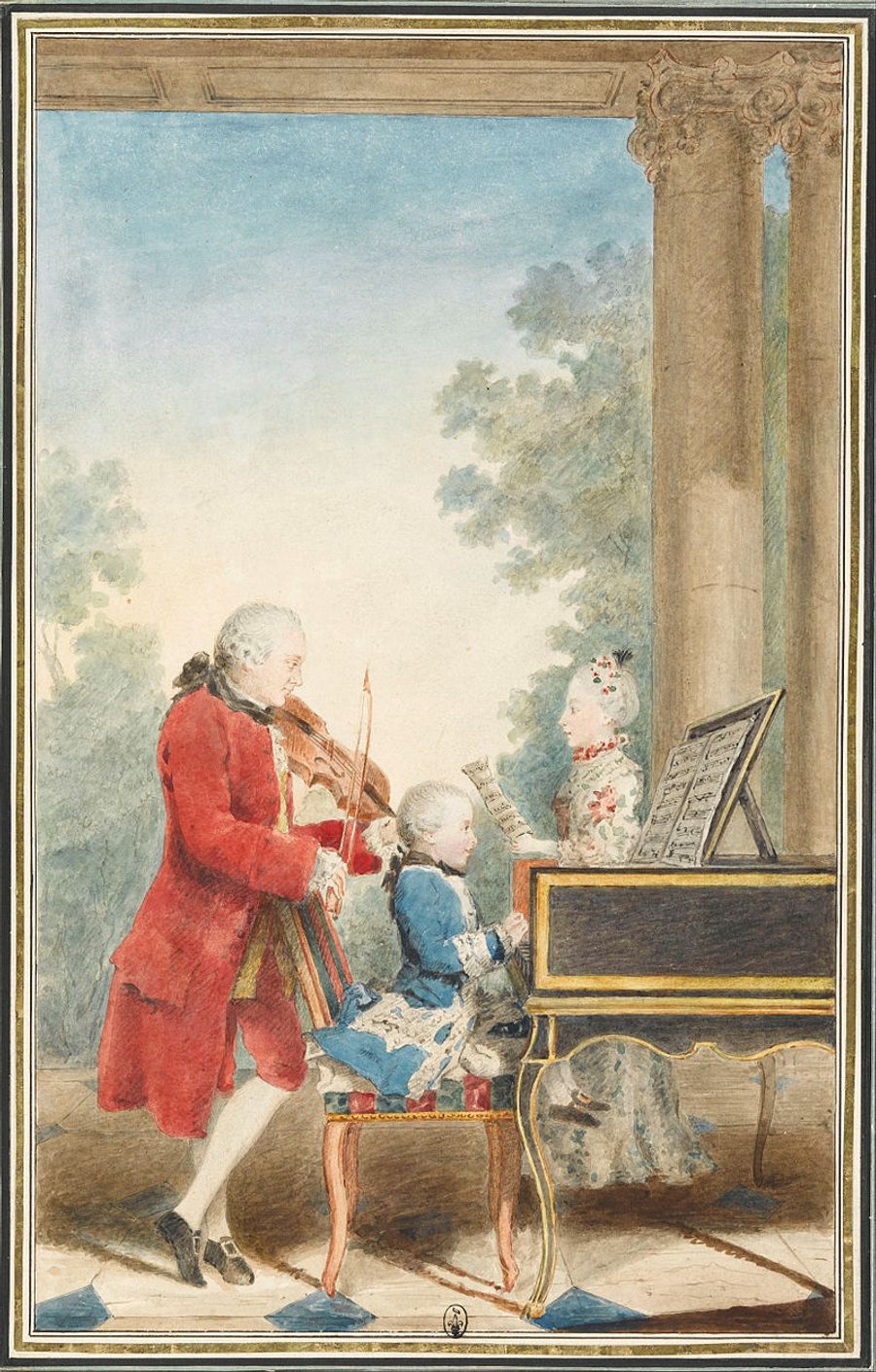
Mozart’s London Sketchbook (K. 15a–ss) is a compilation of 43 brief keyboard pieces and fragments written in London in 1764–65, when Wolfgang Amadeus Mozart (1756–1791) was only eight. More document than “cycle,” it preserves the young composer’s first attempts to capture ideas directly on paper—miniatures that illuminate how Mozart learned to think at the keyboard.
Mozart’s Life at the Time
In 1764 the Mozart family were in London as part of their extended European “grand tour,” presenting the prodigy Wolfgang and his sister Maria Anna (“Nannerl”) to aristocratic and public audiences. The children appeared at court soon after their arrival and also gave public concerts—evidence that London was not merely a stopover, but a major proving ground for the eight-year-old’s keyboard playing and improvisatory gifts [1] [2].
This is also the period in which Mozart encountered the city’s cosmopolitan musical life (Italian opera, English concert culture, and a strong market for keyboard music). For the child composer, such surroundings mattered: the London Sketchbook sits alongside more formal London works (notably the accompanied keyboard sonatas K. 10–15) as evidence of rapid stylistic assimilation—music absorbed, tested, and reshaped at the instrument [3].
Composition and Manuscript
The London Sketchbook (German: Londoner Skizzenbuch) is catalogued in Köchel as K. 15a–ss and consists of 43 short, mostly untitled items notated across two staves—ranging from compact dances to tiny, unfinished ideas [4] [5].
Modern scholarship (reflected in the Neue Mozart-Ausgabe) emphasizes the book’s practical, almost technological significance: it documents Mozart learning to write music fluently with pen and ink, so that he could preserve inspiration without always relying on a parent or copyist. Leopold Mozart’s involvement is visible too—corrections appear in pencil, suggesting a teaching hand hovering over a child’s first independent notational steps [4].
Because it is a sketchbook rather than a publication project, the set should be treated as juvenilia in the literal sense: a working notebook from which later “finished” Mozart is still in the process of emerging. Some items are fragmentary (for example, K. 15rr and K. 15ss), and the collection’s boundaries and attributions are best understood through critical editions rather than romantic ideas of a unified opus [5].
Musical Character
The notebook’s charm lies not in grand architecture but in concentrated gestures. Many entries are minute-long character pieces—Menuetto, Contredanse, Andante, Rondo—as if Mozart were trying out the basic social and galant vocabulary of mid-1760s keyboard style in rapid succession [5]. Even when a piece is only a few lines, one often hears a future dramatist’s instinct for cadence timing, contrast, and “scene-setting” at the keyboard.
Several entries are labelled on modern lists as “sonatas,” but here that usually means short sonata-movements or sonata-like essays rather than the multi-movement, public-facing genre Mozart would later master. The London Sketchbook is therefore distinctive within Mozart’s keyboard output: it shows process—how dance rhythms, passagework patterns, and phrase structures are learned by doing, then immediately recycled into new combinations.
Why does it deserve attention today? Precisely because it is not “mature repertoire.” K. 15a–ss lets listeners and players witness Mozart’s compositional thinking at close range: tiny experiments in form, figuration, and key-to-key motion, with occasional glimpses of ambition (a fugue fragment among the final items) that point beyond the notebook’s modest scale [5]. For broadly curious musicians, it is also a reminder that genius has a material history: even Mozart had to learn the craft of writing down what he heard in his head—one small London page at a time.
Sources
[1] Overview of the Mozart family’s grand tour; London timeline and court appearance dates.
[2] MozartDocuments.org: documentation of London concert life and the Mozarts’ public/court appearances (context for 1764–65).
[3] Reference overview of the London keyboard sonatas with accompaniment (K. 10–15), placing K. 15a–ss alongside Mozart’s other London keyboard output.
[4] Wikipedia article summarizing the London Sketchbook (K. 15a–ss), including NMA-derived remarks about purpose and Leopold’s pencil corrections.
[5] IMSLP work page for The London Sketchbook, K. 15a–15ss, including item list and links to Neue Mozart-Ausgabe materials.