- Köchel Number
- K9 10 | K6 10
- Genre
- Chamber Music
- Form
- Violin Sonatas & Variations
- Key
- B Flat Major
- Date
- 1764
- Place
- London
- Age
- 8
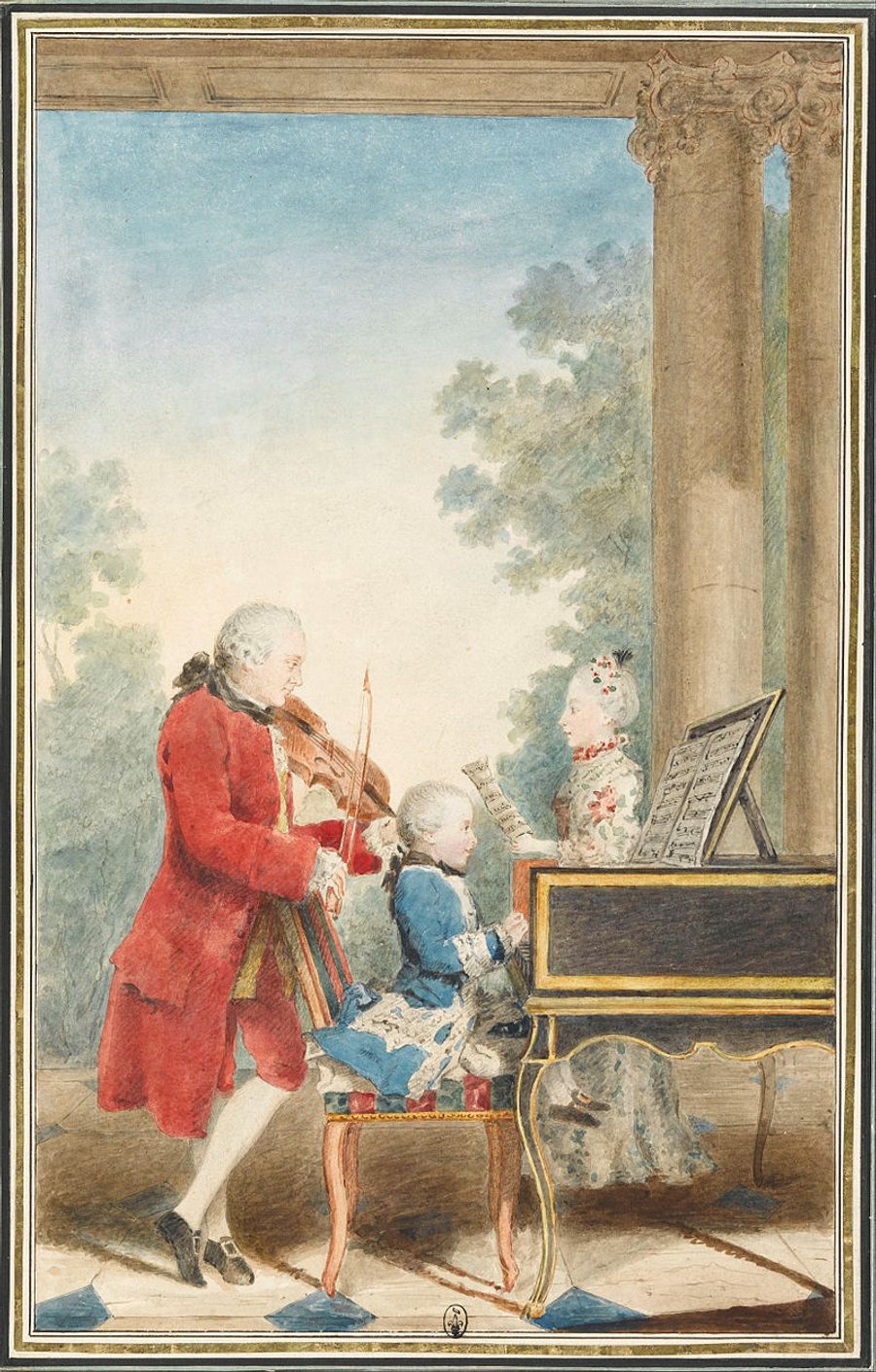
Mozart’s Violin Sonata No. 5 in B♭ major (K. 10) was composed in London in 1764, when he was eight years old, and belongs to a set of “accompanied sonatas” in which the keyboard part leads while the violin often functions as a colouristic partner. Heard on its own terms—as a compact London souvenir from the grand tour—it offers an unusually direct glimpse of how quickly Mozart absorbed fashionable galant style and translated it into clean, audience-friendly musical rhetoric.
Mozart’s Life at the Time
In 1764 the Mozart family was in London as part of the long European grand tour that showcased Wolfgang Amadeus Mozart (1756–1791) and his sister Maria Anna (“Nannerl”) as prodigious performers. The London period proved musically formative: the city offered public concerts, a market for printed music, and a cosmopolitan taste for the latest galant idiom—tunefulness, clear phrase structure, and light textures.
K. 10 stands at a telling point in Mozart’s juvenilia. It follows immediately after the Paris sonatas K. 6–9 (his “Opus 1” publications) and initiates a new London group, K. 10–15, conceived explicitly for domestic music-making on harpsichord (or early fortepiano) with optional string participation. These works are best understood not as later “equal partnership” violin sonatas, but as keyboard sonatas with accompaniment—an important distinction for performance and for listening expectations.[2]
Composition and Manuscript
The Sonata in B♭ major, K. 10 was composed in London in 1764 as part of the set K. 10–15.[2] The title-page evidence for the group is especially revealing: the six sonatas were published in London in 1765 and dedicated to Queen Charlotte, with wording that underscores practical flexibility—playable with violin or flute, and with a violoncello ad libitum.[3]
That publication framing helps explain why K. 10 can feel “pianistic” even when a violinist is present. The right hand frequently carries the melodic argument, while the violin often shadows, reinforces cadences, or adds brilliance by doubling at the octave—an 18th-century, market-savvy approach rather than a sign of compositional immaturity.
Musical Character
K. 10 is typically performed today as a two-movement sonata, concise and public-facing in tone, with the keyboard in the foreground.[1] Its B♭-major world (a “friendly” key for winds and strings alike) suits the work’s open, sociable affect—music that can charm without demanding prolonged development.
What makes the piece worth attention is precisely this blend of simplicity and skill. Even within a lightweight accompanied-sonata format, Mozart shows an instinct for:
- Balanced phrasing: regular, speech-like periods that feel inevitable rather than mechanical.
- Keyboard-led drama in miniature: cadential pacing and quick harmonic turns that give a small canvas a sense of direction.
- A social kind of virtuosity: passagework that sparkles at the keyboard while keeping the ensemble texture clear for amateur settings.
Placed beside Mozart’s mature Viennese violin sonatas—where violin and piano negotiate as equals—K. 10 is a reminder that “sonata” in the mid-1760s could still mean a keyboard piece designed for the living room, with the violin as a welcomed guest. In that sense, it documents not only an eight-year-old’s precocity, but also the musical economy of London: publishable, performable, and immediately pleasurable.
Sources
[1] IMSLP work page for *Violin Sonata in B-flat major, K.10* (score access and basic catalog framing).
[2] Wikipedia overview of the London set *Violin Sonatas, KV 10–15* (context: London 1764, accompanied-sonata concept, catalog/editorial notes).
[3] King’s College London, *Mozart & Material Culture*: “Accompanied sonatas K10–15” (publication framing, dedication to Queen Charlotte, instrumentation wording including violin/flute and cello ad lib.).