- Köchel Number
- K9 15 | K6 15
- Genre
- Chamber Music
- Form
- Violin Sonatas & Variations
- Key
- B Flat Major
- Date
- 1764
- Place
- London
- Age
- 8
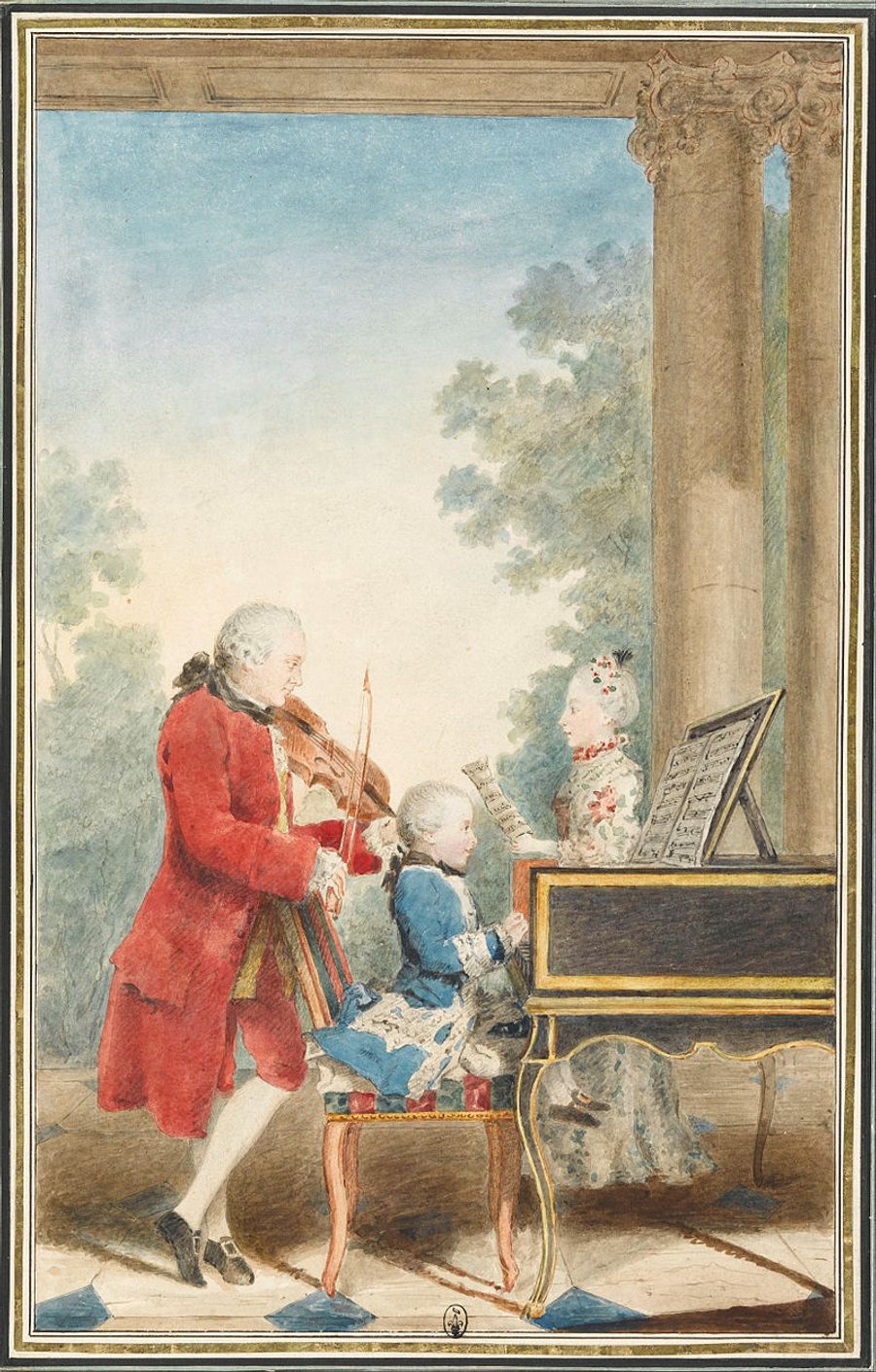
Mozart’s Violin Sonata No. 10 in B♭ major, K. 15 was composed in London in 1764, when he was eight years old, as the closing work of a set of six “accompanied” keyboard sonatas (K. 10–15). Heard today as a compact, graceful two-movement sonata, it rewards attention for what it reveals about Mozart’s early London style: elegant tune-making, a sure sense of cadence and proportion, and a practical understanding of domestic music-making at the harpsichord.
Mozart's Life at the Time
In 1764 the Mozart family was in London as part of their long European tour, performing, networking, and seeking publication opportunities for the young composer. Wolfgang Amadeus Mozart (1756–1791) was eight years old—already seasoned as a travelling virtuoso, yet still writing music that addressed immediate, real-world circumstances: patrons, publishers, and the kinds of music that could be played in salons and private homes.
K. 15 belongs to a London group of six sonatas, K. 10–15, conceived for keyboard with an accompanying melodic instrument (violin or, in some contexts, flute), with a cello part sometimes supplied ad libitum (optional) [2]. They were closely tied to the city’s musical marketplace: in 1765 they appeared as Mozart’s Opus 3, with a dedication to Queen Charlotte [2].
Composition and Manuscript
The Köchel-Verzeichnis (Mozarteum) lists K. 15 as a London work from 1764 in B♭ major, headed by the tempo marking Allegro grazioso [1]. No autograph is known to survive for the set K. 10–15; instead, the musical text is anchored in an early printed edition from 1765, regarded as essentially authentic [3]. That early edition, with its flexible scoring (violin or flute, with optional cello), helps explain why these pieces sometimes sit on the border between “violin sonata” and early “piano trio” traditions in later cataloguing and editions [3].
For modern performers and listeners, it is worth keeping the original premise in mind: the keyboard part is primary, while the violin participates as an obbligato partner only intermittently—an aesthetic that differs from Mozart’s mature Vienna violin sonatas of the late 1770s and 1780s.
Musical Character
K. 15 is concise, clear-textured, and designed to charm rather than astonish. In keeping with the “accompanied sonata” model, the keyboard typically carries the principal thematic argument, while the violin reinforces, echoes, or lightly decorates that discourse.
Movements (as commonly transmitted for K. 15):
- I. Allegro grazioso (B♭ major) [1]
- II. Menuetto (with contrasting section/trio in some editions and performances) [4]
What makes the sonata distinctive within Mozart’s juvenilia is not harmonic daring but the poise of its musical rhetoric—phrases that “breathe” naturally, cadences that arrive with well-timed certainty, and a melodic style that seems already aligned with the galant ideal: singable, symmetrical, and socially fluent. The first movement’s grazioso character is especially telling: even at eight, Mozart writes with an instinct for elegance as an expressive goal, not merely an absence of complexity.
K. 15 also deserves attention as a document of genre history. The New Mozart Edition’s discussion of K. 10–15 emphasizes how these London sonatas stand at a transitional point: they can function as keyboard sonatas with optional accompaniment, yet they also anticipate the later classical piano trio by inviting (in some sources) a cello line that does more than merely double the bass [3]. In other words, K. 15 is small in scale, but it sits at an important stylistic crossroads—between the harpsichord-centered domestic sonata and the emerging conversational chamber-music textures that Mozart would ultimately master.
Approximate original instrumentation concept (for the Op. 3 set):
- Keyboard: harpsichord (or early fortepiano by later practice)
- Melodic instrument: violin (or flute)
- Optional bass: violoncello ad libitum [2]
Sources
[1] Mozarteum (Köchel-Verzeichnis) work entry for KV 15 (Sonate in B♭), including key and tempo heading.
[2] King’s College London, Mozart & Material Culture: overview of the accompanied sonatas K. 10–15 (London 1764; publication and dedication details).
[3] Digital Mozart Edition (Mozarteum): New Mozart Edition VIII/22/2 (Piano Trios) foreword discussing KV 10–15 (authentic 1765 print, classification, and genre transition).
[4] Wikipedia overview of the London sonatas K. 10–15, including commonly given movement listing for K. 15.