- Köchel Number
- K9 14 | K6 14
- Genre
- Chamber Music
- Form
- Violin Sonatas & Variations
- Key
- C Major
- Date
- 1764
- Place
- London
- Age
- 8
Mozart’s Sonata for Keyboard and Violin in C major, K. 14 (1764) belongs to the celebrated London set K. 6–K. 15, composed when he was just eight years old. Although the keyboard part remains primary—true to the mid-18th-century “accompanied sonata” tradition—the work already shows Mozart’s instinct for crisp thematic profile and theatrical pacing.
Mozart's Life at the Time
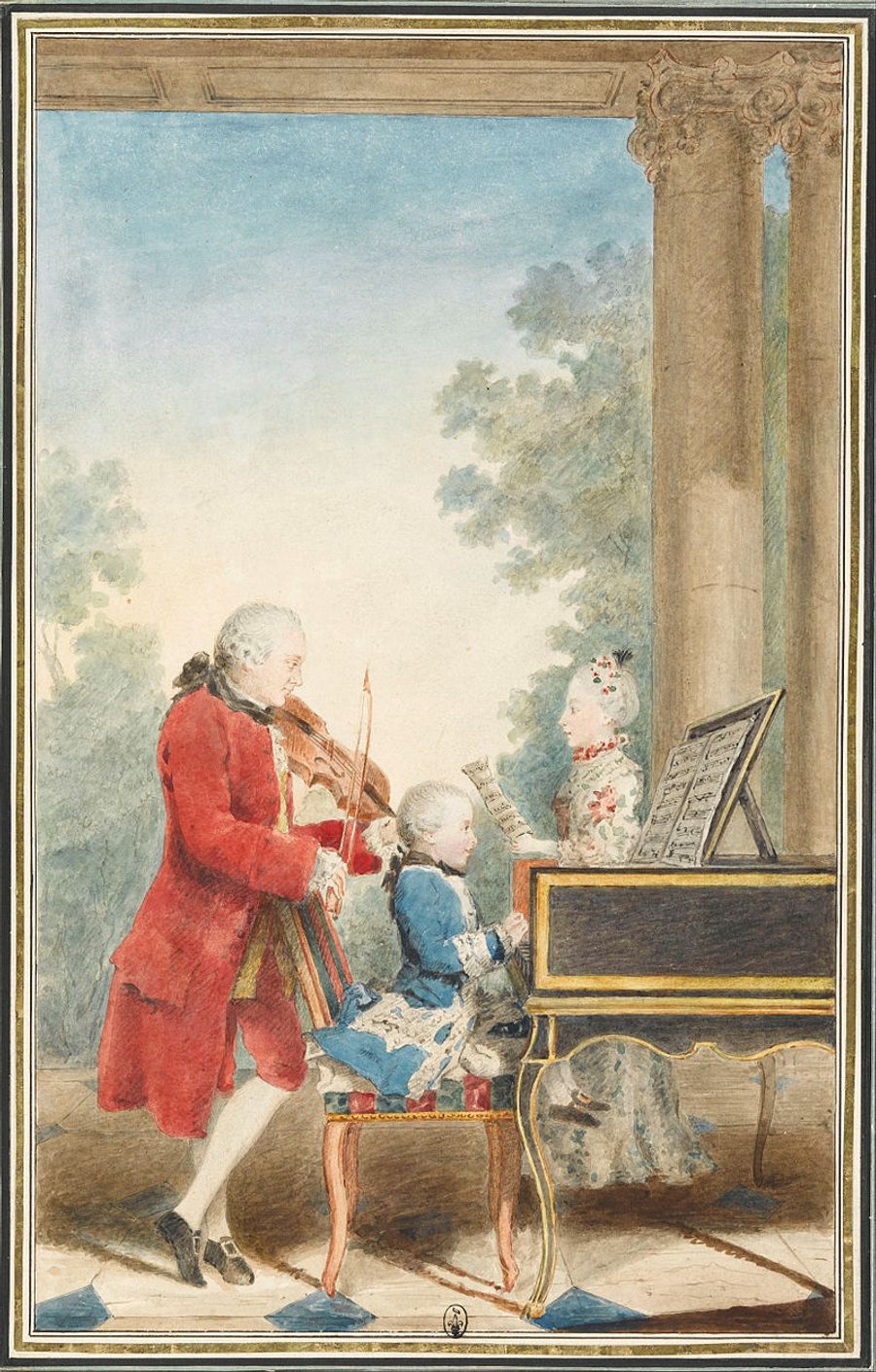
In 1764, Wolfgang Amadeus Mozart (1756–1791) was eight years old and living in London with his family as part of the grand European tour that made the child prodigy famous. London offered both prestige and practical opportunity: performances at court, public concerts, and—crucially—access to a music-publishing market eager for marketable, elegant keyboard music suitable for domestic performance. The sonatas K. 6–K. 15, including K. 14, stand at the intersection of travel, virtuoso display, and commerce, presenting Mozart as a composer-performer whose gifts could be sold not only in the concert room but also on the music desk at home.[1]
Within Mozart’s output, these London sonatas form an important early laboratory. They show him absorbing the galant idiom—clear melodies, balanced phrases, and lightly articulated accompaniment patterns—associated with the cosmopolitan style he encountered in the city (often linked in scholarship and commentary with Johann Christian Bach’s London presence). Even when the musical language remains intentionally uncomplicated, the pieces reveal a young composer learning how to “time” an opening, spin a cadence, and keep a listener’s attention across multiple short movements.[2]
Composition and Manuscript
K. 14 is catalogued as a Sonata in C major for Keyboard and Violin, composed in London in 1764.[1] Like its siblings in K. 6–K. 15, it belongs to a genre that modern audiences often file under “violin sonata,” but which in its own time was commonly understood as keyboard-led chamber music with a supporting string line. That hierarchy matters for performance and listening: the right hand of the keyboard tends to carry the principal melodic argument, while the violin often doubles, answers, or adds a bright edge to cadences and transitions rather than competing as an equal protagonist.
The work is conventionally transmitted in editions and online catalogues under the “keyboard and violin” designation, and it appears in modern reference cataloguing as K. 14 within this early group.[3] In practical terms, K. 14 also survives as a performable two-player sonata that can be realized on harpsichord or fortepiano with violin; the violin line’s relative simplicity is not a weakness so much as a window into mid-century chamber practice, in which a tasteful added instrument could “colour” a keyboard piece for a salon without overcomplicating the social act of music-making.
Musical Character
K. 14 is laid out in three movements, a compact plan typical of many early accompanied sonatas.[1] Heard as juvenilia, its interest lies less in harmonic daring than in the young Mozart’s sense of gesture: phrases tend to speak cleanly, cadences arrive with satisfying inevitability, and the musical “conversation” is managed with an entertainer’s timing.
From the outset, the bright C-major tone and tidy periodic themes project public-facing confidence—music that could plausibly introduce a prodigy to polite society. Yet the sonata deserves attention precisely because it is not merely a miniature: it demonstrates how early Mozart could already organize momentum across several short spans, using repetition with small adjustments (register, figuration, or violin reinforcement) to keep the surface lively. For listeners tracing Mozart’s development, K. 14 offers a baseline point: a vivid example of the accompanied sonata model from which he would later move toward the more equal, dialogic partnership of violin and keyboard in his mature sonatas.
Sources
[1] IMSLP work page: composition place/year (London, 1764) and movement count (3) for Sonata in C major, K. 14.
[2] Naxos booklet note (PDF) discussing the Mozart family’s London stay and the publication context for the early sonatas for keyboard with violin/flute (including K. 14).
[3] MozartDocuments.org Köchel index entry listing K. 14 as “Sonata in C Major for Keyboard and Violin.”