- Köchel Number
- K9 13 | K6 13
- Genre
- Chamber Music
- Form
- Violin Sonatas & Variations
- Key
- F Major
- Date
- 1764
- Place
- London
- Age
- 8
Mozart’s Sonata for Keyboard with Violin in F major (K. 13) dates from late 1764, when the composer was only eight years old and living in London during the family’s grand tour. Though conceived in the period’s “keyboard-first” sonata style, it already shows Mozart’s gift for balanced phrase, graceful melody, and a keen sense of public, domestic music-making.
Mozart's Life at the Time
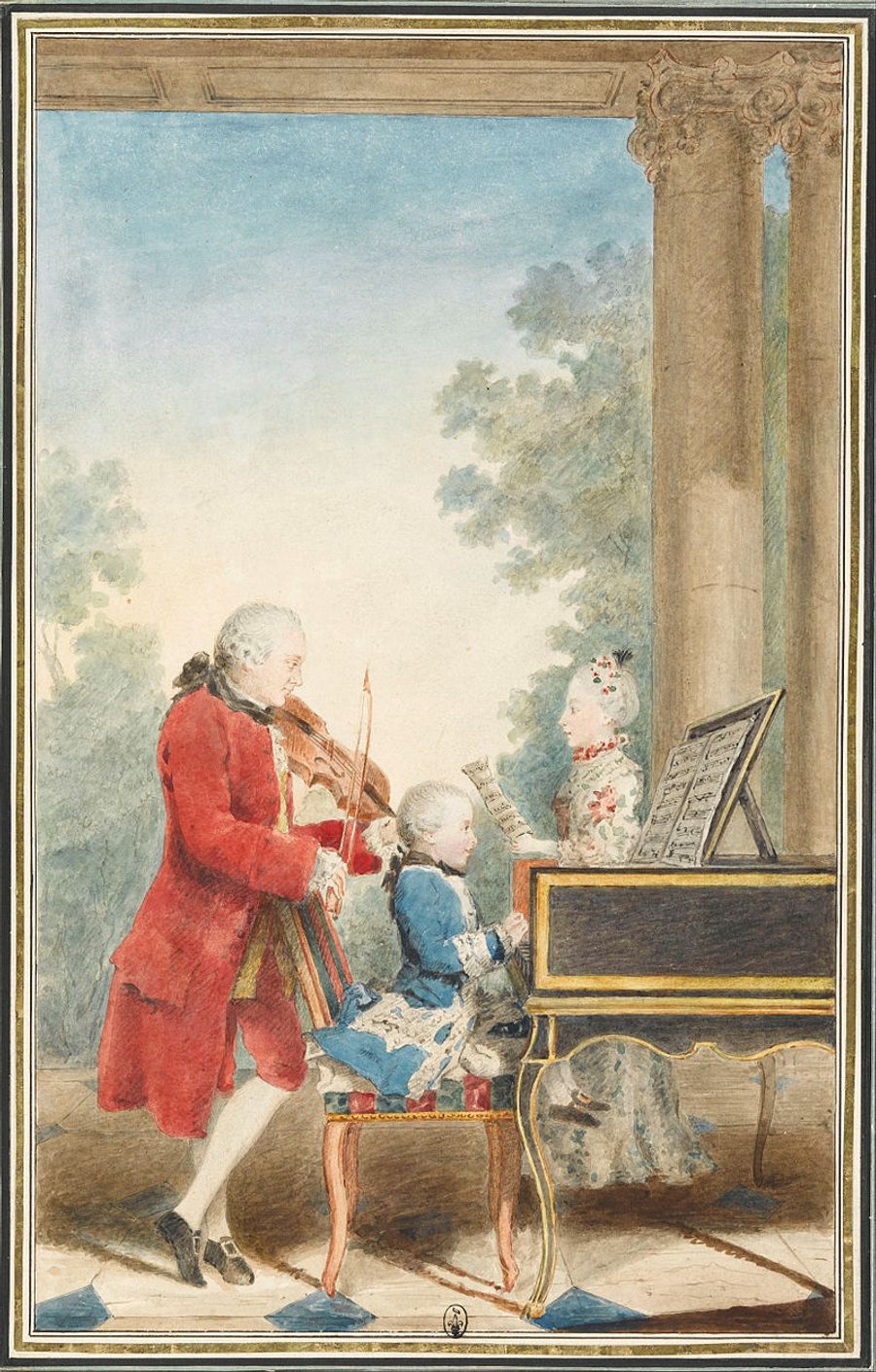
In 1764 the Mozart family—Leopold Mozart, his wife Anna Maria, and their two remarkable children, Maria Anna (“Nannerl”) and Wolfgang Amadeus Mozart (1756–1791)—were in London as part of a long European tour designed to display (and fund) the siblings’ talents. They had left Paris for London in April 1764, and the English capital quickly became one of the most consequential stops of the journey, exposing the young Mozart to a thriving concert culture, fashionable keyboard playing, and a market for printed music aimed at cultivated amateurs.[1]
K. 13 belongs to a compact London group of six “sonatas for keyboard with accompaniment of violin (or flute) and cello,” K. 10–15—music that sits at the crossroads of the private salon and the public marketplace. Modern catalogues often file these pieces among the violin sonatas, yet their original concept is telling: the violin part supports and colours a keyboard-centered design rather than partnering it as an equal (as in Mozart’s mature Viennese sonatas).[2]
Composition and Manuscript
Mozart composed the set K. 10–15 in London in late 1764.[2] Within that set, the F-major work K. 13 is typically identified as a sonata for keyboard with violin accompaniment, and sources and editions also acknowledge alternative scoring practices typical of the time (violin or flute, with an optional bass line for cello).[3]
This “accompanied keyboard sonata” genre matters for how one hears K. 13. The keyboard carries nearly all thematic responsibility; the violin often doubles, answers, or lightly ornaments the melodic line, providing brilliance and sociability rather than a true conversational counterweight. That said, Mozart’s London sonatas are not merely pedagogical trifles: even at eight, he writes with an instinct for clear harmonic pacing and the kind of symmetrical phrasing that would become a signature of the Classical style.
Musical Character
K. 13 is laid out in the era’s familiar three-movement plan—fast, slow, and a closing minuet—designed for elegant variety rather than large-scale drama.[2] Heard as juvenilia, it rewards attention not through profundity, but through craft: how quickly Mozart can set a scene, turn a cadence, and refresh a repeated idea through register, figuration, or a small harmonic sidestep.
What makes K. 13 distinctive within its modest genre is its sense of finish. Many children’s works sound like sketches; K. 13 sounds like a publishable product for London’s amateur market—music that knows its audience and meets it with charm. In that respect it also foreshadows Mozart’s lifelong pragmatism as a composer: an ability to write “for the occasion” without sacrificing style.
Instrumentation (period concept)
- Keyboard: harpsichord (often realized today on fortepiano or modern piano)
- Violin: accompanying/obbligato line (sometimes playable on flute in period practice)
- Optional bass: violoncello (ad libitum, depending on edition and domestic resources)[3]
Movements
- I. Allegro
- II. Andante
- III. Menuetto (with two minuet strains commonly described as Menuetto I & II in recordings and catalogues)[4]
In the opening Allegro, listeners can notice how Mozart favors clean, vocal-like ideas that sit naturally under the fingers—an important clue that the keyboard is the true protagonist. The Andante shifts the atmosphere toward a more singing, cantabile world, where the violin’s presence can add a human “breath” to the line even when it is technically subordinate. The concluding Menuetto places the sonata firmly in the social realm of dance; its courtly poise helps explain why these works circulated comfortably in domestic music-making.
In sum, Violin Sonata No. 8 (K. 13) deserves attention precisely because it is not yet a “great” sonata in the later, equal-partner sense. It is a snapshot of Mozart learning to write in the international idiom of the 1760s—polished, market-aware, and already unmistakably his—while still thinking from the keyboard outward.[2]
Sources
[1] MozartDocuments.org — timeline document noting departure for London on 10 Apr 1764 (grand tour context).
[2] Wikipedia — overview of Violin Sonatas K. 10–15: composed in London in late 1764; genre as keyboard sonatas with accompaniment; includes K. 13 entry.
[3] IMSLP — work page for Sonata in F major, K. 13 (sources/editions; instrumentation conventions and score access).
[4] MusicBrainz — tracklisting metadata for recordings of K. 13 showing movement titles (including Menuetto I & II usage).