- Köchel Number
- K9 12 | K6 12
- Genre
- Chamber Music
- Form
- Violin Sonatas & Variations
- Key
- A Major
- Date
- 1764
- Place
- London
- Age
- 8
Mozart’s Sonata for Keyboard and Violin in A major, K. 12 was composed in London in 1764, when he was eight years old. A compact two-movement work from the family’s Grand Tour, it typifies the early “accompanied sonata” in which the keyboard leads and the violin supplies color, dialogue, and cadence.
Mozart's Life at the Time
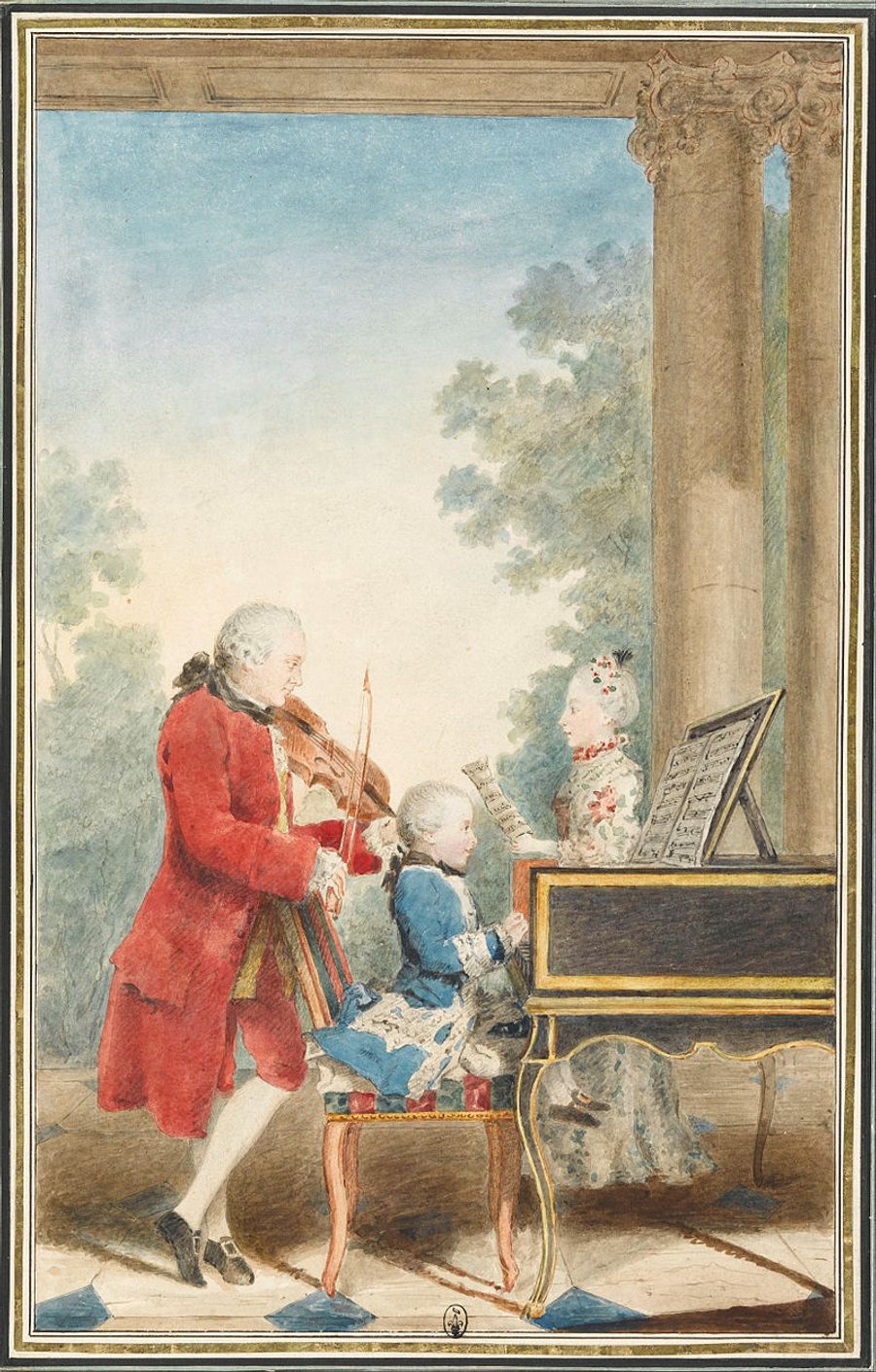
In 1764, Wolfgang Amadeus Mozart (1756–1791) was in London as part of the Mozart family’s extended European tour—an ambitious itinerary curated by Leopold Mozart to display his children’s talents to courts and public concert audiences. The London stay proved unusually fertile: Mozart encountered a thriving musical city and, crucially, absorbed the fashionable galant idiom associated with Johann Christian Bach (the “London Bach”), whom the young composer met and admired.[3]
K. 12 belongs to a set of six accompanied sonatas (K. 10–15) written in this environment. Their basic premise is revealing: rather than the later Classical “duo sonata” ideal—two equal partners—these are primarily keyboard sonatas with optional melodic reinforcement. That makes K. 12 less of a violin showpiece than a snapshot of an eight-year-old learning how to shape period style, phrase structure, and simple tonal drama for the instrument he himself most often played in public: the keyboard.[1]
Composition and Manuscript
The accompanied sonatas K. 10–15 were composed in London in 1764 and published the following year (1765), advertised as playable with violin or flute, with a cello part ad libitum (optional) in keeping with contemporary domestic music-making.[1] K. 12 is explicitly listed in documentary catalogues as a “Sonata in A Major for Keyboard and Violin,” and it sits early in Mozart’s Köchel catalogue—evidence not of artistic immaturity alone, but of how quickly his works entered circulation through print and performance during the tour.[4]
A particularly telling detail is the set’s presentation to Queen Charlotte: the title-page rhetoric and dedication frame these pieces as cultivated courtly offerings, not mere child’s exercises.[1] In other words, K. 12 is juvenilia written with a real public in mind—music designed to flatter, to charm, and to demonstrate precocious competence in the reigning style.
Musical Character
K. 12 is concise, in two movements—Andante followed by Allegro.[3] Its genre label matters: these London works are “accompanied sonatas,” where the keyboard carries most thematic material and harmonic activity, while the violin often doubles, punctuates, or provides light counter-lines rather than sustained thematic leadership.[1]
What, then, makes K. 12 worth attention today?
- First, it captures an important historical moment in Mozart’s development: the assimilation of a London, Bach-inflected galant language—balanced phrases, clear cadences, and an emphasis on surface elegance.[3]
- Second, its ordering (Andante then Allegro) suggests a child-composer already thinking in terms of contrast and pacing, beginning with poise before turning to brighter motion.[3]
- Finally, hearing the violin in an “accompanying” role can be clarifying rather than disappointing: it reminds modern listeners that the later equality of Mozart’s mature violin sonatas was an achievement, not a default. K. 12 lets one hear the starting point—keyboard-centered conversation gradually learning to become true chamber dialogue.
In sum, Violin Sonata No. 7 in A major, K. 12 is not celebrated for profundity, but for its vivid documentary value and its distilled charm: a small London artifact in which Mozart, at eight, tests the manners of his time and—almost casually—makes them sing.
Sources
[1] King’s College London — Mozart & Material Culture: overview of the accompanied sonatas K. 10–15 (London 1764; published 1765; dedication and scoring context).
[2] IMSLP — score and publication information hub for the Violin Sonata in A major, K. 12 (digital scans/editions).
[3] Wikipedia — Violin Sonatas, K. 10–15: movement listings for K. 12 and context (London 1764; J. C. Bach influence).
[4] MozartDocuments.org — Köchel Index entry identifying K. 12 as “Sonata in A Major for Keyboard and Violin.”