- Köchel Number
- K9 11 | K6 11
- Genre
- Chamber Music
- Form
- Violin Sonatas & Variations
- Key
- G Major
- Date
- 1764
- Place
- London
- Age
- 8
Mozart’s Violin Sonata No. 6 in G major (K. 11) was written in London in 1764, when he was eight years old, as part of a set of six “sonatas for keyboard with violin (or flute) accompaniment.” Though modest in scale, it offers a revealing glimpse of how the child composer absorbed London’s fashionable galant style—especially the influence of Johann Christian Bach—while already thinking in clear, balanced phrases and tidy formal designs.[2]
Mozart's Life at the Time
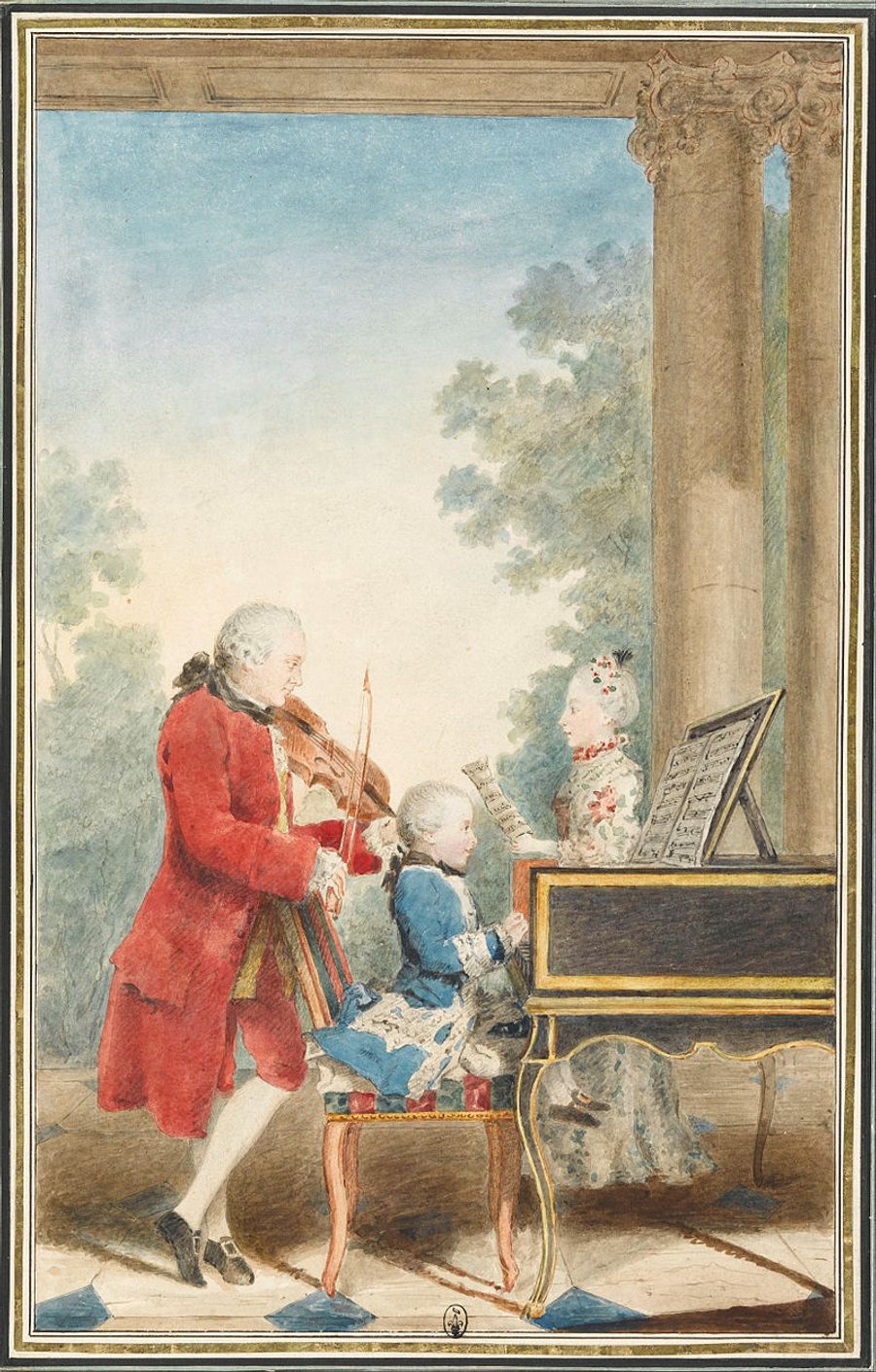
In 1764 the Mozart family was in the midst of the celebrated “Grand Tour,” presenting Wolfgang Amadeus Mozart (1756–1791) and his sister Nannerl across Europe as prodigious keyboard players. Their London stay proved unusually productive: besides public and court appearances, Mozart composed a cluster of works designed to meet local taste and to circulate in print. The sonatas K. 10–15 belong to this practical, cosmopolitan London moment—music written for domestic music-making, where a capable keyboard player could shine and a second player could join in without undue difficulty.[1][2]
What makes K. 11 worth attention is precisely this context. It is not yet the later “conversation” sonata of Mozart’s Vienna years; instead, it documents a genre in transition, when the accompaniment instrument is still optional in concept, yet increasingly integrated in practice. Hearing K. 11 with alert ears, one can catch the young Mozart learning how to pace contrasts, articulate cadences, and sustain interest over a multi-movement plan—skills that would later underpin his mature chamber music.[1]
Composition and Manuscript
Violin Sonata No. 6 in G major (K. 11) was composed in London in late 1764 as part of the set K. 10–15: sonatas for keyboard with the accompaniment of violin (or flute) and cello.[1] They were commissioned for the English court and dedicated to Queen Charlotte, with Leopold Mozart overseeing their publication in London as Mozart’s “Opus III.”[1]
Modern cataloguing also reflects the sonatas’ mixed identity. Although many editions and traditions call them “violin sonatas,” the Neue Mozart-Ausgabe groups K. 10–15 with the piano trios—an editorial reminder that the keyboard carries the structural argument while the violin part typically reinforces melody, doubles lines, or adds light counterpoint.[1] The work is widely available in score through major public-domain repositories, which has helped keep these early sonatas in study and performance despite their comparative rarity on mainstream recital programs.[3]
Musical Character
K. 11 is a three-movement sonata whose layout already suggests Mozart’s instinct for contrast and proportion:
The opening Andante is poised and vocal in its phrasing—music that feels written to be “spoken” at the keyboard. The violin’s role, as in many juvenile sonatas, tends to colour and support the melodic line rather than to compete with it; nevertheless, the very option of adding violin points toward a social, collaborative style of music-making that London audiences and amateur players valued.[1]
The brief central Allegro in C major functions like a bright interlude—an efficient change of key and affect that keeps the overall design light on its feet. The closing Menuetto (with a return “da capo”) places K. 11 close to the dance-inflected world of mid-18th-century domestic entertainment: balanced two- and four-bar units, clear cadential punctuation, and a surface charm that is not “lesser Mozart” so much as Mozart writing exactly what the moment required.[1]
In sum, Violin Sonata No. 6 in G major deserves attention as a small but telling document of Mozart’s London apprenticeship: a child composer working inside an established commercial genre, absorbing the galant idiom, and already shaping it with unmistakable clarity. For listeners who know the mature violin sonatas, K. 11 offers a fascinating before-image—an early sketch of Mozart’s lifelong gift for making simple materials feel inevitable.
Sources
[1] Wikipedia: background on Mozart’s London set K. 10–15 (commission, dedication, publication context) and K. 11 movement list
[2] Naxos booklet note (PDF) for the early London sonatas: arrival in London (April 1764), publication/dedication (January 1765), stylistic influence (J. C. Bach), and track listing including K. 11 movements
[3] IMSLP: public-domain score access page for Violin Sonata in G major, K. 11