
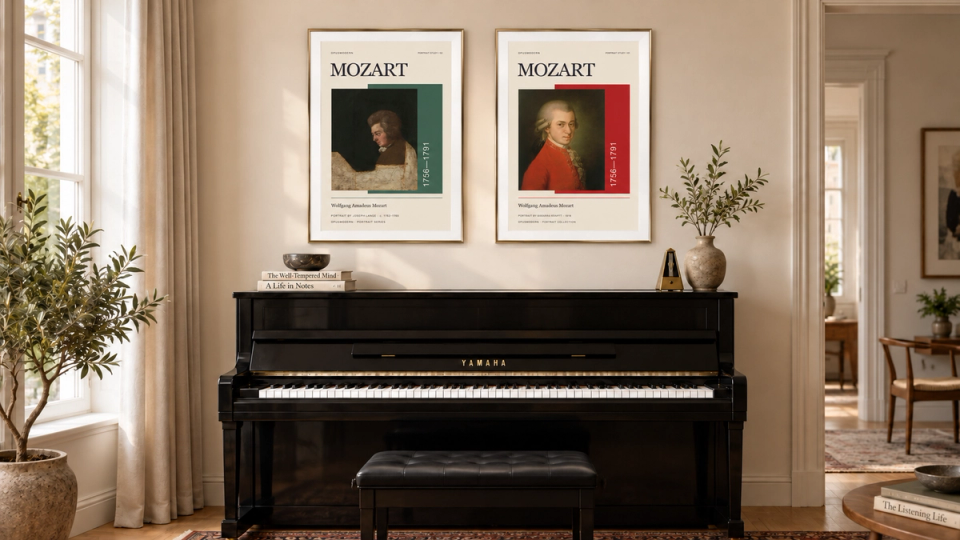
We know his music. His face is harder to pin down. Three portraits reveal how Mozart was seen and remembered—and why we give each face a different place, colour and presence in Opus Modern’s poster designs.
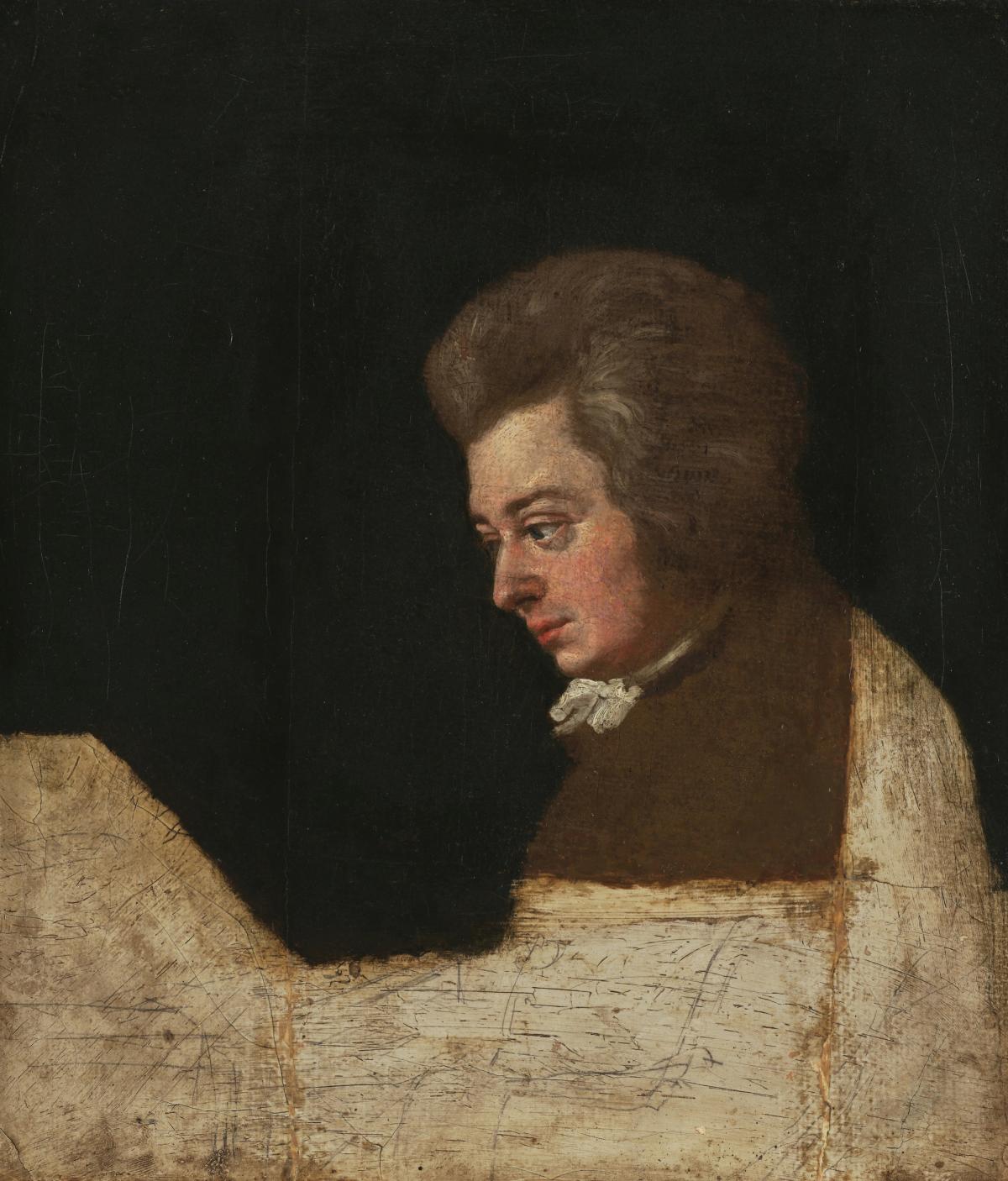
Look at Joseph Lange’s portrait of Mozart and the eye goes straight to the face. Light catches the forehead and nose. The gaze turns downwards, towards a keyboard that the painter never fully brought into view. Below the dark coat, the picture opens into an expanse of unfinished canvas.
It is tempting to imagine the brush stopping halfway through a sitting. The painting has a more surprising history: evidence indicates that its finished head began as a smaller portrait, later incorporated into a larger canvas. The unfinished work is the extension around it. [1]
That distinction changes how we look at Mozart. A portrait can preserve a meeting, carry a family’s memories or assemble a face from earlier images. The three paintings associated with Joseph Lange, Johann Nepomuk della Croce and Barbara Krafft do all these things between them. In Opus Modern’s Mozart portrait collection, we bring those faces into a shared graphic setting while giving each its own colour. The choices make more sense when we look at the original and its history alongside the poster.
Joseph Lange: a finished face inside an unfinished painting
Lange belonged to Mozart’s family circle. An actor as well as a painter, he married the singer Aloysia Weber, elder sister of Constanze Mozart. When Mozart married Constanze in 1782, Lange became his brother-in-law. He knew the man whose face he painted. [1]
Painting was a serious pursuit alongside Lange’s theatrical career. He had trained at the Vienna Academy, and other surviving portraits show his interest in modelling faces through colour and light. Here, the small illuminated head has a concentration that is easy to overlook when the bare lower canvas attracts all the attention. [1]
The musicologist Michael Lorenz compared older photographs with the painting and examined it in Salzburg in 2010. His reconstruction places a small portrait of Mozart’s head and upper shoulders inside the larger composition. In photographs taken before restoration, the boundaries of that earlier piece are much easier to see. [1]
The dates become more intelligible when we think of two stages. The original small portrait may date from around 1782–83. An enlargement intended to show Mozart at a piano may belong to about 1789. These are proposed dates, supported by different clues, rather than a securely documented timetable for the surviving object. Why the enlargement remained unfinished is unknown. [1]
Mozart’s letters offer two tantalising glimpses. On 3 April 1783, writing from Vienna to his father Leopold, he mentioned two portraits that would follow and said he thought both were good likenesses. Lorenz proposes that Lange’s small Mozart portrait could have been one of them, alongside a portrait of Constanze. The letter itself does not name their painter or identify the surviving canvases. [1][2]
Six years later, on 16 April 1789, Mozart wrote to Constanze from Dresden. Among questions about visitors and life at home, he asked whether the Langes came by and whether work on the portrait was continuing. The connection is suggestive; it does not establish beyond doubt that he meant the enlargement we see today. [3]
The same letter reveals how much a likeness could matter in ordinary life. Mozart told Constanze that he placed her portrait before him when writing to her, and spoke to it before going to bed and on waking. For him, a painted face could keep an absent person company. The letter does not identify that portrait either, but it gives these small family pictures an intimacy that a museum label cannot convey. [3]
Constanze’s own later judgment adds another layer. Accounts of Vincent and Mary Novello’s visit in 1829 report that she regarded Lange’s portrait as the best likeness of her husband. This is the memory of a widow nearly four decades after Mozart’s death. It matters deeply, while answering a different question from what Mozart himself thought of the image. His 1783 letter gives us an opinion about two likenesses; it does not establish a favourite portrait. [2][4]
Why muted green for Lange
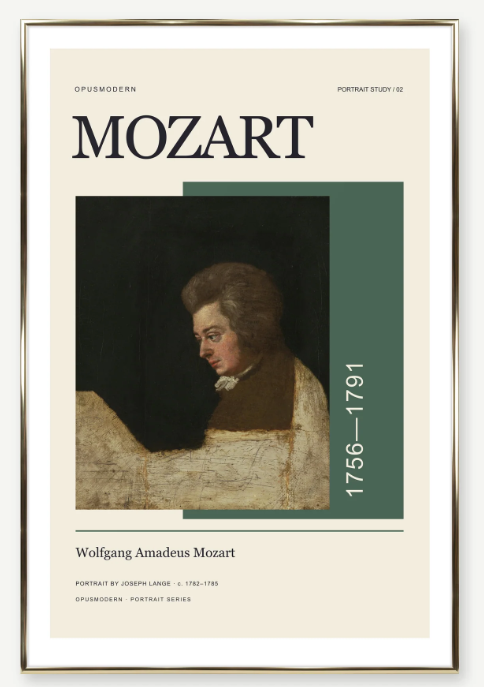
For Opus Modern’s Lange Portrait art print, we pair Lange’s portrait with a muted green panel. Its subdued colour gives the dark painting room, while the warm light on Mozart’s face remains the point of attention. The green also sits comfortably beside the brown tones and exposed canvas. In this design, the surrounding colour supports the small, concentrated face rather than competing with it.
Keeping the unfinished area in the poster matters just as much as choosing the colour. A crop of the head alone would hide the painting’s most intriguing history. The larger image lets the finished face and unresolved surrounding work remain visible together. The restrained green suits that close looking: this is the Mozart known within a family circle, preserved in a painting whose physical history still invites questions.
The Croce portrait: put the family back into the picture
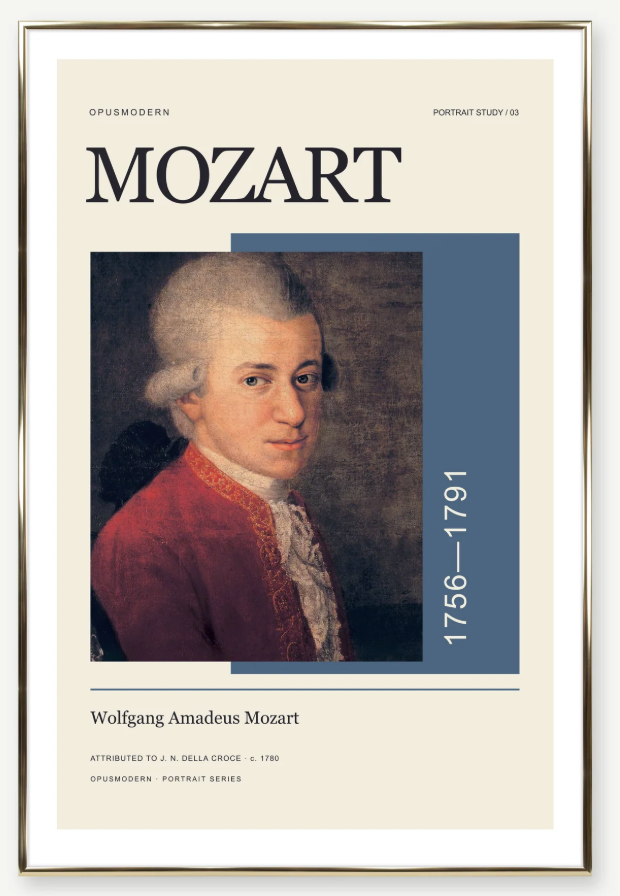
The red-coated Mozart associated with Johann Nepomuk della Croce is often encountered as a face on its own. Restore the wider picture and an entire household comes into view.
In the large Mozart family portrait, Wolfgang and his sister Maria Anna—known as Nannerl—sit at the keyboard. Leopold holds a violin. Above them, their mother Anna Maria appears in a framed portrait within the painting. She had already died: her painted presence allows the family to appear together again. The Mozarteum’s institutional catalogue dates the work to 1780/81. [5]

The arrangement makes music a family activity. Hands, instruments and the shared keyboard belong to the story as much as Wolfgang’s face. A cropped reproduction gives us a composer; the complete canvas lets us see the son and brother within the musical household that shaped him.
The artist’s name needs care. The painting is traditionally attributed to Johann Nepomuk della Croce. That attribution should accompany the image with its qualification intact, rather than turning a familiar label into certainty. Nor does a contemporary family painting, by itself, prove that Mozart sat for the artist named in its later cataloguing. [5]
For likeness, Nannerl’s recollections are more revealing. In the correspondence surrounding Barbara Krafft’s later Mozart portrait, she judged the figure of her brother in the family painting favourably and made the picture available as a model. She was remembering a face she had known throughout his life, although her account was written many years after the family canvas was made. [7][8]
The Croce motif used by Opus Modern is a detail of this family composition. Seeing the whole painting explains what disappears when Wolfgang is isolated: Nannerl’s place beside him, Leopold’s presence and the image of their mother above. The full canvas also leads directly to the third portrait, because it helped another artist reconstruct Mozart after his death. [5][7][8]
Why blue for the family-portrait detail
In Opus Modern’s Croce Portrait art print, we set the cropped face against a muted blue panel. The cooler field provides a contrast to the red coat and warm skin, giving the portrait a different balance from Krafft’s red design. Two red-coated Mozarts can then stand beside one another without looking like repetitions of the same image.
The crop moves Wolfgang into the foreground of our design. His turned head and direct look become easier to study, but the original family setting remains part of what the image means. That is why we show the complete painting here as well. The poster presents the face; its story returns the people around it. We retain the qualified artist credit beneath the image, so that the modern composition also carries the historical uncertainty.
Barbara Krafft: the familiar face painted in 1819
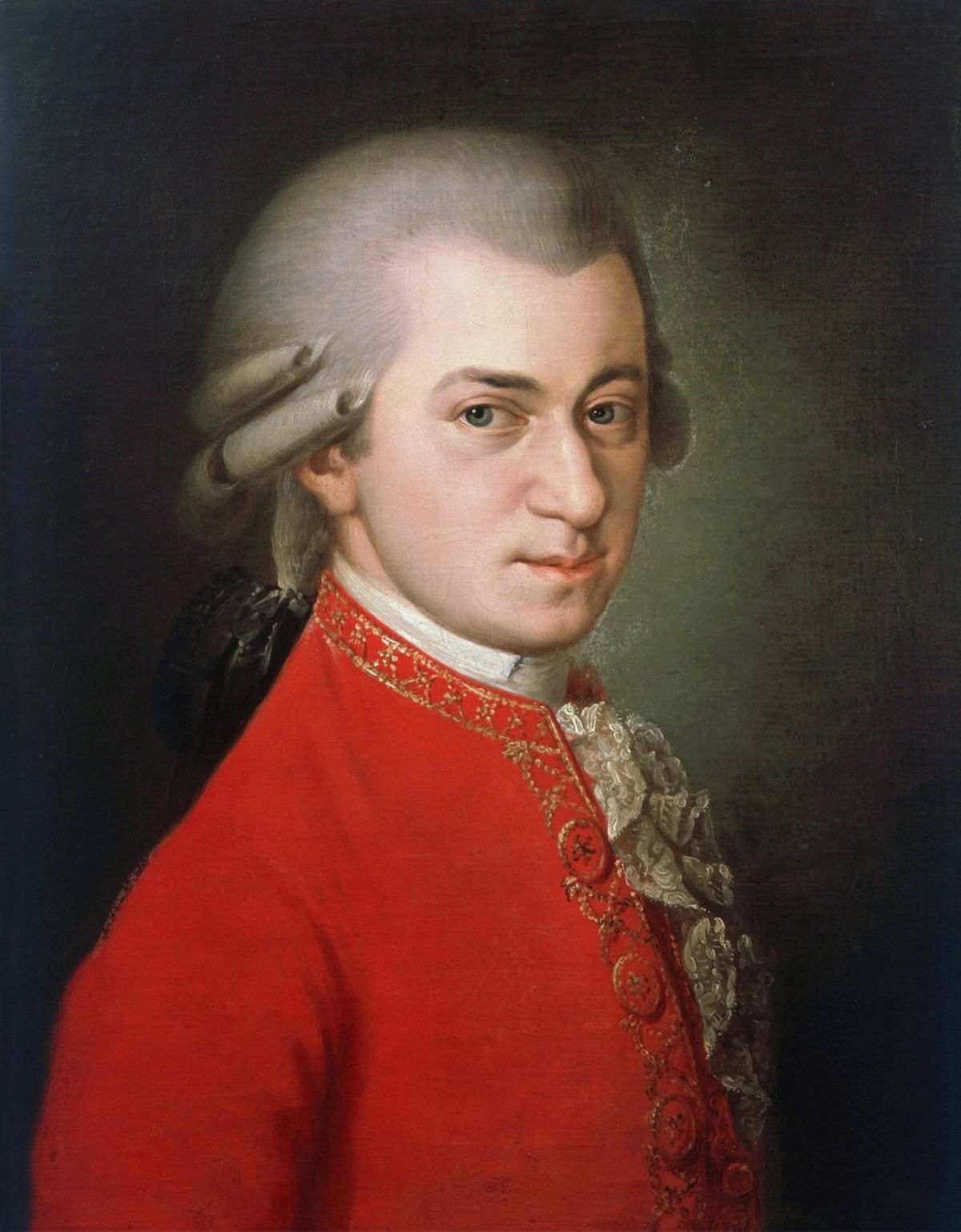
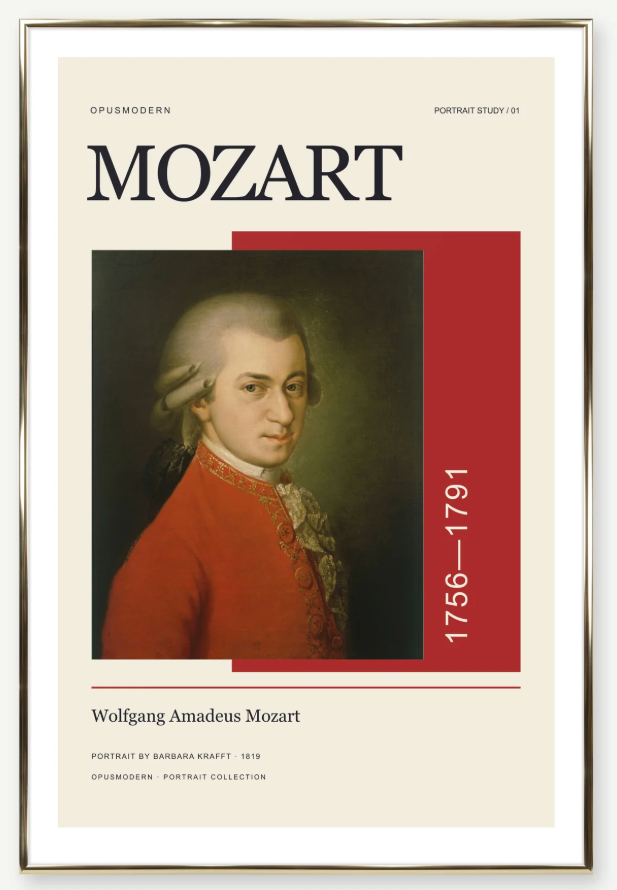
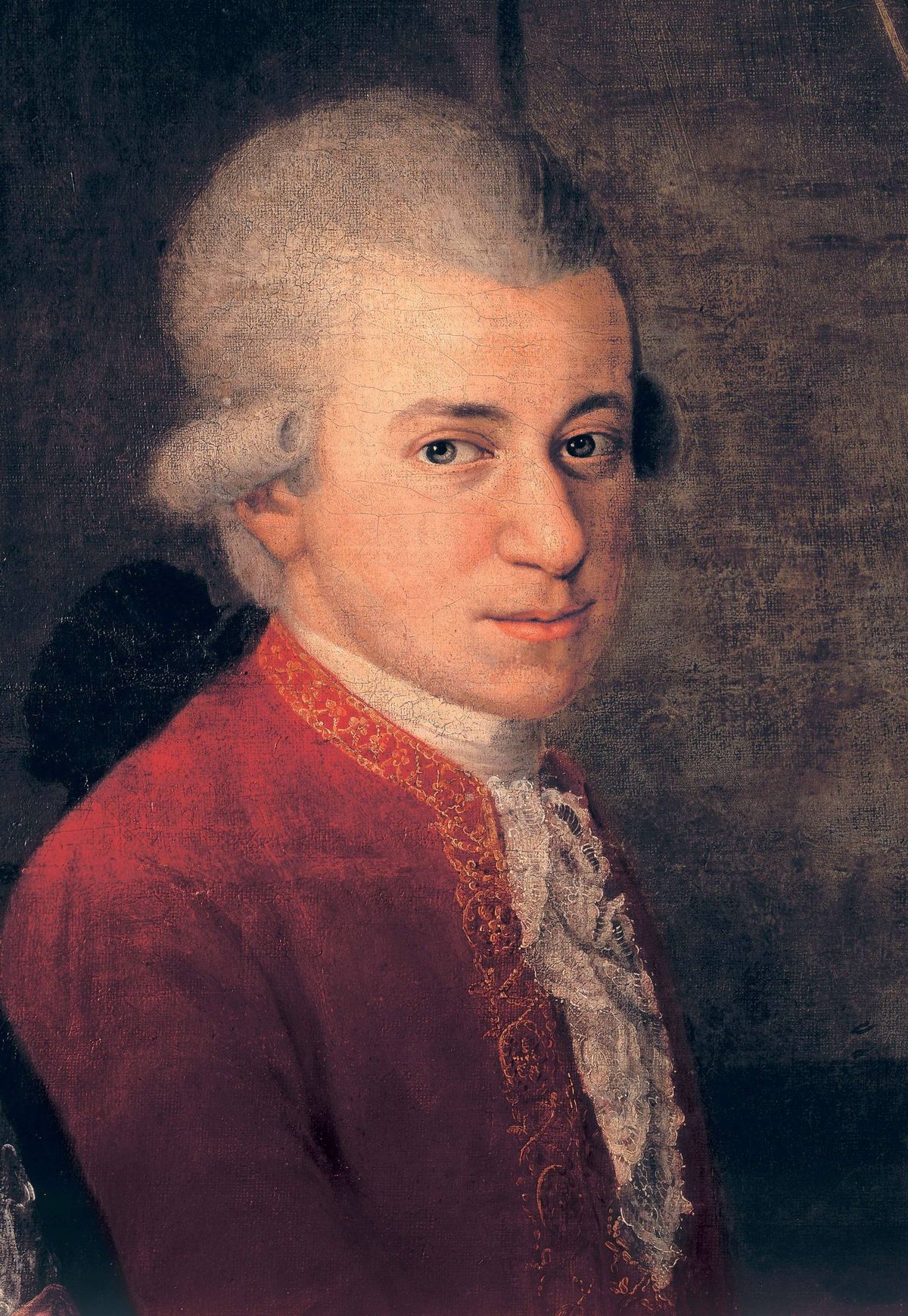
Barbara Krafft’s Mozart seems so familiar that it is easy to forget when it was made. The red coat, pale neckcloth and direct, composed gaze belong to a portrait painted in 1819, twenty-eight years after Mozart died. There could be no sitting for this commission. [6][7]
Joseph Sonnleithner commissioned the painting for the Gesellschaft der Musikfreunde’s collection of composer portraits in Vienna. Krafft needed earlier likenesses, and Mozart’s sister supplied them. The Austrian National Library’s catalogue identifies the family portrait and a now-lost miniature among her sources, citing Nannerl’s letter to Sonnleithner of 2 July 1819. [7][8]
The documentary account describes a practical problem. Nannerl considered the Mozart figure in the family portrait a good likeness; a smaller, later image showed him older but was difficult to enlarge. Krafft had to bring together information from pictures made at different times. Nannerl’s recognition helped guide the reconstruction, and the painter supplied the new composition. [8]
Krafft deserves to be seen alongside the famous face she created. Trained by her father, the painter Johann Nepomuk Steiner, she worked in Vienna, Salzburg, Prague and Bamberg. Salzburg Museum describes a woman who supported herself and her children through portraiture. Giving a sitter a recognisable presence was her profession. [6]
Her Mozart concentrates attention on the individual. The keyboard and family group have disappeared. Against the dark background, the face and bright coat carry the picture. Its compact composition helps explain why the image travels so easily into books, posters and other reproductions.
Family testimony gives this posthumous portrait a valuable connection to Mozart’s lifetime. It cannot remove the act of interpretation. Nannerl’s favourable assessment of the earlier family likeness should also be kept distinct from the frequently repeated claim that she declared Krafft’s finished painting the best portrait of all. The traceable account of the source pictures supports the former; it should not be made to prove the latter. [7][8]
Why red for Krafft
The red panel in Opus Modern’s Redline Portrait Mozart art print picks up the most prominent colour in the painting: Mozart’s coat. Extending that colour into a flat geometric shape connects the historical image to the surrounding design. The familiar face holds its place within the composition, while the red gives it a clear presence against the warm ivory ground.
This is the most immediately recognisable of our three Mozart faces, and the colour reinforces that familiarity. The painter’s name and the date 1819 remain below it. They give the viewer a way back into the story: the face that looks so established was created after Mozart’s death, with earlier portraits and Nannerl’s knowledge helping to bridge the distance.
Three portraits to look at again
Each image rewards a different kind of attention. With Lange, look at the boundary between the resolved face and the unfinished surrounding work. With the family portrait, look beyond Wolfgang to the people and music around him. With Krafft, consider how an artist working after his death turned older likenesses and his sister’s knowledge into a face that became widely familiar.
There is no need to choose one as the final answer to what Mozart looked like. Together, they show how recognition survives: in an artist’s acquaintance, a sister’s judgment, a widow’s recollection and the choices of a painter working for posterity.
A shared design, three different stories
Opus Modern’s three Mozart portrait posters share a warm ivory ground, a large serif MOZART heading, an offset colour panel and a compact artist credit. The arrangement gives this part of Opus Modern’s poster collection the consistency of a series. The ivory leaves breathing room around the darker paintings, and the serif lettering gives the name the presence of a title on an art-book cover. Smaller lettering keeps the painter and attribution available to a viewer who steps closer.
The vertical dates, 1756–1791, belong to Mozart’s life. The dates in the artist credit belong to the portrait. Keeping those two kinds of date distinct is especially revealing with Krafft: Mozart’s lifetime ends in 1791, while the image beneath his name was painted in 1819. Lange’s current poster credit uses c.1782–1785; the fuller history discussed here separates the possible early head portrait from the later, unfinished enlargement.
Colour gives each member of the series its own identity. Red echoes Krafft’s coat and the portrait’s familiar presence. Blue creates a cooler counterpoint around the family-portrait detail. Muted green accompanies the darker, unfinished Lange composition. These are contemporary responses to the paintings we have chosen, grounded in what the viewer can see.
The room illustration above shows Opus Modern’s Lange and Krafft designs together over a piano. Their shared layout connects them, while their colours and different views of Mozart keep each distinct. Knowing the originals gives the pairing another dimension: one face comes from a painter in Mozart’s family circle, the other from a reconstruction made long after he died.
Sources
[1] Michael Lorenz, ‘Joseph Lange’s Mozart Portrait’, 19 September 2012, updated 20 July 2019.
[4] Vincent and Mary Novello, A Mozart Pilgrimage: Being the Travel Diaries of Vincent & Mary Novello in the Year 1829, Novello, 1955.
[6] Salzburg Museum, ‘Barbara Krafft – Porträtistin der Mozartzeit’, exhibition presentation, 2019–2020.
[7] Österreichische Nationalbibliothek, ‘Bildnis Wolfgang Amadeus Mozart’, ÖNB Digital, BAG_10001582.
Image credits
Supplied by Opus Modern for this advertiser-content feature.
Opus Modern official brand logo.
Joseph Lange / Wikimedia Commons. Public domain. Source. Public Domain Mark.
Opus Modern. Supplied design reference.
Traditionally attributed to Johann Nepomuk della Croce / Wikimedia Commons. Public domain. Source. Public Domain Mark.
Opus Modern. Supplied design reference.
Traditionally attributed to Johann Nepomuk della Croce / Wikimedia Commons. Public domain. Source. Public Domain Mark.
Barbara Krafft / Wikimedia Commons. Public domain. Source. Public Domain Mark.
Opus Modern. Supplied design reference.