This article looks at the Minuet in G major, K. 1e (KV 1,01), with its short Trio in C major, as preserved in Nannerl’s Notebook. It traces Leopold Mozart’s role as notator, discusses why its date is debated, and breaks down the music’s simple minuet‑and‑trio design and style.
Inside the Mozart Home: How a Five-Year-Old Wrote His First Masterpiece
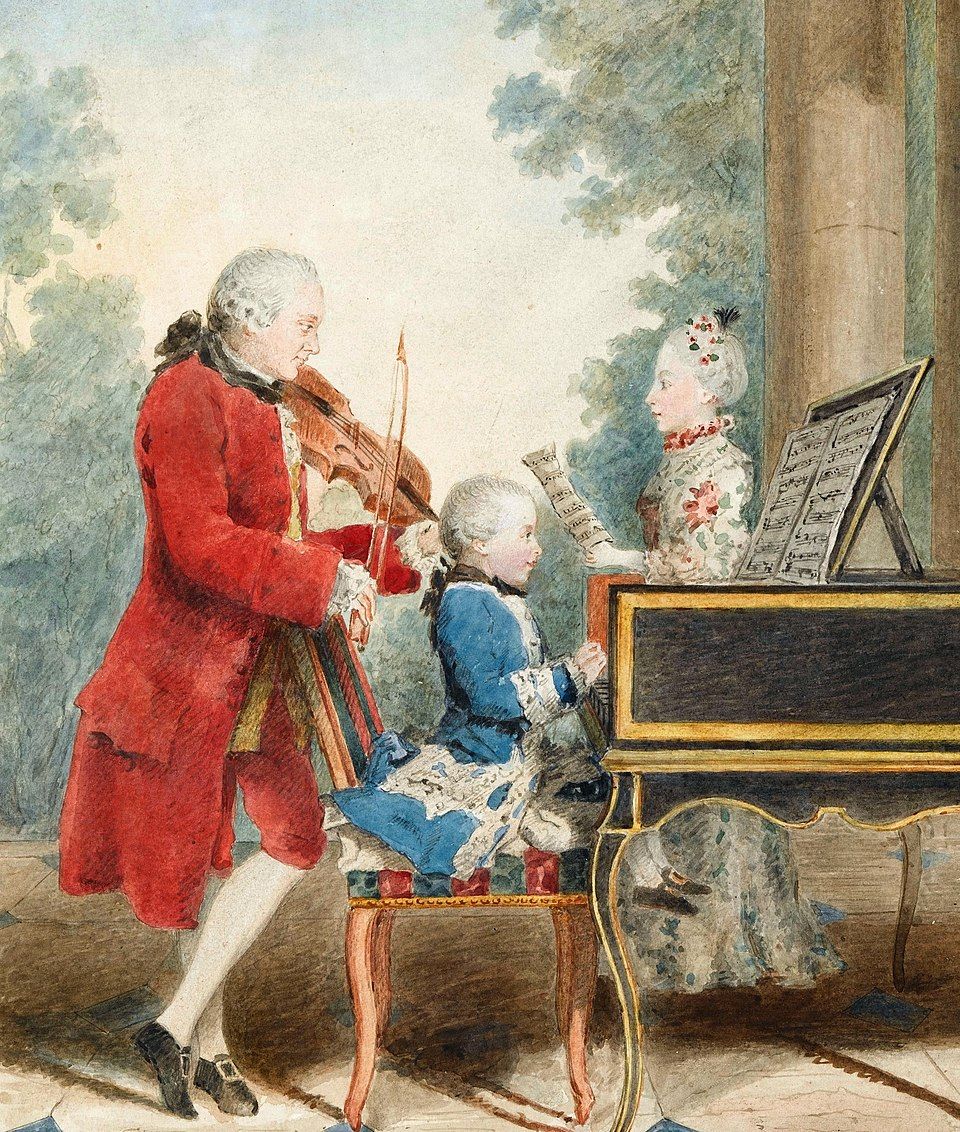
In the early 1760s, the Mozart home in Salzburg was alive with music. Family patriarch Leopold Mozart – a violinist, composer, and renowned pedagogue – began teaching his children music almost as soon as they could walk. Young Wolfgang Amadeus Mozart received his first keyboard, violin, and even basic composition lessons at the astonishing age of four, alongside his older sister Maria Anna “Nannerl” Mozart[1]. Leopold had compiled a notebook of simple keyboard pieces in 1759 for seven-year-old Nannerl’s training, and Wolfgang, ever curious, quickly joined in using this Notenbuch (music book) as well[2]. By all accounts, Wolfgang was eager and absorptive – he idolized Nannerl and wanted to do everything she did. Family lore recounts how the toddler would watch Nannerl’s harpsichord lessons with rapt attention and then imitate her playing by ear[3]. The siblings were very close, even inventing fantasy kingdoms in play, and Nannerl often helped her little brother grasp musical concepts between formal lessons[4]. In this nurturing yet disciplined environment – overseen by Leopold’s strict but loving guidance – the seeds of Mozart’s genius took root.
Leopold’s approach to teaching was thorough and somewhat ahead of its time. He not only taught his children to play instruments and read music, but introduced music theory from the start. The very first page of Nannerl’s notebook contains a hand-drawn table of musical intervals, evidence that Leopold drilled fundamentals early[5]. He even gave little Wolfgang and Nannerl rudimentary composition exercises – supplying a bass line or a simple melody for them to continue or vary, and showing them basic structural models[5]. In essence, he treated composition as part of their music lessons from the outset. This patient mentorship laid the groundwork for Wolfgang’s own creative attempts.
Crucially, Leopold also had the acuity to recognize true talent and preserve it. He observed Wolfgang’s uncanny musical ear and memory with amazement. On one occasion, Leopold noted in the notebook that Wolfgangerl (his affectionate nickname for Wolfgang) learned an entire minuet and trio by a local composer in just 30 minutes – this on January 26, 1761, the day before Wolfgang’s fifth birthday[6]. In another entry, Leopold recorded that Wolfgang, at age four, learned a scherzo by Georg Wagenseil “between 9 and 9:30 in the evening of 24 January 1761”[7]. These jottings give us a vivid glimpse of the Mozart household at night: the tiny boy up past his bedtime, eagerly mastering a new piece in mere minutes while his proud father documented the feat for posterity. Such anecdotes foreshadow the prodigy’s near-miraculous ability – “by the time he was five, he was already competent on keyboard and violin, had begun to compose, and performed before European royalty”[8].
Contemporaries were initially skeptical that any child could display such musical prowess. The Prince-Archbishop of Salzburg himself doubted the authenticity of Wolfgang’s earliest pieces, suspecting Leopold must have written them because they were “not nearly so childish” as one would expect from a five-year-old[9]. But Leopold was determined to prove his son’s genuine talent. He carefully dated Wolfgang’s accomplishments and even saved humorous evidence of the boy’s gifts. For instance, family friend Andreas Schachtner later recounted walking in to find four-year-old Wolfgang “busy with his pen”, attempting to compose a keyboard concerto before he even knew proper notation[10]. The manuscript was a blotted mess of ink. Schachtner and Leopold initially laughed at the “apparent nonsense”, until Leopold’s eyes fell on patterns in the boy’s scrawl. He grew serious and reportedly wept with joy, exclaiming: “Look… how correct and orderly it is!”[11]. The only problem was that Wolfgang had imagined a piece so difficult no one could play it, to which the precocious child replied that of course it was hard – “that is why it is a concerto; it must be practiced till it is perfect!”[12]. Such stories, whether embellished or not, portray a household astonished by its youngest member. Even as Leopold guided every step, he too was often scrambling to keep up with Wolfgang’s natural gifts.
Nannerl’s Notebook and Wolfgang’s First Compositions
Leopold’s Notenbuch für Nannerl (Nannerl’s Music Book) became the chronicle of Wolfgang’s first compositions. This small bound book – essentially a homemade beginner’s method – contained dozens of short keyboard pieces (mostly minuets, allegros, and dances) that Leopold or others had written out for Nannerl to practice[13]. As Wolfgang began experimenting with making his own melodies on the clavier, Leopold took the extraordinary step of acting as his scribe. In fact, Wolfgang’s first 14 compositions (written between ages five and seven) are all notated in Leopold Mozart’s handwriting[14]. The young Wolfgang “learned to play and compose before learning music notation”, as one scholar notes, so his father dutifully wrote down the boy’s improvisations[15]. This raises an obvious question: how much of these pieces was truly Wolfgang’s invention, and how much came from Leopold’s guiding hand? Surviving evidence suggests a nuanced answer. Leopold did provide a framework – teaching Wolfgang common patterns and probably giving feedback – but he also appears to have transcribed the child’s ideas faithfully, without heavy editing[16][17].
A Tiny Minuet with Big Implications: K. 1e in G Major
Among Mozart’s notebook compositions, one piece has gained particular fame: the Minuet in G major, K. 1e, often cited (albeit mistakenly) as Mozart’s first composition. This charming 18-bar minuet – with an accompanying 8-bar trio in C major – exemplifies the musical world of the Mozart children and the creative leaps Wolfgang was making. It is frequently lauded because the idea of a five-year-old writing a graceful minuet seems almost magical. However, historical sleuthing reveals an intriguing twist: this particular Minuet in G was probably composed a few years later than the others, around 1764 when Wolfgang was about seven or eight[29]. In the past, many assumed it was written in 1761, but modern scholars analyzing paper types and chronology of the notebook concluded that “the oft-cited earliest composition, the Minuet in G major with Trio (K. 1e), actually originated later, in 1764”[29]. By that time Mozart had toured Europe and was no longer the baby composer of Salzburg, but a seasoned child performer who had absorbed a world of new music (including the London and Paris styles). This likely explains a subtle stylistic difference: K. 1e sounds a bit more polished and galant compared to the rawer pieces from 1761[30].
Despite the dating quirk, the Minuet in G is still part of Mozart’s earliest collection of works, and it richly deserves attention. Leopold presumably notated it in the notebook as he did the others[31]. The piece is written for solo harpsichord (as were all the notebook pieces) and is in a bright G major. As a minuet, one might expect a stately, courtly dance in triple time – but Mozart’s youthful take on the form is actually lively and light-footed. Marked allegro in some editions, it moves along with a cheerful energy (quick 3/4 time) rather than a slow, ceremonious lilt[30]. The structure shows that by age seven Wolfgang understood the basic layout of a minuet-and-trio. The Minuet section itself is a short binary form: two phrases of eight bars each, each phrase repeated. Every two-bar subphrase begins with a distinctive motif – a descending interval of a fifth, followed by four chords outlining the harmony[32]. Within this simple framework, the “tune” gently unfolds. It’s essentially a series of repeated ideas: Mozart sets up a pattern (a falling fifth and chordal response) and sticks with it, creating a sense of balance and symmetry even with limited material. The harmony is rudimentary (just two-part writing, with Alberti-type broken chords at times), but correct; the little boy knew to end his phrases with proper cadences in G major.
The Trio section provides contrast by shifting to the subdominant key of C major (a typical Classical-era move for a trio)[33][34]. This trio, only eight measures long, likely corresponds to what some catalogues list as K. 1f, suggesting it was conceived as a pair with the G major minuet[33][35]. When played together, the minuet, trio, and a da capo repeat of the minuet barely last a minute – but within that minute we hear Mozart experimenting with the graceful dance form that would recur in his later serenades and quartets. Interestingly, unlike the slightly earlier Minuet in F, K. 1d, which still showed heavy Baroque influences (like start-and-stop phrases and ornamental trills in the style of his father’s pieces), this G major minuet sounds simpler and more “modern”[30]. A musicologist notes that K. 1e is “far less influenced by the Baroque style” than K. 1d[30]. Instead, it aligns with the light galant style of the mid-18th century – the kind of elegant, unpretentious melody one might hear in a ballroom or drawing room. In short, Mozart’s Minuet in G is a snapshot of a child composer mastering the rules of a courtly dance while infusing it with his own ingenuous charm.
To an analytical ear, there is nothing particularly innovative in K. 1e – it uses the standard vocabulary of its day. But the mere fact that a child could internalize this vocabulary and produce a coherent piece of dance music is astounding.
Today, the Minuet in G major is often one of the first pieces by Mozart that piano students learn, precisely because it’s short and accessible. Knowing its origins, one can’t help but smile at the idea that Mozart wrote it (or something very close to it) as a small child. The piece exemplifies purity and clarity: it has no false notes, no awkward turns, just a straightforward little melody with a gentle swing.
Genius in the Making: Reactions and Reflections
Contemporaries who heard Mozart’s early compositions were often at a loss to explain them. Many simply marveled. After the Mozart children’s first public appearances in 1762, a flurry of testimonies speak of Wolfgang’s ability to improvise an accompaniment to any melody, to play complex pieces blindfolded, and to compose little songs on a dare[36][47]. Such accounts fed the myth of the effortless “natural genius”. It is telling, though, that Leopold Mozart – in private letters – downplayed mysticism and emphasized hard work. He described how he drilled Wolfgang daily, and how music occupied almost all their hours on tour[48][49]. The reality was a mixture of innate aptitude and relentless training. Mozart’s Minuet in G, K. 1e can be seen as a product of that synergy. It is at once a little boy’s creation and the outcome of an exceptional music pedagogy.
What do today’s scholars say about K. 1e and its brethren? They tend to smile at these pieces as precocious amusements, never intended as great art but invaluable for what they reveal. In them, we see Mozart learning the craft. We see Leopold teaching composition by having Wolfgang piece together small forms – a minuet here, an allegro there – much like a child learning to build sentences. One scholarly examination notes that Leopold likely provided harmonic templates and exercises, “suggesting that Mozart try various experiments with rhythm and melody while keeping to a given bass line”[50][51]. In K. 1e’s case, the repeated two-bar phrases over a simple bass could well have been such an exercise (“Wolfgang, see how many bars you can make with this falling fifth pattern”). If so, the boy passed with flying colors. Historians also point out that Nannerl’s influence should not be overlooked. She was by all reports an extremely talented pianist for her age; some have mused that her playing and even her feedback might have spurred Wolfgang on – essentially a friendly sibling rivalry pushing him to excel[52][53]. Though no compositions of Nannerl survive, it’s acknowledged that she likely helped preserve Wolfgang’s early works and perhaps even had a creative dialogue with him[54]. The Mozart family’s dynamic – two wunderkind children and an ambitious father – created a unique incubator for genius.
Thus, Mozart’s K. 1e Minuet in G major is far more than a beginner’s exercise. It is a tiny testament to the early flowering of an immortal talent. Historians treasure it for the honest window it gives into Wolfgang’s upbringing – the lessons with Papa Leopold, the duets with Nannerl, the innocent confidence of a boy who didn’t yet know what he wasn’t supposed to be able to do. And for listeners, this little minuet still carries a special excitement. When those first four chords sound, announcing a child’s idea of a courtly dance, we are hearing the dawn of genius. It may only last half a minute, but in that half-minute lies the opening chapter of one of music history’s most extraordinary stories[22][57].
//
Sources:
Sources
- Mozart family letters and documents (Mozarteum’s Digital Mozart Edition)[22][58][6]
- Nannerl’s Music Book (Wolfgang Plath ed., Neue Mozart-Ausgabe)[5][30]
- Otto Jahn, Life of Mozart (1856), including Schachtner’s 1792 letter[59][12]
- Otto Erich Deutsch, Mozart: A Documentary Biography (1965) – translated excerpts
- Ruth Halliwell, The Mozart Family: Four Lives in a Social Context (1998)
- Cliff Eisen & Simon P. Keefe (eds.), The Cambridge Mozart Encyclopedia (2006)
- Ulrich Leisinger (intro), Nannerl-Notenbuch facsimile (Mozarteum/ISM, 2009)[60][43]
- Rebekah Maxner, analysis of Leopold’s teaching methods[61][21] (2021)
- Pianolibrary and IMSLP references to K.1a–1f[33][34]
- [1][22][23][29][36][58] Wolfgang Amadeus Mozart – Wikipedia
- https://de.wikipedia.org/wiki/Wolfgang_Amadeus_Mozart
- [2][6][7][43][57][60] Mozart, Wolfgang Amadeus (1756-1791) | Mozart & Material Culture
- https://mmc.kdl.kcl.ac.uk/entities/person/mozart-wolfgang-amadeus/index.html
- [3][4][52][53][54] Maria Anna Mozart: The Prodigy & Sister in Wolfgang's Shadow | Piano Lessons & Music History | Move Over Mozart
- https://www.moveovermozart.net/newsletters/mmm-volume-3
- [5][18][19][27][28][30][31][32][44] Nannerl Notenbuch - Wikipedia
- https://en.wikipedia.org/wiki/Nannerl_Notenbuch
- [8] Wolfgang Amadeus Mozart - Wikipedia
- https://en.wikipedia.org/wiki/Wolfgang_Amadeus_Mozart
- [9][37][38][41][48][49] The Myth of Mozart’s Education | Mozartrazom
- https://www.mozartrazom.com/the-myth-of-mozarts-education/
- [10][11][12][24][42][47][59]Life of Mozart, by Otto Jahn
- https://www.gutenberg.org/files/43411/43411-h/43411-h.htm
- [13][15][26] The Music Books of Mozart & His Sister – Pianodao
- https://pianodao.com/2018/10/19/the-music-books-of-mozart-his-sister/
- [14][16][17][20][21][25][39][40][45][46][51][55][56][61] Leopold Mozart’s guide on how to teach composition to creative kids – Rebekah Maxner
- https://rebekah.maxner.ca/2021/01/26/leopold-mozarts-guide-on-how-to-teach-composition-to-creative-kids/
- [33][34][35] Notebook for Nannerl, KV 1–8 (Wolfgang Amadeus Mozart)
- https://www.pianolibrary.org/composers/mozart/notebook-for-nannerl/
- [50] Mozart's first compositions - Pianonoise!
- https://www.pianonoise.com/Composer.Mozart.htm