- Köchel Number
- K9 1d | K6 1d
- Genre
- Piano Music
- Form
- Piano Pieces
- Key
- F Major
- Date
- 16 December 1761
- Place
- Salzburg
- Age
- 5
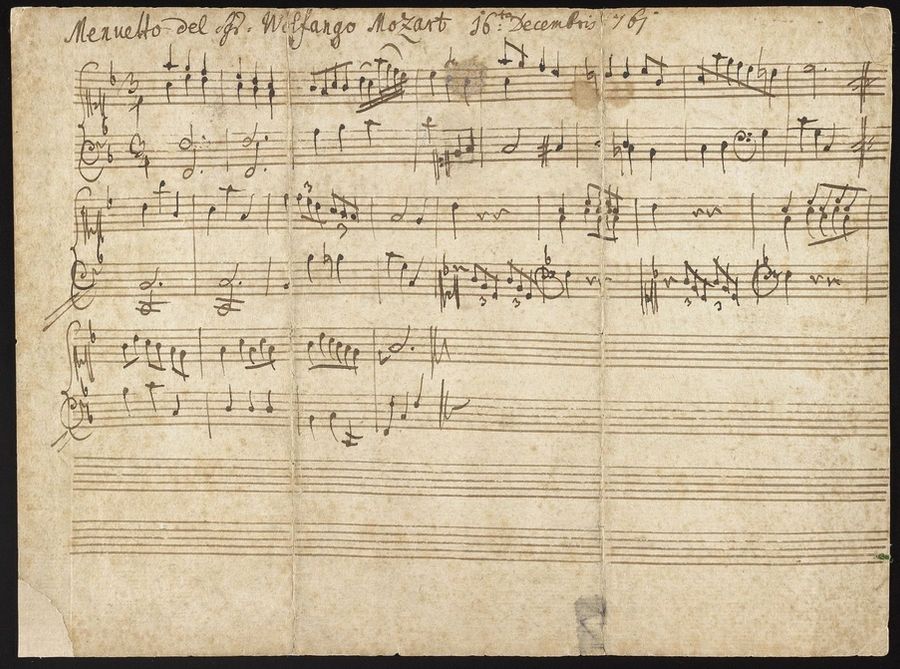
Mozart’s Minuet in F major, K. 1d is a tiny solo keyboard dance from his earliest childhood, written down by Leopold Mozart in Nannerl’s notebook in December 1761. This article outlines what a minuet is and describes the piece’s structure, key plan, and characteristic figurations.
Mozart’s First Minuet: The Story of K. 1d in F Major
Mozart’s Minuet in F major, K. 1d holds a special place as one of the very first compositions by the young prodigy. It is a charming, minute-long keyboard piece – a graceful courtly dance written in December 1761 when Mozart was only five.
This tiny minuet is remarkable not only for the composer’s tender age but also for its polished form and musicality, offering early evidence of Mozart’s extraordinary talent nurtured in Salzburg.
What Is a Minuet?
The minuet (from the French menuet) is a social dance of French origin, popular in 17th- and 18th-century courts, known for its stately, elegant character and triple meter (3/4 time).
Originally a dance for pairs of dancers, the minuet also evolved into a musical form – typically a short piece with two repeated sections (often followed by a contrasting trio and a return to the minuet in larger works).
By Mozart’s era, minuets were common in teaching pieces and in high society entertainment. A minuet’s music is usually graceful and moderate in tempo, emphasizing poised, balanced phrases to match the refined steps of the dance.
A Prodigy at Five: Mozart Composes K. 1d
Wolfgang’s musical journey began astonishingly early. His father, Leopold Mozart, was a skilled composer and the deputy Kapellmeister in Salzburg, who started teaching music to Wolfgang’s older sister Maria Anna (“Nannerl”) around 1759. The young Wolfgang absorbed these lessons eagerly.
By age four, he could play pieces and even tried composing simple melodies. In 1761, shortly after his 5th birthday, Wolfgang produced his first little compositions, which Leopold proudly wrote down in Nannerl’s music notebook. These included a brief Andante and Allegro in C (K. 1a and K. 1b) and an Allegro in F (K. 1c), all only a few bars long but musically coherent.
By December 1761, Wolfgang was ready to tackle a more refined dance piece. On 16 December 1761, Leopold inscribed “Menuetto del Sgr: Wolfgango Mozart” with that date at the top of a new piece.
This was the Minuet in F, K. 1d, the last of Wolfgang’s compositions that year – essentially the culmination of his first year of composing. It’s likely that young Mozart was inspired by the music he heard and played during lessons: Nannerl’s notebook contained many simple minuets and pieces by Leopold and other composers like Georg Wagenseil.
Wolfgang’s own minuet closely follows the style of those pieces. In fact, historians note that K. 1d shows the influence of Leopold’s teaching pieces – it mirrors their galant, late-baroque flavor while still bearing the simplicity needed for a child.
Composing a minuet at age five also made practical sense: the minuet was a fashionable dance and a beginner-friendly form, so it was an ideal way for Wolfgang to demonstrate his progress.
Indeed, Leopold was preparing to showcase his wonder-child to the world – just a few weeks later, in early 1762, the Mozart family set off on their first public concerts in Munich and Vienna. K. 1d can be seen as proof that Wolfgang had mastered the basics of composition before this tour, adding a stately dance to his little repertoire of tunes.
Musical Features of K. 1d (Minuet in F)
Despite its brevity, the Minuet in F major K. 1d is impressively well-formed. It is written for solo keyboard (harpsichord at the time) and lasts only about one minute in performance.
The piece is constructed in an extended binary form: an eight-bar first section and a slightly longer second section of twelve bars, each marked with repeat signs. This means the minuet consists of two balanced halves (both halves are repeated), a common structure for dance movements.
In the first half, Mozart firmly establishes the home key of F major, presenting a polite, well-balanced opening theme. The second half ventures briefly to the dominant key of C major, with a few passing touches of minor color, before returning gracefully to F major for a clear and satisfying close – a simple form, yet one that shows young Wolfgang already understood how to create a small musical journey and return home harmoniously.
Stylistically, the minuet is stately in feeling – it has the poised, courtly character expected of the dance.
Each phrase begins with a firm chordal pattern (block chords in the right hand, for example), giving rhythmic clarity and emphasis for the dance step. As the piece unfolds, Mozart adds ornamentation and flowing triplet figures that bring elegance and forward motion to the melody.
This alternation between chordal openings and decorative movement closely mirrors the style of minuets by Leopold Mozart or Wagenseil, whose works the young composer would have known well. The result is a miniature yet refined piece that sounds polished, balanced, and charming despite its simplicity.
In performance, grace and lightness are essential: the downbeats should be gently accented, the phrasing airy and elegant, preserving the poised dignity of an 18th-century courtly dance.
///////
Sources:
Mozart’s Nannerl Notenbuch (Notebook) entries and commentary[11][22]; biographical notes from the Morgan Library and modern biographies[23][24]; and analysis from music historians[14][19], which together confirm the details of K. 1d’s composition, form, and historical context in 1761.
Nannerl Notenbuch - Wikipedia
https://en.wikipedia.org/wiki/Nannerl_Notenbuch
Wolfgang Amadeus Mozart — Grant Park Music Festival
https://www.grantparkmusicfestival.com/biographies/wolfgang-amadeus-mozart/
Minuet - Wikipedia
https://en.wikipedia.org/wiki/Minuet
Mozart's childhood - all information about the genius | Viennatickets
https://viennatickets.com/en/mozart-the-child-prodigy/
Hear the Pieces Mozart Composed When He Was Only 5 Years Old | Open Culture
Earliest compositions, K. 1a-1d : manuscript in the hand of Leopold Mozart, 1761. | Mozart, Wolfgang Amadeus, 1756-1791. | The Morgan Library & Museum
https://www.themorgan.org/music-manuscripts-and-printed-music/115399
Listen to the first piece that Mozart ever wrote… when he was FIVE years old - Classic FM
https://www.classicfm.com/composers/mozart/first-piano-music-minuet/
Sheet Music
Download and print sheet music for K. 1d Minuet in F from Virtual Sheet Music®.