K. 1,02

Minuet in C for Piano

볼프강 아마데우스 모차르트 작

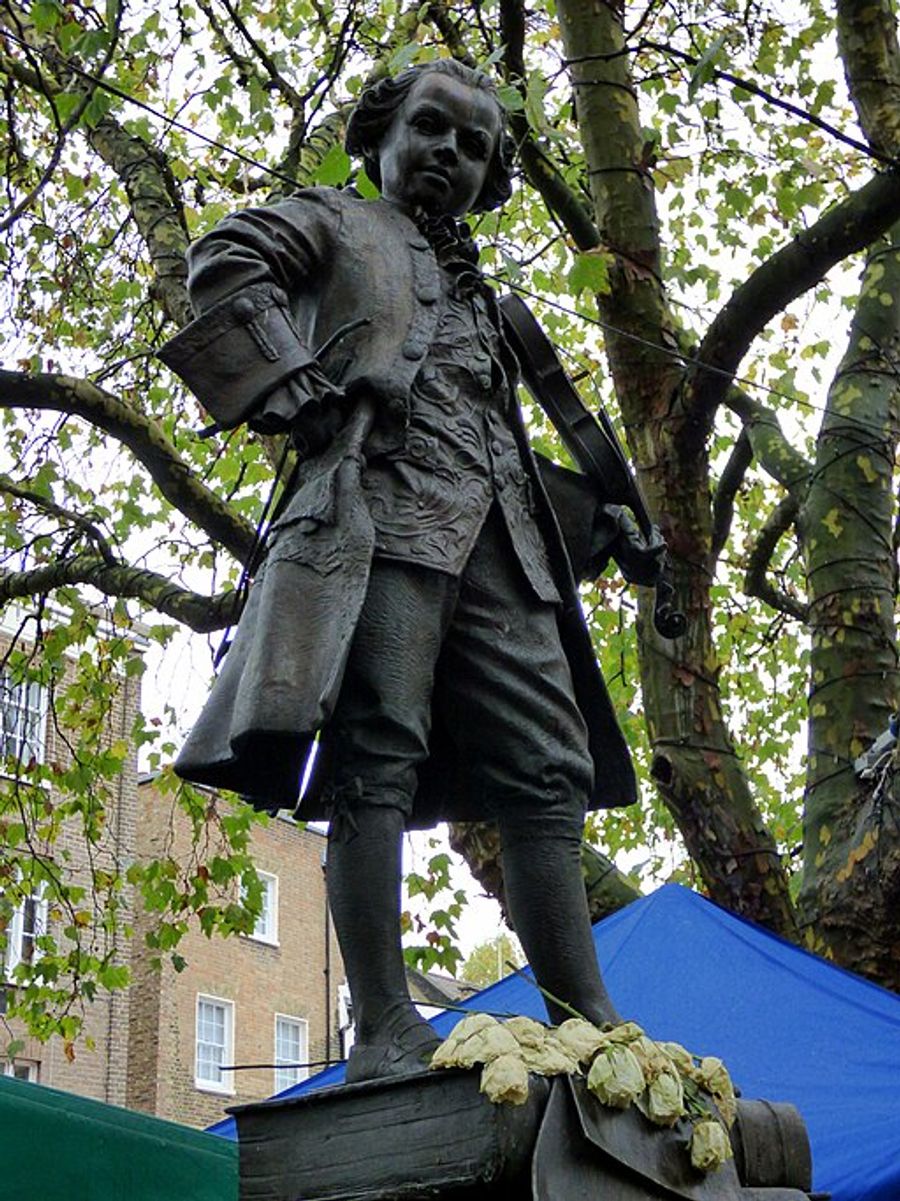
Statue of Wolfgang Amadeus Mozart, 1994, by Philip Jackson, Orange Square, corner of Ebury Street and Pimlico Road, Belgravia, City of Westminster, London.

Composition & Context

Mozart’s Minuet in C major, K. 1f is one of his earliest keyboard pieces, preserved in the notebook compiled by his father (Leopold) for Wolfgang and his sister Nannerl. Its origin has been debated: older sources long held that Mozart composed this minuet at age five in Salzburg (late 1761 or January 1762)[1]. However, modern scholarly analysis of the manuscript paper and chronology suggests it was likely written down a few years later, around mid-1764 during the Mozart family’s stay in London[2]. (By then Wolfgang was eight.) Notably, this C major Minuet is closely associated with an accompanying Minuet in G (K. 1e); the two were originally listed together as “K. 1” in Köchel’s first catalog[3], hinting that they might form a minuet-and-trio pair. The piece was finally published in the late 19th century (1878) as part of Mozart’s collected works[4].

As an Amazon Associate we earn from qualifying purchases.

Form & Musical Character

This work is a short dance piece (approximately one minute in duration) exemplifying the polite minuet style of the mid-18th century. It is written for solo keyboard (harpsichord or piano) in a light two-voice texture[5]. The music features balanced, repeating phrases and simple harmonic patterns. For instance, every two-bar idea often outlines a descending fifth followed by four chords, forming an eight-bar phrase[6]. The minuet unfolds in a rounded binary or ternary design characteristic of a minuet-and-trio: an opening section, a contrasting middle strain (trio), and then a reprise of the opening material[6]. Stylistically it leans toward the galant elegance of Mozart’s era – noticeably less Baroque-influenced than some of his other early pieces[7]. These miniatures also echo the dance forms and pedagogical pieces Mozart learned from Leopold and contemporary composers like Wagenseil[8], yet already hint at the young composer’s melodic gift within their modest framework.

Reception & Legacy

Although just a brief juvenile piece, the Minuet in C, K. 1f has attracted enduring interest as a window into Mozart’s childhood genius. It remained unknown to the public until long after Mozart’s death – only surfacing in print in 1878[4] – but has since been included in scholarly editions (e.g. the Neue Mozart-Ausgabe) and recordings of Mozart’s early works. Today the minuet is often performed on harpsichord (its original instrument) or piano[5], and it frequently appears in student piano anthologies due to its approachability and historical significance. While not part of the standard concert repertory, it is valued as a charming musical snapshot of Mozart’s first steps as a composer. Listeners and biographers have long cited this little C major dance (together with its G major counterpart) as evidence of Mozart’s precocity – a piece once thought to be penned by a five-year-old prodigy. Recent research has clarified the timeline, but the Minuet K. 1f still enjoys fame as an early testament to Mozart’s talent, often delighting audiences and young players with its simple grace and the story of its remarkable creation[2][5].

Sources:

As an Amazon Associate we earn from qualifying purchases.

[1][4] Minuet in C major, K.1f (Mozart, Wolfgang Amadeus) - IMSLP

https://imslp.org/wiki/Minuet_in_C_major,_K.1f_(Mozart,_Wolfgang_Amadeus)

[2][3][5][6][7][8] Nannerl Notenbuch - Wikipedia

https://en.wikipedia.org/wiki/Nannerl_Notenbuch