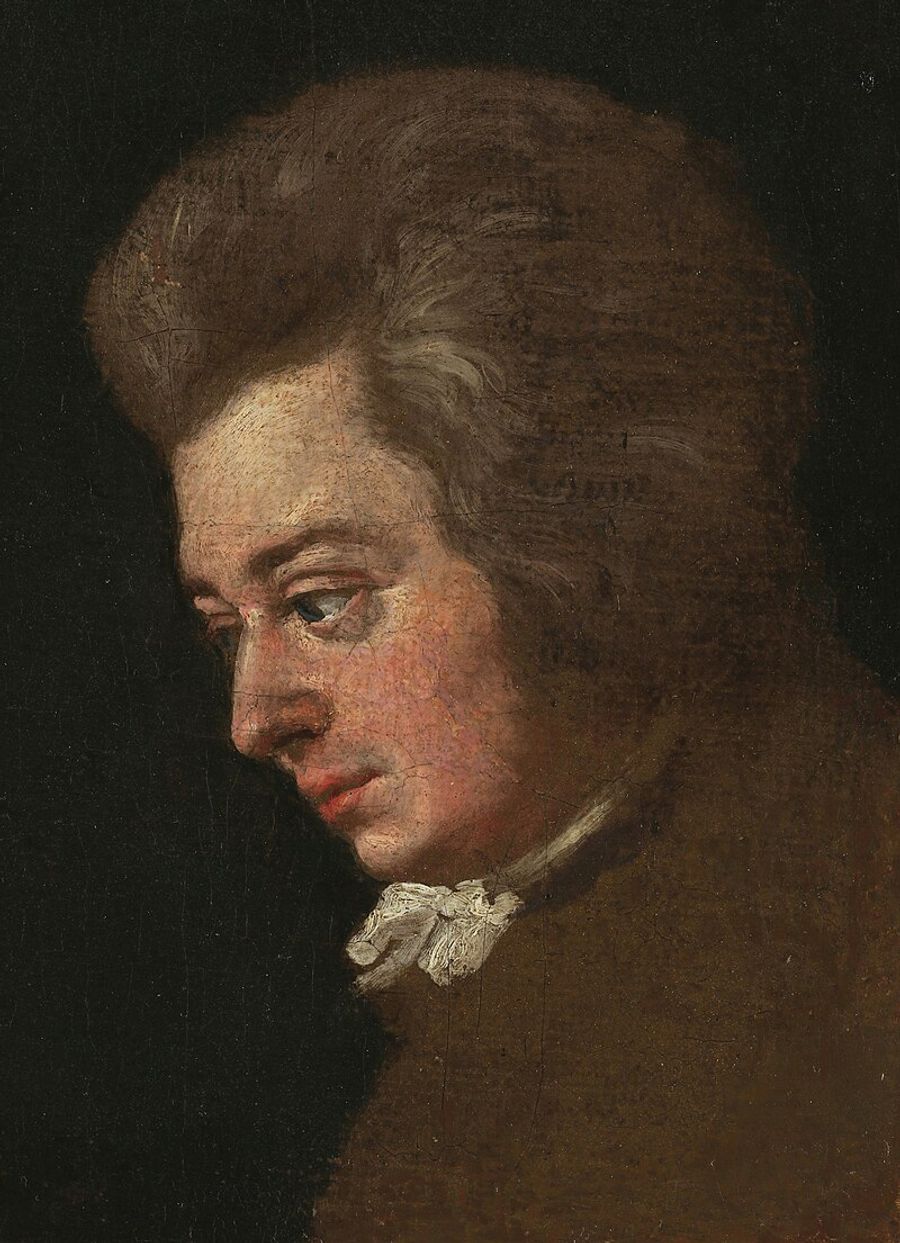
- Köchel Number
- K9 Anh.H 1,01 | K6 453b
- Genre
- Vocal Music
- Form
- Lieder
- Key
- G Minor
- Date
- 1784
- Age
- 28
Mozart’s Exercise Book for Barbara Ployer (K. Anh.H 1,01) is a miscellaneous pedagogical manuscript associated with his Viennese teaching circle in 1784, when he was 28. Its best-known musical item is a short Fugue in G minor for string quartet, catalogued separately as K. Anh.H 12,17, preserved in fragmentary transmission and with uncertain provenance.
Background and Context
In 1784—at the height of his Vienna success as pianist-composer—Wolfgang Amadeus Mozart (1756–1791) taught several advanced private pupils, among them Barbara (Babette) Ployer, for whom he also wrote and performed concertos [1]. The document now described as an “exercise book” linked with Ployer (K. Anh.H 1,01) belongs to that practical teaching world rather than to Mozart’s public publication stream; its surviving state suggests a small, assembled collection of study material rather than a single, continuously planned composition [2]. Attribution and dating are generally given as 1784, but the place is not securely documented, and the manuscript tradition appears miscellaneous rather than uniform [2].
Musical Character
The most concrete “music on the page” connected with this dossier is the Fugue in G minor for string quartet (K. Anh.H 12,17) [3]. Written in a severe, contrapuntal idiom, it is built around a single subject treated imitatively across the four voices—exactly the sort of concentrated texture useful for training a student’s ear and technique in voice-leading and ensemble balance. Even in fragmentary form, the emphasis falls on equality among parts (the inner voices are not mere accompaniment), aligning with Mozart’s broader mid-1780s fascination with learned counterpoint cultivated alongside his more theatrical, concerto-driven style [4]. In sum, K. Anh.H 1,01 is best heard not as a “song collection,” but as a window onto Mozart’s studio: disciplined craft, G‑minor gravity, and chamber-writing conceived as a laboratory for musical thinking.
Sources
[1] Barbara Ployer: biographical overview and connection to Mozart (Vienna pupil; concerto performances).
[2] MozartPortal composition page for K. Anh.H 1,01 (exercise book for Barbara Ployer; includes reference to the fugue K. Anh.H 12,17; basic catalog framing).
[3] IMSLP work page for the Fugue in G minor for string quartet, K. Anh.H 12,17 (score links and work identification).
[4] Digital Mozart Edition / Neue Mozart-Ausgabe: String Quartets, VIII/20/1/3 (editorial discussion referencing fugue fragments and transmission issues).