- Köchel Number
- K9 99 | K6 63a
- Genre
- Orchestral Music
- Form
- Serenades, Cassations & Divertimenti
- Key
- B Flat Major
- Date
- Summer 1769
- Place
- Salzburg
- Age
- 13
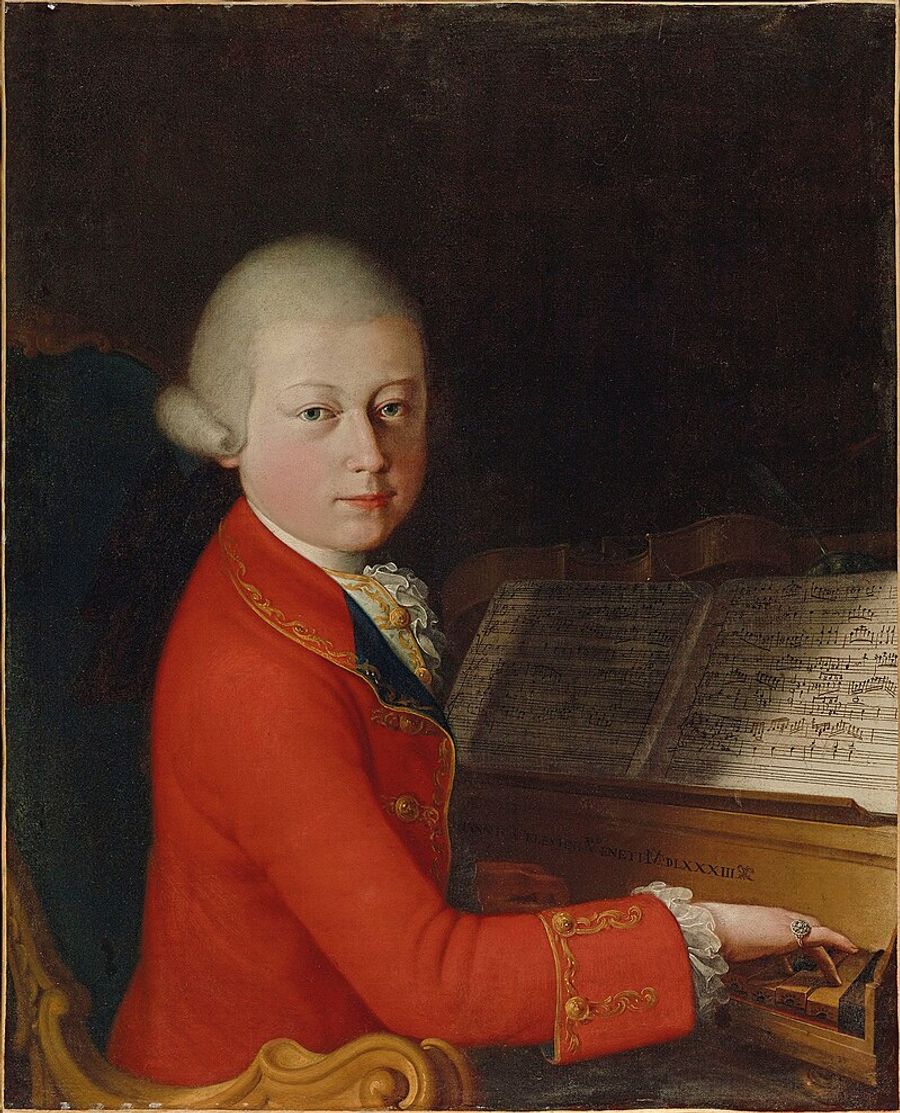
Mozart’s Cassation in B♭ major (K. 99; also catalogued as K6 63a) is an early Salzburg outdoor serenade, composed in 1769 when the composer was only thirteen. Scored for oboes, horns, and strings, it shows the teenage Mozart already fluent in the city’s festive “cassation/serenade” idiom—music designed to be mobile, public-facing, and immediately engaging [1].
Background and Context
In Mozart’s Salzburg, orchestral cassations and serenades belonged to the practical musical life of the city: festivities, academic celebrations, and other semi-public occasions that called for bright sonorities and flexible, multi-movement designs. The Mozarteum’s Köchel catalogue entry places K. 99 within this Salzburg tradition of outdoor orchestral music—works typically cast in several contrasting movements, often framed by a march and punctuated by minuets [1].
For the thirteen-year-old Wolfgang Amadeus Mozart (1756–1791), 1769 was a year of consolidation at home before the first Italian journey at the end of the year. A piece like the Cassation in B♭ is revealing precisely because it is not “private” apprentice music: it assumes real players, real listeners, and a social function. Its modest orchestration (winds plus strings) also suggests a work intended to be performable by the resources readily available in Salzburg rather than a showpiece conceived for a large ceremonial band.
Why does K. 99 deserve attention today? Because it captures a formative point where Mozart’s craft meets a local genre that values clarity, rhythm, and variety over symphonic argument. In miniature, it previews characteristics that will remain central to Mozart’s mature style: buoyant opening gestures, a sure sense of cadence and proportion, and an instinct for turning functional dance-and-processional forms into music with genuine character.
Composition and Premiere
K. 99 is securely regarded as authentic and survives as a completed work [1]. The Mozarteum’s dating window places it in Salzburg between 5 January and 13 December 1769 [1]. (This broad range is typical for many Salzburg occasional works, whose precise event and first performance were often not documented.)
As with many serenade-type pieces, movement ordering can appear in different guises across catalogs and editions; modern reference sources commonly describe the work as a seven-movement cassation framed by a march that returns da capo [2]. The presence of a repeated march points to an outdoor or processional function: the same music could accompany the beginning and end of an event, or serve as a recognizable “frame” for a longer evening’s entertainment.
No fully documented premiere is known, but the work’s design aligns closely with Salzburg practice as summarized by the Köchel catalogue: a strong opening, contrasting slow movement(s), pairs of minuets, and a lively conclusion—components that could be excerpted, reordered, or reused depending on circumstance [1].
Instrumentation
The Mozarteum lists the scoring succinctly as:
- Winds: 2 oboes
- Brass: 2 horns
- Strings: violins I & II, viola
- Bass: bass (i.e., cello/double bass line)
This is the kind of “small outdoor orchestra” that can still sound brilliant: oboes and horns provide carrying power and color, while the strings supply rhythmic propulsion and harmonic body [1]. In B♭ major—an especially congenial key for natural horns—Mozart can exploit open-horn resonance for festive punctuation and cadential sparkle.
Form and Musical Character
Although catalogs summarize K. 99 in different ways, a widely circulated seven-part layout (reflecting modern performance and reference practice) runs as follows [2]:
- I. Marcia. Allegro molto
- II. Andante
- III. Menuetto e Trio I
- IV. Andante
- V. Menuetto e Trio II
- VI. Finale (Allegro – Andante – Allegro – Andante)
- VII. Marcia da capo
March and opening allegro
The framing march is more than a ceremonial preface: it establishes a public, outdoorsy tone from the outset. Marked Allegro molto in common listings, it suggests brisk motion—music that can literally move. In serenade traditions, this sort of opening often functions like a “calling card,” immediately gathering attention and projecting a confident tonal center.
The two Andante movements
The presence of not one but two Andante movements is a reminder that cassations are built from contrasts rather than from a single symphonic trajectory. In Salzburg practice, slow movements often shift to a different key area and a more singing texture, providing respite from the open-air brilliance of march and minuet writing [1]. Even in an early work, Mozart’s gift lies in making this contrast feel inevitable: melody becomes more vocal, accompaniment more discreet, and wind coloring more pointed.
Minuets: social dance and orchestral showmanship
Two minuets with trios underline the work’s social origin. These are functional dances, yet they also offer Mozart a compact laboratory for orchestral variety—especially in the trio sections, where scoring and register can shift suddenly. The ear learns to recognize the ensemble’s “public” sound (full group, strong cadences) versus its more intimate interior spaces.
Finale: sectional energy
The finale’s alternating tempo blocks (Allegro – Andante – Allegro – Andante in one common description) point to a sectional design typical of light ceremonial genres: rather than developing themes symphonically, Mozart juxtaposes characterful panels. In performance, the effect can be theatrically effective—quick turns of mood that keep attention in a context where listeners may be moving, conversing, or hearing the music at a distance.
Reception and Legacy
K. 99 has never been as ubiquitous as Mozart’s later, larger serenades (such as Eine kleine Nachtmusik), but it occupies an important position in his Salzburg “serenade-like” apprenticeship. The Mozarteum’s catalog places it firmly within the Salzburg cassation/serenade tradition—music written for specific civic and academic contexts, with an inherent modularity that allowed movements to circulate independently [1].
For modern listeners, the work’s value lies in hearing Mozart’s early command of occasion music: how a thirteen-year-old could write for real players, exploit the bright profile of oboes and horns, and organize a multi-movement sequence so that contrast itself becomes a form of coherence. In an era when Mozart’s juvenilia can be dismissed as merely “promising,” K. 99 stands out as music that is already doing a job—efficiently, stylishly, and with flashes of the compositional personality that would soon transform Salzburg entertainment into masterpieces of the mature Classical style.