- Köchel Number
- K9 8 | K6 8
- Genre
- Chamber Music
- Form
- Violin Sonatas & Variations
- Key
- B Flat Major
- Date
- January 1764
- Place
- Paris
- Age
- 8
Mozart’s Sonata for Keyboard with Violin in B♭ major (K. 8) was composed in Paris in late 1763/early 1764, when he was just eight years old. Part of the so-called “Paris” sonatas (K. 6–9), it exemplifies a mid-18th-century genre in which the keyboard leads and the violin adds color—yet already hints at the quick-eared stylistic absorption that would define Mozart’s mature chamber music.
Mozart’s Life at the Time
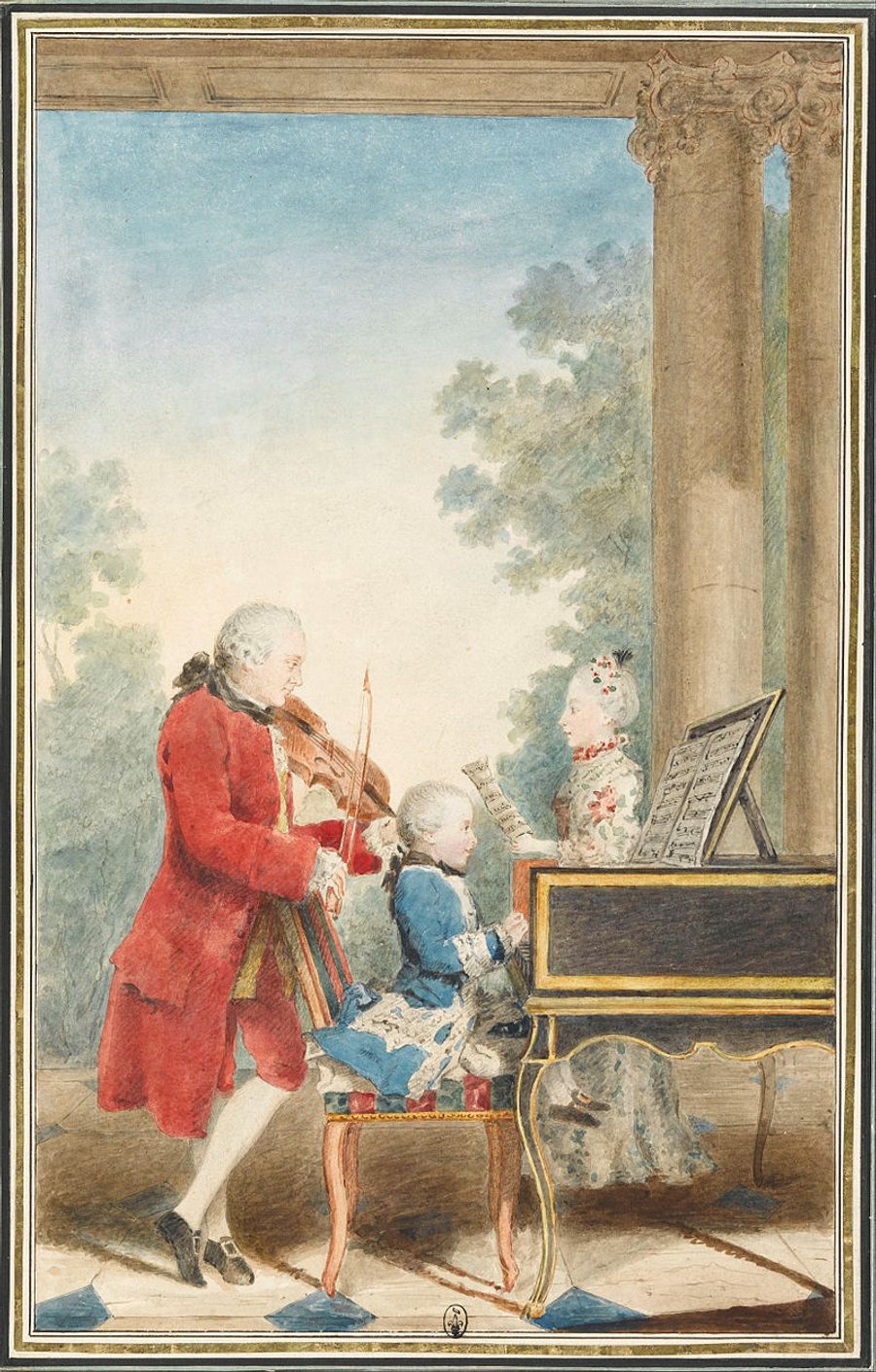
In November 1763 the Mozart family arrived in Paris during the grand tour that showcased Wolfgang Amadeus Mozart (1756–1791) and his sister Maria Anna (“Nannerl”) as prodigies. The city offered not only aristocratic patrons and public curiosity, but also a fashionable musical language—galant in style, keyboard-centered in texture, and designed for domestic performance. Within this environment Mozart produced the group of sonatas now catalogued as K. 6–9, works that circulated early as part of his public profile as a “child composer.”[2]
K. 8 (often numbered “Violin Sonata No. 3”) is therefore best heard not as a fully fledged equal partnership for violin and piano (the later Mozart model), but as an artifact of Parisian musical life in 1764—one that nonetheless reveals an eight-year-old already fluent in contemporary phrase structure and keyboard idiom.[1]
Composition and Manuscript
The Digital Köchel catalogue places K. 8 in Paris, within the window 20 November 1763 to March 1764.[1] Modern scholarship also emphasizes the original “consumer label” of the set: these are essentially keyboard sonatas that may be played with violin accompaniment—an orientation made explicit by the French title transmitted for K. 6–9 (Sonates pour le clavecin… avec l’accompagnement de violon).[3]
For K. 8–9 in particular, the violin is not merely optional: the King’s College London “Mozart & Material Culture” project summarizes the set as “sonatas for keyboard with violin accompaniment,” and even notes that the Allegro of K. 8 bears a specific date (21 November 1763) in its documentation.[2] The same source usefully anchors the social reality behind the music: Leopold Mozart’s Paris letters describe the engraving and planned presentation of these early sonatas to high-born patrons, underscoring their function as both music and calling-card.[2]
Musical Character
K. 8 is typically performed today as a three-movement sonata for keyboard and violin (modern editions often specify violin and piano), consistent with its listing in major reference catalogues and performance libraries.[4]) Its style is compact and agreeable, aimed at clarity rather than drama: balanced phrases, straightforward harmonic rhythm, and a texture in which the right hand of the keyboard projects the principal melody while the violin frequently reinforces, answers, or decorates.
What makes the work worth attention is precisely this “in-between” status. On one hand, it is an authentically Parisian product—domestic in scale, fluent in the idiom of keyboard sonatas with string accompaniment, and close to the sound-world cultivated in the city by composers such as Johann Schobert (often cited as a plausible influence in Paris at this time).[3] On the other hand, listeners can already sense Mozart testing how a second instrument can sharpen articulation: a violin entry can clarify cadences, add brilliance to repeated material, or supply conversational “echoes” that make the phrase structure feel theatrically timed.
In short, K. 8 is not a neglected late masterpiece; it is something rarer and, historically, just as instructive—an early snapshot of Mozart learning a cosmopolitan musical language at speed, and turning it into performable, publishable chamber music while still in childhood.[1][2]
Sources
[1] Köchel Verzeichnis (Mozarteum): KV 8 — dating/place and work record for “Sonata in B-flat for clavier and violin.”
[2] Mozart & Material Culture (King’s College London): overview of sonatas K. 6–9, composition context, dating note for K. 8 Allegro, and Leopold Mozart letters on engraving/dedications.
[3] Wikipedia: Violin Sonatas, KV 6–9 — original French title indicating keyboard-led genre; Paris context and possible influence of Johann Schobert.
[4] IMSLP: “Violin Sonata in B-flat major, K. 8” — basic work identification and movements/sections listing as commonly performed today.