- Köchel Number
- K9 72a | K6 72a
- Genre
- Piano Music
- Form
- Piano Pieces
- Key
- G Major
- Date
- 6 January 1770
- Place
- Verona
- Age
- 14
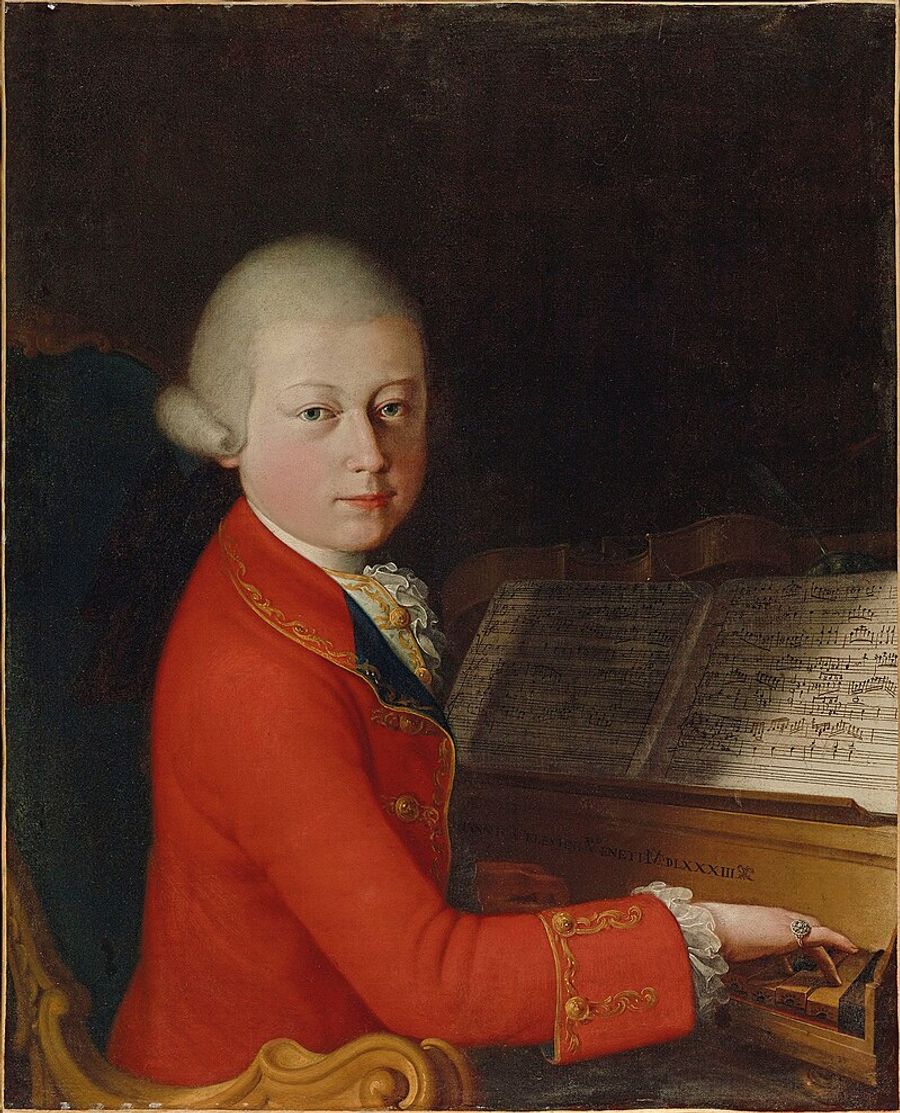
Mozart’s Molto Allegro in G major (fragment), K. 72a, dates from his Italian journey and is associated with Verona in January 1770, when he was fourteen. Only 35 bars survive—preserved because they were carefully painted onto a portrait’s music stand—leaving a tantalizing glimpse of an intended sonata-style opening.
What Is Known
The surviving Molto Allegro (K. 72a) is a fragment for solo keyboard in G major, linked to Verona during Mozart’s first Italian journey (1769–70). Its sole “source” is unusual: the music survives because an artist meticulously rendered the notes on the stand in the famous Verona portrait commissioned by Pietro Lugiati; the notation breaks off at bar 35.[1] In other words, what we have is not an autograph manuscript but a painted transmission of a short opening portion.
Because the evidence is so indirect, Mozart’s authorship has sometimes been treated cautiously: IMSLP summarizes a scholarly view (associated especially with Daniel Heartz and the NMA editor Wolfgang Plath) that the style can seem atypical of Mozart and has prompted comparisons with Baldassare Galuppi.[2] Still, the fragment has long circulated under Mozart’s name and remains bound to the image of the fourteen-year-old prodigy in Verona.[1]
Musical Content
On the page (as preserved in the portrait), the fragment presents a brisk Molto Allegro opening that suggests the start of a sonata movement: a compact initial idea in the home key, followed by passagework that appears to press forward into a continuation—then stops mid-course.[1] Heard as a torso, it belongs to the world Mozart was absorbing in Italy in 1770: fluent galant keyboard writing, quick harmonic motion, and the rhetorical “launch” of a concert-style first movement—captured just long enough to hint at a larger plan before the surviving text abruptly ends at bar 35.[1]
Sources
[1] The Morgan Library & Museum: “Mozart in Verona” (online exhibition entry describing the Verona portrait and noting the Molto Allegro fragment breaks off at measure 35; identifies it as the beginning of a sonata movement).
[2] IMSLP work page for Molto Allegro in G (fragment), K. 72a (summarizes transmission via the Verona portrait and reports scholarly doubts/alternative attribution to Galuppi).