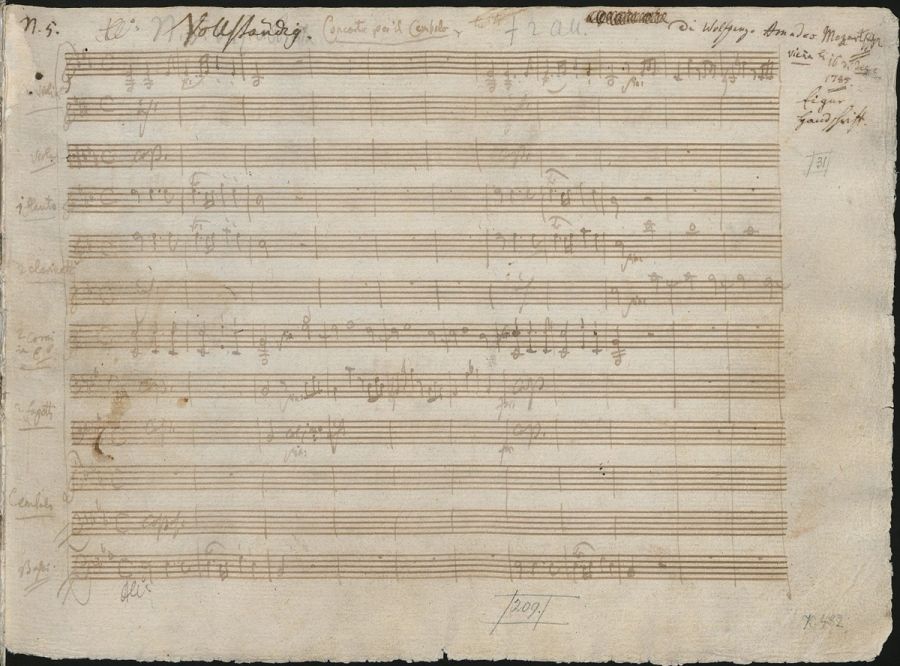
- Köchel Number
- K9 482 | K6 482
- Genre
- Concertos
- Form
- Piano Concertos
- Key
- E Flat Major
- Date
- 16 December 1785
- Place
- Vienna
- Age
- 29
Mozart’s Piano Concerto No. 22 in E-flat major, K. 482 is a large-scale Vienna concerto notable for its rich wind writing, including his first use of clarinets in a piano concerto. This article covers its composition context, orchestration, three-movement design, and reception, including the encore request for the Andante.
Background and Composition Context
Mozart composed his Piano Concerto No. 22 in E-flat major, K. 482 in Vienna during the winter of 1785[1][2]. At this time, Mozart was at the height of his popularity in Vienna, having freed himself from servitude under the Salzburg court and thriving as an independent composer-performer[3]. Culturally, Vienna in the mid-1780s was a vibrant center of music and Enlightenment ideas under Emperor Joseph II’s relatively liberal reign. Public concerts (or “academies”) were popular, especially during seasons like Advent and Lent when operatic performances were limited, giving composers like Mozart an opportunity to showcase new works. Opera was considered the most prestigious musical genre of the day, but piano concertos were Mozart’s “bread and butter” – he regularly wrote and performed them in subscription concerts for the Viennese public[4]. In 1785, Mozart’s daily life was filled with concertizing, teaching pupils, and moving in aristocratic circles of patrons and Freemason lodge brothers; he was also a young husband and father striving to maintain an upscale lifestyle, which often put him under financial pressure[5].
By December 1785, Mozart was simultaneously working on his comic opera The Marriage of Figaro (premiered in 1786) while producing a series of new piano concertos[2]. Despite his operatic ambitions, Mozart needed to secure income; he had no salaried position and was living beyond his means, accumulating debts[5]. To raise funds quickly, he organized a subscription concert series in Vienna. In fact, Mozart arranged three Advent 1785 concerts (on December 9, 16, and 23) with around 120 subscribers, a considerable audience for the time[7]. Piano Concerto No. 22 in E-flat was completed on 16 December 1785 and the ink was barely dry on the manuscript when Mozart himself premiered it that very evening[8][9]. The first performance took place not as part of a formal stand-alone concert, but between the acts of a stage work by Mozart’s colleague Carl Ditters von Dittersdorf[8]. This unusual premiere setting – inserting a concerto during another composer’s opera-oratorio performance – reflects the 18th-century practice of mixing genres on a single program.
Mozart’s new concerto was received enthusiastically from the start. His father Leopold Mozart reported with pride that the audience demanded an encore of the slow Andante movement, noting that having to repeat a middle movement was “a somewhat unusual occurrence”[10][11]. (Encores were more commonly requested for lively final movements, so the public’s insistence on hearing the poignant Andante again showed how deeply it moved them[12].) This E-flat concerto was one of a trilogy of great piano concertos that Mozart wrote in the span of a few months, alongside the Piano Concerto No. 23 in A major (K.488) and the Piano Concerto No. 24 in C minor (K.491), which followed in early 1786[13][14]. Remarkably, he composed all three while also preparing The Marriage of Figaro. Mozart’s ability to produce such an “astonishing sequence” of concertos and operatic music at once attests to him being at the peak of his creative powers[13][15].
Instrumentation and Orchestration
Piano Concerto No. 22 is scored for a relatively large Classical orchestra, giving it a rich and varied sonic palette. In addition to the solo fortepiano (Mozart himself was the soloist at the premiere), the work is scored for:
Woodwinds: 1 flute, 2 clarinets in B♭, 2 bassoons
Brass: 2 horns in E♭, 2 trumpets in E♭
Percussion: Timpani (in E♭ and B♭)
Strings: Violins, violas, cellos, and double basses (standard string section)[16].
Notably, this was the first of Mozart’s piano concertos to incorporate clarinets in the orchestration[17]. In fact, clarinets were still a relatively new addition to orchestras in the 1780s, and Mozart had long wanted to use them for their warm, mellow tone[18]. Here he replaces the usual oboes with clarinets, which lends a softer, woodier timbre to the ensemble than the brighter oboe sound. Mozart exploits the clarinets especially in the concerto’s gentle, lyrical episodes – for example, in the slow movement and the tender sections of the finale – where their “highly versatile” and mellow sound adds emotional depth[19][14]. The inclusion of trumpets and timpani, on the other hand, contributes a festive, majestic color to the outer movements, reinforcing the E-flat major key’s association with grandeur. (These brass and drums fall silent in the intimate Andante movement, ensuring its darker mood is not disturbed[16].) Mozart was also responsive to advances in keyboard instruments at the time – the fortepiano in the mid-1780s had improved sustain and dynamic range – allowing him to write more expressive, “singing” melodic lines for the piano, especially in slower passages[20]. Overall, the concerto’s instrumentation was innovative for its day, expanding the orchestral colors available in a piano concerto and foreshadowing the fuller sonorities that later composers (like Beethoven) would explore.
Pianist Hannes Minnaar and the Philharmonie Zuidnederland conducted by Kevin John Edusei perform Mozart's Piano Concerto no. 22 in E Flat K.482:
Form and Musical Character
Like most of Mozart’s concertos, No. 22 in E-flat has three movements, following the fast–slow–fast structure. However, it stands out as one of Mozart’s longest concertos (around 35 minutes)[21] and is exceptionally rich in musical ideas and contrasts. Each movement has its own character and form:
Allegro (E-flat major): The first movement is an expansive sonata-allegro form that introduces an abundance of thematic material. The orchestra opens with a grand, attention-grabbing tutti: an energetic fanfare-like theme in E-flat major, punctuated by trumpets and drums[22]. This forceful opening is immediately answered by a softer, more lyrical idea introduced by the woodwinds (with the clarinets and bassoons playfully echoing the fanfare in a gentler mode)[23]. Mozart “was never more generous with his number of themes” than in this movement – the orchestral introduction presents a whole sequence of contrasting motifs, from majestic to tender, almost as if announcing characters in an opera[24][25]. When the solo piano enters, it does so with a completely new theme of its own, rather than merely echoing the orchestra’s melodies[26]. A lively dialogue ensues between the pianist and orchestra, full of dramatic contrasts and quick shifts of mood that have been likened to operatic scenes[27]. Mozart treats the piano and orchestra as equal partners – at times in almost witty conversation, exchanging themes and comments. The development section ventures through several distant keys, including a surprising detour into B-flat minor initiated by an agitated, dark piano passage[28]. At one striking moment, the piano introduces a brief but hauntingly beautiful new melody during the development – a serene oasis that appears only once, offering a moment of respite before the music moves back toward the recapitulation[29]. Throughout the movement, the winds (especially the clarinets) add color and engage in dialogues with the piano. Notably, Mozart left no written cadenzas for this concerto, meaning that during the solo cadenza near the end of the movement performers must supply their own (Mozart himself would have improvised one in performance)[30]. After the cadenza, the movement concludes with a spirited coda, affirming the bright, vigorous mood. Overall, this Allegro movement balances “grandly theatrical” passages with gentle humor and elegant interplay, epitomizing Mozart’s mature concerto style[27].
Andante (C minor): The second movement shifts to the unexpected key of C minor, providing a dramatic emotional contrast. It is cast in the form of a theme and variations, though with some creative departures from a strict variation form[31]. The tone here is somber, introspective, and richly expressive – so much so that contemporary listeners found it profoundly moving. Mozart reserved C minor (a “dark”, passionate key for him) for some of his most emotional music, and this Andante is a prime example[32]. It opens with the muted strings alone presenting a grave, sighing main theme in a slow 3/8 meter[33]. The piano then enters, elaborating that theme with ornamentation and slight variations, adding its own voice to the melancholy song[34]. What follows is a series of inventive variations and episodes: the orchestra and soloist take turns developing the theme, sometimes intensifying its melancholic seriousness, and at other times offering moments of consolation or brightness[32]. In one variation, a duet for flute and bassoon in a major key tries to lighten the mood, introducing a gentle new melody as if offering hope[35][36]. The piano responds with another yearning variation of the main theme, suggesting that the sadness cannot be easily dispelled[37]. There are dialogues between piano and winds – for instance, the woodwinds at one point interject with a tender major-key idea, which the piano gently overcomes by returning to the plaintive minor theme[38]. This push-and-pull between darkness and light gives the movement a deeply poignant quality. By the coda, the woodwinds ultimately join the piano in agreement, and together they bring the movement to a quiet, affecting close[39]. Listeners of the day were struck by the Andante’s expressive depth – as noted earlier, it was so heartfelt that audiences demanded it be encored at the premiere[40]. Modern commentators even hear foreshadowings of Beethoven in this movement’s emotional intensity and use of C minor (a key Beethoven would famously use for drama)[35]. In Mozart’s oeuvre, this Andante stands out as an embodiment of his lyrical pathos, using the orchestra (with clarinets adding a soft glow) as an “expressive tool” to support the piano’s intimate soliloquies[35].
Allegro (E-flat major), with an Andantino cantabile episode: The finale is a joyful rondo that brings the concerto back to an exuberant, celebratory mood. Its main theme is a bright, dance-like tune in 6/8 time, often described as having a hunting or folk-like character (E-flat major was commonly used for music evoking horns and outdoor scenes, hence the “hunting horn” style)[41]. This sprightly theme – with its upbeat rhythms and rustic charm – returns periodically, separated by contrasting episodes in classic rondo fashion[42]. Mozart, however, infuses the rondo with surprises and sophisticated touches. After the initial bounding theme is stated, the music comes to a brief halt and transitions into a completely new idea: the strings begin a soft, pulsating accompaniment, and over it the piano introduces a delicate, lyrical melody marked andantino cantabile (at a slower, singing tempo)[43]. This graceful interlude in the midst of the fast rondo feels like an operatic aria tenderly blooming inside a lively dance – and indeed commentators hear echoes of Mozart’s The Marriage of Figaro in this sweet, cantabile section[44]. Soon, a third theme appears: a broadly lyrical, flowing melody that adds yet another character to the mix[45]. Despite these detours, the merry main theme always returns to keep the rondo on course. In the middle of the finale, Mozart even writes a short cadenza: the music plunges into a brief dramatic pause, allowing the soloist a flourish that unexpectedly leads into a slow, dream-like Andante cantabile passage[46]. Here the woodwinds, especially the clarinets, shine with an “aria-like” dialogue alongside the piano, briefly recalling the tender sentiment of the second movement[47]. But Mozart’s playful spirit ensures the mood doesn’t stay serious for long – another quick cadenza by the piano whisks the music back to the cheerful main theme[48]. As the rondo hurtles toward the finish, Mozart inserts one last witty touch: just when the listener expects the final bars, the music pauses and the piano slyly reminisces the earlier delicate melody one more time (a friendly reminder of that beautiful moment)[49]. Only then does the orchestra burst in to conclude the piece with a rousing finish. This clever false-ending jest often draws smiles; it’s Mozart’s way of saying he hasn’t forgotten any of the musical threads. The finale’s mix of “light and joyous” atmosphere with a heartfelt center section showcases Mozart’s deft balance of popular appeal and artistry[47].
Throughout this concerto, Mozart’s stylistic traits of the late Vienna period are on full display: an operatic sense of dialogue between soloist and ensemble, sophisticated wind writing, sudden shifts between major and minor for expressive effect, and the seamless fusion of melodic elegance with technical virtuosity. At about 35 minutes in length, the work’s scale and grandeur are notable[21], yet the music never loses the clarity and grace characteristic of the Classical style. Mozart also tailored the piano writing to his own virtuosic but tasteful playing style – contemporary accounts (such as Irish tenor Michael Kelly’s recollection) praise Mozart’s “rapid fingers, great execution, and the inspiration” of his improvisations at the keyboard[50]. Indeed, in this concerto the solo part requires both sparkling agility and expressive nuance, making it one of the more challenging Mozart concertos for the performer (bravura passages abound, but must be executed with Mozartean elegance rather than showy bombast[26]).
Reception and Legacy
Upon its debut and in Mozart’s lifetime, Piano Concerto No. 22 was held in high esteem, even if it did not immediately become the most famous of his concertos. As noted, its premiere in 1785 was a success – the fact that the audience demanded a repeat of the Andante attests to its strong impact[40]. Mozart himself performed the concerto on multiple occasions. Surviving records indicate he played it at least three times: twice in late 1785 (including the informal premiere during Dittersdorf’s program) and again at one of his subscription concerts in early 1786 during Lent[51]. His father Leopold bragged about the concerto’s reception in letters, and one can imagine Mozart’s satisfaction at the work’s warm welcome in Vienna’s competitive musical scene.
In the decades after Mozart’s death (1791), the E-flat Concerto – like many of Mozart’s piano works – was somewhat overshadowed by the rising tide of Romantic repertoire. During the 19th century, Mozart’s concertos were not programmed as often as those of Beethoven or the virtuoso concertos of later composers, and No. 22 was performed less frequently than some of Mozart’s more immediately popular concertos (such as the dramatic D minor Concerto No. 20, K.466, or the graceful C major No. 21, K.467). Musicologists have noted that No. 22 “has never been quite as popular as its near neighbours,” perhaps because Nos. 21 and 23 gained more fame, yet they hasten to add that it contains wonderful music equal to any in Mozart’s output[52]. Indeed, the E-flat Concerto was “undeservedly overshadowed” by its siblings for some time[11]. Part of the reason might have been practical: the inclusion of clarinets (still not standard in every orchestra through the 1800s) meant the piece wasn’t as easy to program until orchestras universally had clarinetists. In some early 19th-century performances, editors even published versions of Mozart’s late concertos with clarinet parts adapted for oboe, to accommodate theaters without clarinets. However, by the late 19th and early 20th century, Mozart’s concertos saw a revival in concert repertoire, and No. 22 began to be appreciated anew by pianists and audiences as a genial and substantial work.
In the 20th century, this concerto’s legacy was cemented as part of the core Mozart concerto repertoire. It has been championed by major pianists and conductors on stage and in recordings. For example, legendary pianist Sviatoslav Richter chose Mozart’s E-flat Concerto No. 22 for a celebrated 1960s performance at the Aldeburgh Festival with composer Benjamin Britten conducting – an event notable because Britten himself composed a special set of cadenzas for the concerto[53]. Britten’s imaginative (if stylistically adventurous) cadenzas, and Richter’s masterful playing, helped draw attention to the concerto’s brilliance. Many other acclaimed pianists, from Daniel Barenboim and Mitsuko Uchida to modern interpreters like Angela Hewitt, have performed and recorded K.482, often pairing it with the C minor Concerto K.491 to showcase the contrast between Mozart’s E-flat “noble and elegant” style versus his stormier minor-key voice[54]. Critics often praise No. 22 for its colorful woodwind writing and the unique charm brought by the clarinets[55].
Today, Piano Concerto No. 22 in E-flat is recognized as one of Mozart’s late-period masterpieces, offering a perfect synthesis of tuneful appeal, structural sophistication, and rich orchestral sonority. It may not have a single famous nickname or a pop-culture reference (unlike No. 21’s “Elvira Madigan” Adagio), but connoisseurs hold it in high regard for its depth and elegance. Modern audiences and musicians appreciate the work’s “wonderful music, especially the central slow movement,” which still has the power to touch listeners’ hearts as it did in Mozart’s time[56]. Its first movement, with its profusion of themes and celebratory E-flat majesty, and its joyous, surprise-filled finale, likewise continue to delight. The concerto is regularly featured in concert halls around the world and remains a staple of the piano concerto literature – a testament to Mozart’s genius in creating music that transcends its era.
In summary, Mozart’s Piano Concerto No. 22 in E-flat major, K. 482 stands as a factual portrait of the composer’s world in 1785 and a musical jewel that has outlasted the 18th-century Viennese context that birthed it. Its background is entwined with Mozart’s life as an entrepreneurial musician in a flourishing cultural capital; its composition showcases his ability to innovate (through new instruments and forms) under time pressure; its music blends Classical form with operatic lyricism and bold creativity; and its legacy shows how a work can initially be a product of its time yet eventually achieve timeless status. Mozart wrote this concerto for the immediate purpose of pleasing his audience and securing his reputation (and finances) in Vienna, but in doing so he also gave the world a piece that continues to “give pleasure without end” – fulfilling the very ideal of Mozartian art in bridging intellect and emotion across the centuries[24][35].
Sources:
Sources
Program notes by Rhode Island Philharmonic and Hong Kong Philharmonic[57][20][10]
Houston Symphony and Henle Verlag essays on Mozart’s Piano Concerto No. 22[58][14]
Mozart’s letters and biography (cited in Mozart: New Documents/Jahn)[7][59]
Wikipedia entry on Piano Concerto No. 22 in E-flat, K.482[17][21]
Angela Hewitt’s liner notes (Hyperion Records) and BBC Music Magazine review[24][53], describing the work’s musical features and later performances.
[1][16][17][21][31] Piano Concerto No. 22 (Mozart) - Wikipedia
https://en.wikipedia.org/wiki/Piano_Concerto_No._22_(Mozart)
[2][4][34][36][37][38][39][42][43][45][46][48][49][50][51][55][58] Something Rare: Mozart's Piano Concerto No. 22 in E-flat major, K. 482
https://houstonsymphony.org/mozart-k482/
[3][10][12][19][20][22][23][27][32][33][40][44][47][52][56] MOZART | Piano Concerto no. 22 | HK Phil
https://www.hkphil.org/watch-and-listen/all-performances/mozart-piano-concerto-no-22
[5][7][9][15][18][24][26][28][29][54] Mozart: Piano Concertos Nos 22 & 24 - CDA68049 - Wolfgang Amadeus Mozart (1756-1791) - Hyperion Records - MP3 and Lossless downloads
https://www.hyperion-records.co.uk/dc.asp?dc=D_CDA68049
[6] File:Mozart - Piano Concerto No. 22 - Opening Page of the Autograph Manuscript.jpg - Wikimedia Commons
[8][13][25][30][35][41][57]THE STORY BEHIND: Mozart's Piano Concerto No.22
https://www.riphil.org/blog/the-story-behind-mozart-s-piano-concerto-no-22
[11][14] Piano Concerto no. 22 E flat major K. 482 | HN1240 | HN 1240
https://www.henle.de/Piano-Concerto-no.-22-E-flat-major-K.-482/HN-1240
[53] Mozart: Piano Concerto No. 22 in E flat, K482; Sinfonia Concertante in E flat for violin & viola, K364 - Classical Music
https://www.classical-music.com/reviews/orchestral/mozart-295
[59]7 April 1786