- Köchel Number
- K9 Anh.A 16 | K6 41
- Genre
- Concertos
- Form
- Piano Concertos
- Key
- G Major
- Date
- July 1767
- Place
- Salzburg
- Age
- 11
Mozart’s Piano Concerto No. 4 in G major, K. 41, is an early “pasticcio” concerto assembled as a learning exercise, adapting movements from sonatas by Leontzi Honauer and H. F. Raupach. This article outlines its scoring, three-movement design, homotonal plan, and later reception.
Background and Composition Context
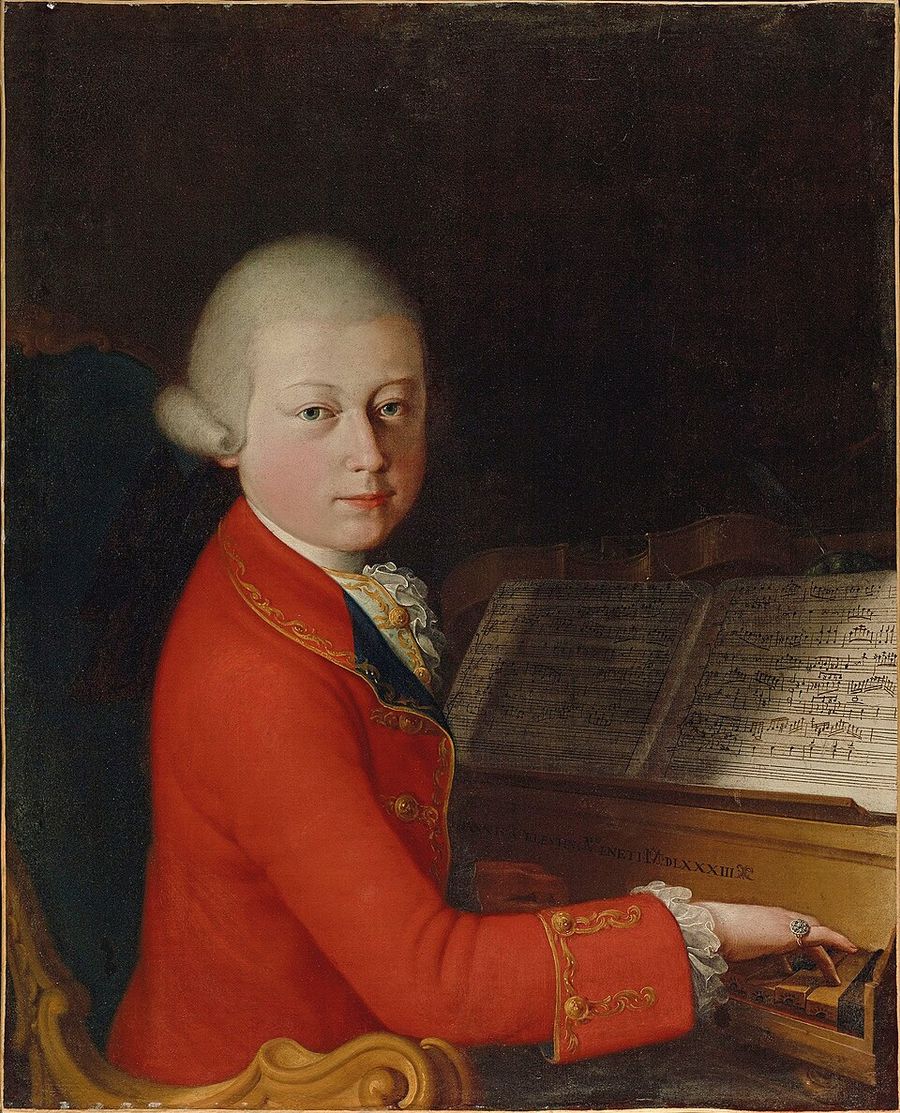
Wolfgang Amadeus Mozart composed his Piano Concerto No. 4 in G major, K. 41, in July 1767 when he was just 11 years old[1]. At this time, the Mozart family had recently returned to their home city of Salzburg after an extensive European tour. Young Mozart had spent his formative years traveling to cultural centers like Paris and London, performing for royalty and meeting influential composers. The broader world around him was in the Enlightenment era; Empress Maria Theresa ruled the Austrian lands, and Europe was enjoying a brief peace after the Seven Years’ War. Culturally, music was transitioning from the ornate Baroque style to the clearer, more balanced Classical style (also called the galant style) that favored graceful melody and form. The piano (or fortepiano) itself was a relatively new invention growing in popularity at the time, gradually overtaking the harpsichord in prominence[2]. As a prodigy touring the courts of Europe, Mozart had absorbed contemporary musical trends – for example, he met Johann Christian Bach in London and heard many fashionable sonatas in Paris – all of which shaped his early compositional approach.
In 1767, Mozart’s daily life mixed intensive music-making with the realities of 18th-century life. For instance, that autumn a smallpox outbreak struck Vienna (which Mozart would contract and survive), highlighting the era’s health hazards amid high society engagements. Against this backdrop, the reason Piano Concerto No. 4 was written ties directly to Mozart’s development as a composer. This concerto was not an entirely original creation but a pasticcio – essentially a composite work stitched together from pre-existing music by other composers[3]. Mozart’s father, Leopold, used this method as a pedagogical exercise to teach the young Wolfgang how to write for solo keyboard and orchestra[4]. The concerto’s movements are adapted from recently published sonatas that the family had likely collected during their travels (many of these sonatas were published in Paris around 1763–64)[5]. By arranging and orchestrating these pieces, Mozart began learning how to solve the structural challenges of concerto form[6]. In fact, Leopold Mozart’s annotations in the autograph score (which is largely in Leopold’s own handwriting) date the concerto to Salzburg, July 1767[1], and he did not include these first four concertos in his 1768 catalog of Wolfgang’s works – suggesting he viewed them more as student exercises than fully independent compositions[4].
Instrumentation and Notable Features
Despite its origin as a learning exercise, Piano Concerto No. 4 in G major is scored for a standard small Classical orchestra of the time. The instrumentation calls for pairs of flutes and horns in G, a string section (violins, violas, cellos/bass), and a solo keyboard part intended for piano or harpsichord[7]. Notably, Mozart chose flutes instead of the more typical oboes for this youthful work, giving the orchestral texture a gentle, airy sound. The two natural horns in G provide harmonic support and brightness in the outer movements. The string orchestra carries much of the accompaniment and melodic interplay with the soloist. Overall, the orchestration is modest and transparent, reflecting the galant style’s preference for clarity. The keyboard writing itself is fairly simple by Mozart’s later standards – appropriate for an 11-year-old virtuoso – yet it already hints at Mozart’s understanding of how to dialogue with an orchestra. Contemporary scholars note that in these early concertos the division between the soloist’s role and the continuo-style accompaniment is sometimes blurred[8], indicating Mozart was still learning how to feature the piano against the ensemble. There are even brief orchestral preludes (ritornellos) that Mozart added to introduce the movements, though these sections contain relatively few themes compared to his mature concertos[8]. In sum, the instrumentation and texture of K. 41 are straightforward and elegant, allowing the charm of the borrowed melodies to shine through without heavy embellishment.
Form and Musical Character
Mozart’s Piano Concerto No. 4 follows the typical three-movement structure of a Classical concerto, though on a smaller scale. All three movements of this concerto are in the home key of G (major or minor), making the work homotonal – an unusual trait since many Classical works shift to other keys for contrast[9]. The movements are:
Allegro (G major, 3/4 time) – A bright opening movement in a lilting triple meter[10]. Uniquely, very few of Mozart’s 27 piano concertos begin in triple meter (only K. 41 and three others do)[11], which gives this Allegro a gently flowing, dance-like character. The movement is adapted from the first movement of a harpsichord sonata by Leontzi Honauer (Op. 1, No. 1, published 1761)[12]. Mozart transforms Honauer’s sonata movement by writing an orchestral introduction and interludes, effectively creating a dialogue between the piano and the ensemble. The style is cheerful and gallant: graceful themes with balanced phrases pass between strings and woodwinds before the piano enters. Listeners will notice that this Allegro, while pleasant and confident in tone, is relatively simple in form – Mozart did not add extra new themes in the development or secondary exposition as he would in later concertos[8]. Instead, the structure stays close to the source material, serving as a concise and charming opener.
Andante (G minor, 2/4 time) – The second movement shifts to G minor, providing a tender and somewhat melancholy contrast[13]. This movement was adapted from a slow movement by Hermann Friedrich Raupach (a violin sonata Op. 1, No. 1, 1762)[14]. In Mozart’s hands, the Andante becomes a short but expressive interlude: the only movement in a minor key among these early concertos. In fact, only a handful of Mozart’s piano concerti feature a slow movement in the minor mode (later examples include K. 271 and K. 488)[15], making this an early instance of that expressive choice. The character of the Andante is intimate and lyrical. Contemporary descriptions note the “rich strings, a beautiful piano line” that give it a nostalgic, longing feeling despite its brevity[16]. The orchestration is subdued here – the flutes and horns fall silent, and strings provide a gentle cushion for the keyboard’s singing melody (a common practice of the time was to omit wind instruments in slow movements). Though barely a few minutes long, this minor-key Andante has a depth of feeling that foreshadows Mozart’s later poignant slow movements.
Molto allegro (G major, 3/4 time) – The concerto concludes with a lively fast movement back in G major[10]. This finale is also derived from Honauer’s harpsichord sonata (likely its final movement)[12]. It is in a brisk triple meter, possibly a quick minuet or contredanse rhythm, but marked Molto allegro to ensure a spirited tempo. The mood is merry and energetic, bringing the concerto to an upbeat close. Here Mozart gives the soloist a bit more to do – the piano part includes passagework that sounds surprisingly virtuosic for such a youthful work[17]. In one recorded cadenza near the end, the writing even comes across as “very confidently-composed,” leading one to marvel at how an eleven-year-old’s hands could cover such ground[18]. Structurally, the finale likely follows a simple rondo or sonata form without a lengthy development, keeping things concise. The cheerful main theme recurs between episodes of keyboard figuration. Overall, this movement caps the concerto with a dose of playful brilliance, if not the complexity of Mozart’s later finales. All three movements are relatively short – the entire concerto lasts only around 10–11 minutes – but they collectively showcase a budding composer experimenting with form and expression within a concise framework.
Reception and Legacy
In Mozart’s own lifetime, these first four piano concertos (K. 37, 39, 40, 41) were essentially training pieces and were not published or widely circulated as his original works were. Leopold Mozart’s records suggest he didn’t count them as Wolfgang’s autonomous compositions[4], implying they were regarded more as arrangements or exercises. Indeed, musicologists have noted that, compared to Mozart’s later masterful concertos – or even to the works of a seasoned concerto composer like J. C. Bach – these early efforts are “slight works” in scale and ambition[8]. The orchestral introductions that Mozart appended to the borrowed sonata movements are thematically limited, and the piano’s role sometimes alternates between soloist and continuo accompaniment in a not yet fully realized way[8]. In other words, the young composer had not yet developed the rich thematic interplay and clear dramatic structure that characterize his mature concertos. Audiences and critics in later eras likewise treated Concertos 1–4 as juvenilia – interesting for what they reveal about Mozart’s development, but rarely programmed in concert.
Performance and publication history: It appears Mozart himself may have performed these concertos in private or semi-private settings (possibly to showcase his keyboard ability to patrons in Salzburg), but there is little documentation of public premieres. The works remained unpublished until long after Mozart’s death; they were finally included in 19th-century complete editions of Mozart’s music (for example, the Breitkopf & Härtel edition of 1877[19]), once their historical importance was recognized. In the 20th and 21st centuries, these concertos have occasionally been recorded – often by pianists completing the entire Mozart concerto cycle – but they are still seldom heard in the concert hall. When they are performed, it is usually in contexts like chamber orchestra series or educational concerts that explore Mozart’s youth. Modern listeners who encounter Piano Concerto No. 4 in G major generally appreciate it as a charming early-classical piece rather than a profound artistic statement.
That said, K. 41 and its companion pieces have earned a modest legacy in one interesting way: they have effectively preserved music by now-obscure composers that Mozart arranged. Today, names like Leontzi Honauer and H. F. Raupach are largely forgotten, yet their melodies live on through Mozart’s concertos[20]. In a sense, Mozart’s youthful reworking of their sonata themes has given those ideas a longer life under his illustrious name. This underscores an ironic aspect of the concerto’s legacy – Mozart’s fame has overshadowed the original sources, to the point that most listeners know these themes only as part of Mozart’s catalog[20].
In summary, Mozart’s Piano Concerto No. 4 in G major, K. 41 stands as a fascinating snapshot of the young composer’s apprenticeship. It was conceived in an age of change (politically stable, culturally evolving toward Classical ideals) and in a household keenly aware of European musical trends. The concerto’s background – an 11-year-old prodigy guided by his father, repurposing Parisian sonatas – explains its straightforward construction. Its music – elegant, tuneful, and uncomplicated – reflects both the galant aesthetic of the 1760s and Mozart’s own nascent genius. And its legacy rests less on public acclaim and more on what it taught Mozart himself. Soon after, he would craft his first wholly original piano concerto (No. 5 in D major, K. 175, in 1773), launching the series of masterpieces that we celebrate today. Piano Concerto No. 4 may lack the brilliance of those later works, but it remains an important stepping stone in Mozart’s musical journey, offering modern audiences a clear window into how a musical genius began mastering his craft[8].
Sources
Sources
Mozart’s Piano Concerto No. 4 in G major, K. 41 is discussed in scholarly and historical contexts including classical music encyclopedias and critical editions. Key information has been drawn from the Neue Mozart-Ausgabe and Mozart’s own manuscript (dated 1767)[21], the analysis of Stanley Sadie and Hermann Abert on Mozart’s early years[22][8], and modern commentary on the concerto’s character and origins[3][23]. These sources collectively paint a factual picture of the work’s conception, structure, and place in Mozart’s oeuvre, as summarized above.
[1] [3] [4] [5] [6] [7] [8] [9] [10] [11] [13] [15] [22] Piano Concertos Nos. 1–4 (Mozart) - Wikipedia
http://en.wikipedia.org/wiki/Piano_Concertos_Nos._1%E2%80%934_(Mozart)
[2] Mozart Piano Concertos | Classical Music Masterpieces | Britannica
https://www.britannica.com/topic/Mozart-Piano-Concertos
[12] [14] [19] [21] Piano Concerto No.4 in G major, K.41 (Mozart, Wolfgang Amadeus) - IMSLP
https://imslp.org/wiki/Piano_Concerto_No.4_in_G_major,_K.41_(Mozart,_Wolfgang_Amadeus)
[16] [17] [18] [20] [23] Mozart Piano Concerto no. 4 in G, K41 – Fugue for Thought
https://fugueforthought.de/2015/07/11/mozart-piano-concerto-no-4-in-g-k41/