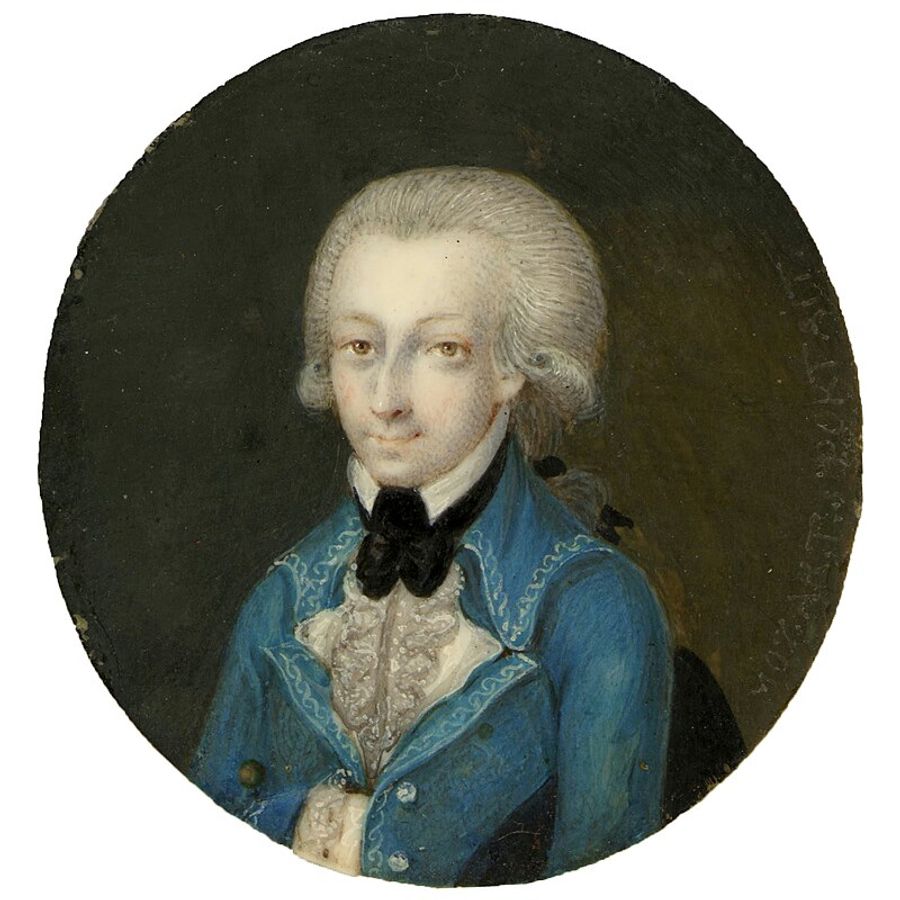
- Köchel Number
- K9 222 | K6 205a
- Genre
- Sacred Music
- Form
- Smaller Church Works
- Key
- D Minor
- Date
- January–February 1775
- Place
- Munich
- Age
- 19
Mozart’s Offertory “Misericordias Domini” (K. 222) is a compact yet unusually ambitious liturgical chorus, written in Munich in January or February 1775, when the composer was 19. Cast in D minor and designed for the Offertory of the Mass, it stands out among Mozart’s smaller church works for its deliberate display of contrapuntal craft and its heightened, tension-charged harmonic language.[1]
Background and Context
In early 1775 Wolfgang Amadeus Mozart (1756–1791) was in Munich for the first performances of his opera La finta giardiniera (premiered 13 January 1775). In that same Munich context he produced the Offertory “Misericordias Domini” in D minor, K. 222—an ecclesiastical miniature with an unmistakably “public” aim: to demonstrate, in church style, the young composer’s command of learned counterpoint.[2]
Although “minor” in scale, the piece deserves attention precisely because it shows Mozart treating a brief liturgical function as an opportunity for concentrated technique and expressive weight. D minor—so often a key of gravity in his later vocal music—already carries an alert, dramatic charge here, while the choral writing balances rhetorical clarity (the text must “speak” in church) with serious polyphonic argument.
Composition and Liturgical Function
“Misericordias Domini” is an Offertory (offertorium): music intended to accompany the preparation of the gifts during Mass. Mozart later documented the circumstances of its creation in a letter to Padre Giovanni Battista Martini, reporting that he composed the work in Munich in January or February 1775 at the request of the Bavarian Elector, and that it was performed there on 5 March 1775.[1]
The text begins with the well-known incipit “Misericordias Domini … cantabo in aeternum,” drawn from Psalm 89 in the Hebrew numbering (Psalm 88 in the Latin/Vulgate tradition).[3]
Musical Structure
At a glance, the work is “one movement,” but internally it behaves like a tightly organized study in contrasting choral textures. A notable strategy is the repeated alternation of homophony (block-chord declamation) and polyphony (imitative entries), turning the simple two-part idea of the text—God’s mercies / the act of singing—into a structural engine.[4]
The scoring is typical of Salzburg-and-southern-German church resources, with Choir: SATB and Orchestra/continuo: strings, 2 oboes, 2 horns, and organ.[5] Within that framework Mozart composes as if he were “writing for the page” as much as for the liturgy: compact motivic work, imitative entrances that read as a credential, and harmonic turns that intensify the penitential hue of D minor.
One intriguing stylistic detail, noted in modern editorial commentary, is Mozart’s incorporation of a motif associated with Johann Ernst Eberlin’s Benedixisti Domine—a reminder that in church music Mozart did not compose in a vacuum, but in active dialogue with the Salzburg tradition he had absorbed as a teenager.[1]
Reception and Legacy
K. 222 is not among the “headline” sacred works that anchor Mozart’s modern reputation, yet it has enjoyed a steady practical life in choral catalogues and editions. Its appeal lies in its dual identity: it is liturgically functional and relatively brief, but it also offers choirs an encounter with Mozart’s learned side—contrapuntal writing that still aims for vivid declamation rather than academic exercise.
In a broader view of Mozart’s sacred output, “Misericordias Domini” is a valuable Munich snapshot from 1775: a moment when operatic obligations and courtly expectations did not prevent him from writing church music of concentrated seriousness. For listeners, it is one of the places where Mozart’s “ecclesiastical” voice and his theatrical sense of tension and release briefly meet—compressed into the span of a small offertory.
Sources
[1] Bärenreiter (UK) product page with editorial summary: composition circumstances, Martini letter, performance date (5 March 1775), Eberlin motif, questions of viola part.
[2] Heinrichvontrotta.eu (Harnoncourt/Teldec notes page) giving Munich context and linkage to *La finta giardiniera* period.
[3] Musica International work entry: identification, genre, and biblical reference (Psalm 88/89).
[4] Christer Malmberg’s “The Compleat Mozart” excerpt (after Zaslaw): Elector’s request for contrapuntal music and description of alternating homophony/polyphony.
[5] Italian Wikipedia ‘Catalogo Köchel’ table entry listing scoring for K. 222 (choir, strings, 2 oboes, 2 horns, organ).