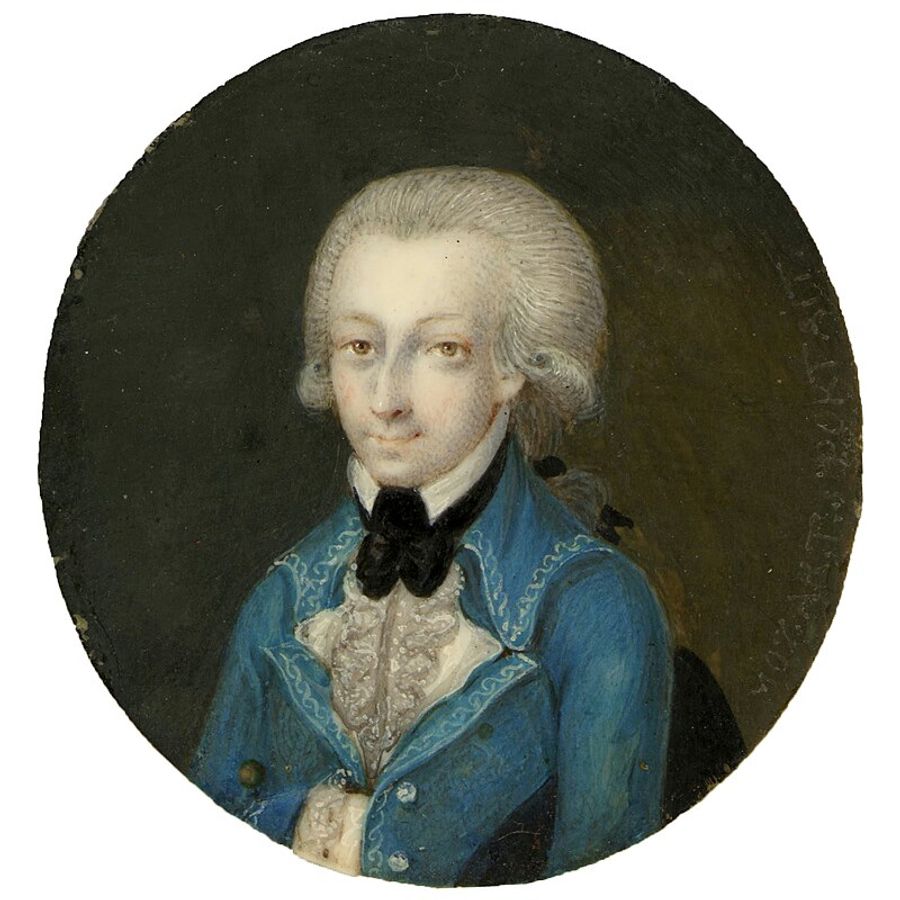
- Köchel Number
- K9 180 | K6 173c
- Genre
- Piano Music
- Form
- Piano Variations
- Key
- G Major
- Date
- Autumn 1773
- Place
- Vienna
- Age
- 17
Mozart’s 6 Variations in G on “Mio caro Adone” (K. 180) were composed in Vienna in 1773, when he was 17, on a minuet-like tune from Antonio Salieri’s opera La fiera di Venezia. Modest in scale yet pointedly imaginative, the set offers a vivid snapshot of Mozart’s early Viennese keyboard style—poised between salon entertainment, improvisatory display, and sharp-eared engagement with contemporary opera.
Background and Context
In 1773, Wolfgang Amadeus Mozart (1756–1791) made one of his formative visits to Vienna, a city whose musical life was shaped as much by the opera house as by the keyboard. Variation sets for clavier (a flexible 18th-century term encompassing harpsichord and the emerging fortepiano) were a popular medium in this environment: they allowed a composer-performer to demonstrate invention, taste, and technique while drawing on a tune the audience might already know.[1]
K. 180 is especially revealing as a piece of cultural listening. Mozart takes his theme from Antonio Salieri’s comic opera La fiera di Venezia—specifically the minuet accompanying the bustling finale of Act II (“Mio caro Adone”).[2] Rather than treating Salieri as a distant rival (a later romantic cliché), the teenage Mozart approaches him as a living Viennese colleague whose theatre music was worth knowing, borrowing, and transforming.
Composition
The International Mozarteum Foundation’s Köchel catalogue identifies the work as an authentic, complete set for clavier in G major, preserving an autograph source and documenting early prints beginning in the late 1770s.[1] Even by Mozart’s standards, K. 180 sits in a conspicuously “quick-response” genre: the kind of music that could arise from improvisation, then be stabilized on paper—half performance souvenir, half calling card.[1]
A practical point matters for interpretation. Although later editions and modern performances often assume the piano, Mozart’s contemporaries would have understood this music as playable on either harpsichord or fortepiano.[1] On harpsichord it reads as elegant, rhythmically articulate ornamentation; on fortepiano its contrasts of register and touch can sound more overtly “theatrical,” as if the keyboard were imitating a small ensemble.
Form and Musical Character
The theme is marked as a Menuetto Andante—already a clue that this is not a bravura showpiece built on a rapid bass pattern, but a civilized, dance-inflected melody with space for characterful rephrasing.[1] Mozart then supplies six variations, creating a compact dramatic arc within a miniature frame.
What makes K. 180 distinctive among early Mozart variations is its balance of three pleasures:
- Operatic recognition: the tune’s origin in an opera finale lends it a social “scene” behind the notes—music for conversation, flirtation, and movement, now refracted through the keyboard.[2]
- Improvisatory rhetoric: the variations feel like successive “solutions” to the same melodic problem, as though Mozart were demonstrating, at the keyboard, how many ways a graceful minuet can be dressed.
- A classical cadence of contrasts: the set includes a slow variation (Adagio) among the six,[1] intensifying the expressive temperature for a moment—an early example of Mozart’s instinct to place cantabile inwardness at the center of a multi-variation span.
These features also connect K. 180 to Mozart’s broader output of the 1770s: the same teenager who could write courtly divertimenti and string quartets was already thinking dramaturgically, shaping even a small keyboard set so that it “turns” from public grace to private lyricism and back.
Reception and Legacy
K. 180’s early publication history suggests real market value. The Köchel catalogue records an autograph source and identifies early printed editions, including a Paris first printing in the 1770s, followed by further late-18th-century issues.[1] Such circulation fits what the work is: accessible enough for skilled amateurs, but witty and refined enough to reward professionals.
Today, these variations remain outside the standard “greatest hits” of Mozart’s piano music, perhaps because they are neither a sonata nor a concerto movement—genres where listeners expect architectural scale. Yet precisely in their smallness lies their charm. K. 180 is a document of Mozart hearing Vienna in real time: opera melody turned into keyboard conversation, the public theatre distilled into private music-making, and a 17-year-old composer already unmistakably in command of character, proportion, and surprise.[1]
Sheet Music
Download and print sheet music for 6 Variations in G on “Mio caro Adone” (Salieri), K. 180 from Virtual Sheet Music®.
Sources
[1] International Mozarteum Foundation (Köchel catalogue): KV 180 work page with key, scoring (“clav”), sources, and publication data; links to NMA online.
[2] Cambridge Core (The Cambridge Mozart Encyclopedia): Salieri entry noting Mozart’s borrowing of the “Mio caro Adone” minuet from *La fiera di Venezia* (Act II finale) for keyboard variations.