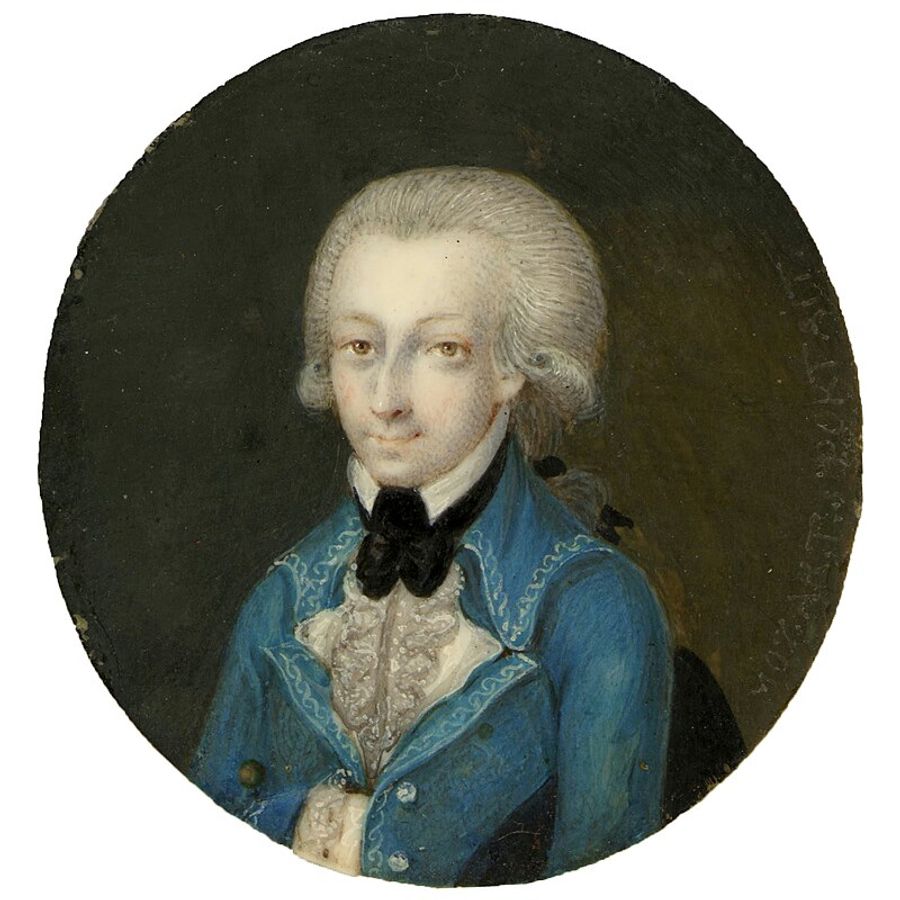
- Köchel Number
- K9 132 | K6 132
- Genre
- Orchestral Music
- Form
- Symphonies
- Key
- E Flat Major
- Date
- July 1772
- Place
- Salzburg
- Age
- 16
Mozart’s Symphony No. 19 in E♭ major (K. 132) was composed in Salzburg in July 1772, when he was just 16. Compact, bright, and unusually horn-rich, it shows the teenage composer testing the ceremonial “E♭-major” symphonic sound-world that would later crown works such as the “Paris” and “Jupiter” symphonies.
Background and Context
In 1772 Wolfgang Amadeus Mozart (1756–1791) was based in Salzburg, employed—directly or indirectly, depending on the precise court arrangements—by the archiepiscopal establishment that maintained a resident orchestra and expected a steady supply of new music for church, theatre, and courtly display. The year was also poised between two creative poles in Mozart’s life: the expansive horizons of his Italian journeys (1770–1773) and the practical routine of writing for Salzburg’s musicians and audiences.
Symphony No. 19 in E♭ major, K. 132 belongs to a concentrated run of Salzburg symphonies from 1772—works that can look modest next to the late Viennese trilogy, yet often feel like laboratories. Mozart’s early symphonies are frequently described as “occasional” music, but K. 132 rewards closer listening because its orchestral color is more assertive than one might expect from a court orchestra of limited resources, and because its four-movement plan (including a minuet) aims at a more “grown-up” symphonic profile than the three-movement Italianate model. [1]
Composition and Premiere
Mozart composed K. 132 in July 1772 in Salzburg. [1] Like many Salzburg symphonies of the period, the specific first performance is not securely documented in modern reference summaries; the likeliest context is the archiepiscopal court’s musical life, where symphonies could function as concert openers, entr’actes, or festive standalone pieces.
One reason K. 132 is particularly “well attested,” despite not being a repertoire staple, is the solid editorial and source tradition around the Salzburg symphonies in the Neue Mozart-Ausgabe (New Mozart Edition). The NMA’s critical materials treat K. 132 as part of the securely transmitted corpus and discuss its scoring within the group of early symphonies. [2]
Instrumentation
K. 132 is scored for a Classical Salzburg orchestra with an arresting twist: Mozart calls for four horns, not merely the usual pair.
- Winds: 2 oboes
- Brass: 4 horns (two high and two low in E♭)
- Strings: violins I & II, viola, cello, double bass
This is not just a matter of “louder is better.” In E♭ major, horns can reinforce both harmony and rhetoric: they thicken cadences, brighten tuttis, and—because natural horns color different registers differently—add a kind of timbral choreography to passages that, on paper, might otherwise resemble standard youthful symphonic writing. The unusual horn complement is explicitly noted in modern work descriptions. [1]
Form and Musical Character
Mozart lays out a four-movement symphony, pointing toward the mature Classical norm.
- I. Allegro (E♭ major)
- II. Andante (B♭ major)
- III. Menuetto and Trio (E♭ major)
- IV. Presto (E♭ major)
(These movement titles and basic tonal plan are consistently transmitted in modern reference descriptions.) [1]
I. Allegro (E♭ major)
The opening Allegro is built to make an immediate public impression: a confident E♭-major profile, clear phrase structure, and a busy interplay between strings and winds. Even when the thematic material is concise, Mozart’s handling of orchestral punctuation—especially the horn writing—adds a ceremonial sheen that feels pointedly “symphonic,” not merely functional.
II. Andante (B♭ major)
The slow movement shifts to the dominant, B♭ major, a standard Classical strategy that relaxes the tonal brightness without losing warmth. Here, the interest lies less in dramatic contrast than in poise: Mozart writes a singing orchestral Andante that suggests his parallel growth in vocal melody (opera and sacred music) being translated into instrumental terms.
III. Menuetto and Trio (E♭ major)
Including a minuet is itself a statement. The Menuetto plants the symphony in the social world of dance—courtly, balanced, and outward-facing—while the Trio typically offers lighter scoring and a more intimate color. In K. 132, the minuet functions as a hinge: it refreshes the ear before the finale, and it strengthens the work’s claim to be a full, four-movement symphony rather than a quick three-movement overture in disguise.
IV. Presto (E♭ major)
The finale’s Presto brings speed and crispness, with the kind of energetic closing rhetoric that Salzburg audiences would have recognized immediately. Mozart’s youthful finales often thrive on momentum and clear cadential signposting; in K. 132, the extra horns help turn those signposts into something closer to architectural pillars.
Reception and Legacy
K. 132 is not among the Mozart symphonies that routinely appear in modern concert seasons, partly because later masterworks dominate the field and partly because early Salzburg symphonies are sometimes (unfairly) treated as apprentice pieces. Yet it deserves attention for two interconnected reasons.
First, it showcases Mozart’s developing orchestral imagination at an age when many composers were still learning to write idiomatically for strings alone. The decision to employ four horns in an E♭-major symphony is an early example of Mozart using instrumentation as a compositional argument—color as structure, not mere decoration. [1]
Second, K. 132 clarifies Mozart’s path toward the “public” symphonic voice. The piece stands at a midpoint between the travel-season cosmopolitanism of his teenage years and the more intensely personal symphonic thinking of the later Vienna period. Heard on its own terms—compact, festive, and sharply profiled—Symphony No. 19 can sound less like a footnote and more like a confident Salzburg calling card: a 16-year-old composer writing not only to satisfy a court, but also to announce what his orchestra could become.
Sources
[1] Wikipedia: overview, composition date (July 1772), Salzburg context, movement list, and instrumentation including four horns.
[2] Digital Mozart Edition (Mozarteum): New Mozart Edition critical report (English PDF) discussing early symphonies and instrumentation context (includes remarks relevant to KV 132).