- Köchel Number
- K9 133 | K6 133
- Genre
- Orchestral Music
- Form
- Symphonies
- Key
- D Major
- Date
- July 1772
- Place
- Salzburg
- Age
- 16
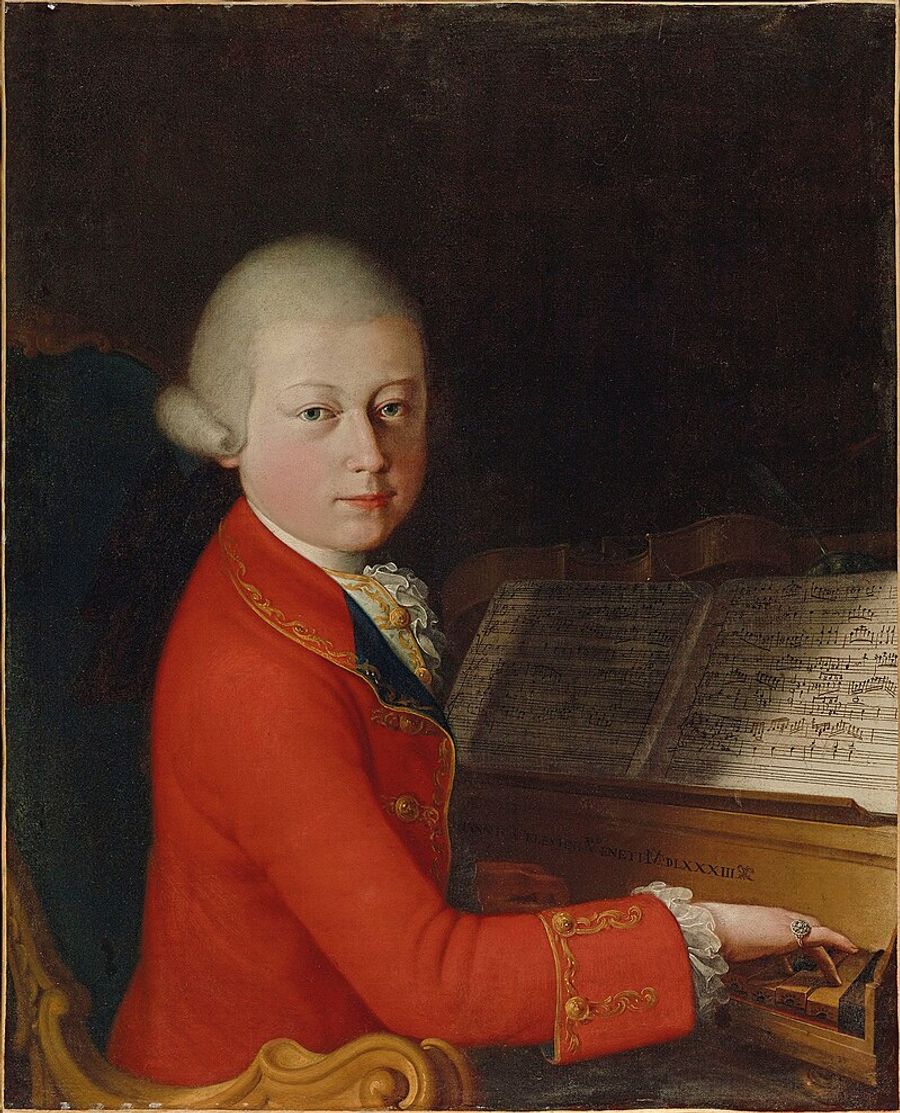
Mozart’s Symphony No. 20 in D major, K. 133 was composed in Salzburg in July 1772, when he was sixteen. Though it belongs to his “teenage symphonies,” its festive D-major brilliance—reinforced by trumpets—shows a young composer already testing how far an early-Classical symphony could be pushed for ceremonial color and formal wit.
Background and Context
In 1772 Wolfgang Amadeus Mozart (1756–1791) was newly returned to Salzburg after extended Italian travels, and—at sixteen—was writing symphonies at a pace that suggests both professional necessity and compositional experimentation. K. 133 is one of the Salzburg symphonies from this period between Italian journeys, a time when Mozart’s orchestral writing oscillates between the compact, overture-like symphony and the more expansive, four-movement design associated above all with Joseph Haydn’s mature practice.[1]
What makes K. 133 worth hearing today is not the scale of its ambition (it is a relatively concise work), but the clarity with which it dramatizes public orchestral rhetoric: bright D major, brilliant brass, and sharply contrasted textures. Even by Mozart’s own prolific 1772 standards, it stands out for its more “festive” palette—music that seems designed to carry in a resonant hall and to register immediately with an audience.[2]
Composition and Premiere
The symphony is generally dated to July 1772 and linked explicitly to Salzburg, placing it among the works Mozart produced while based at the archiepiscopal court.[1] The precise occasion is not firmly documented; modern commentary often notes that the combination of D major (a key long associated with ceremonial display) and the addition of two trumpets suggests a particularly festive context, even if the first performance circumstances remain uncertain.[2]
This balance—clear archival dating but incomplete performance documentation—is typical for early Salzburg symphonies. For listeners, the absence of a “famous premiere” is less a drawback than an invitation: K. 133 can be approached as functional court music that nonetheless contains compositional personality, including a striking formal joke in the first movement (discussed below).[1]
Instrumentation
K. 133 is scored for a classical Salzburg orchestra with added festive brass.[1]
- Winds: 1 flute (Andante only), 2 oboes
- Brass: 2 horns, 2 trumpets
- Strings: violins I & II, viola, cello, double bass
The scoring is notable in two ways. First, the trumpets intensify the work’s ceremonial profile—Mozart uses them not merely for sustained harmonic “shine,” but for emphatic punctuation and fanfare-like exchanges with the horns.[2] Second, Mozart withdraws from that brilliance in the slow movement: the Andante calls for a solo flute (largely doubling above the first violin line) while the violins play con sordino (with mutes), and the bass proceeds pizzicato, creating a delicately “serenade-like” sound world in sharp contrast to the surrounding D-major brilliance.[1]
Form and Musical Character
Mozart adopts a four-movement plan—already a sign of aspiration beyond the three-movement Italian overture model—and fills it with clear-cut contrasts rather than extended development.[2]
I. Allegro (D major)
The opening movement is cast in sonata-allegro form, but Mozart plays with the listener’s expectations at the moment of return: the recapitulation begins with the second theme, and only later—near the end—does the opening material reappear, first softly in the strings and then reinforced by the full forces.[1] This reversal is more than a clever trick: it reframes the “homecoming” of D major as a staged revelation, allowing the music’s ceremonial character (especially the trumpets) to feel freshly earned rather than mechanically repeated.
II. Andante (A major)
In the dominant key of A major, Mozart changes not just tempo and key but genre-character: the movement has often been described as serenade-like, in part because of its muted upper strings and the gently plucked bass that can suggest a guitar-like accompaniment.[1] The flute’s role—appearing only here—adds a pale sheen, as if the symphony momentarily steps indoors, away from ceremonial brilliance toward an intimate, nocturnal lyricism.[2]
III. Menuetto – Trio (D major / G major)
The Menuetto returns to public D major with a firm, confident tread. The Trio shifts to G major and is scored more lightly (strings with touches of oboe), offering a pastoral-relief panel before the final sprint.[1] Even in this conventional minuet framework, Mozart’s ear for contrast—bold outer frame, softened center—keeps the dance from becoming mere filler.
IV. [Allegro] (D major)
The finale brings back the full festive apparatus and pushes the symphony toward kinetic exuberance. Modern notes emphasize the alternation between strings-only softness and full tutti brilliance—an early example of Mozart’s instinct for orchestral “lighting,” where the same theme can appear with different emotional meanings depending on the forces that articulate it.[2] It is music of quick reflexes: a teenager’s delight in momentum, but also a craftsman’s ability to control it.
Reception and Legacy
K. 133 is not among Mozart’s most frequently programmed symphonies, partly because later works (from the dramatic “Little G minor” Symphony, K. 183 onward to the final trilogy of 1788) have come to dominate the concert narrative. Yet this relative neglect can obscure what the early Salzburg symphonies reveal: Mozart’s symphonic style did not simply “arrive” in the 1780s; it was built through years of practical court composition and continual formal trial.
In that sense, Symphony No. 20 deserves attention as a study in ceremonial color and structural playfulness. The trumpets and D-major rhetoric project confidence, but the work’s most Mozartian signature may be the first movement’s witty recapitulation strategy—an audible sign that, even at sixteen, he could turn a textbook form into theater.[1] For listeners exploring Mozart beyond the “greatest hits,” K. 133 offers a rewarding portrait of the young composer balancing Salzburg’s functional demands with an unmistakable drive toward surprise and character.
Sources
[1] Wikipedia: overview, date (July 1772), Salzburg context, instrumentation, and formal notes (notably the reversed recapitulation in the first movement).
[2] Milwaukee Symphony Orchestra program note PDF (“Storm & Drive”): context for 1772 output, festive scoring with trumpets, uncertainty of first performance, and movement character commentary.