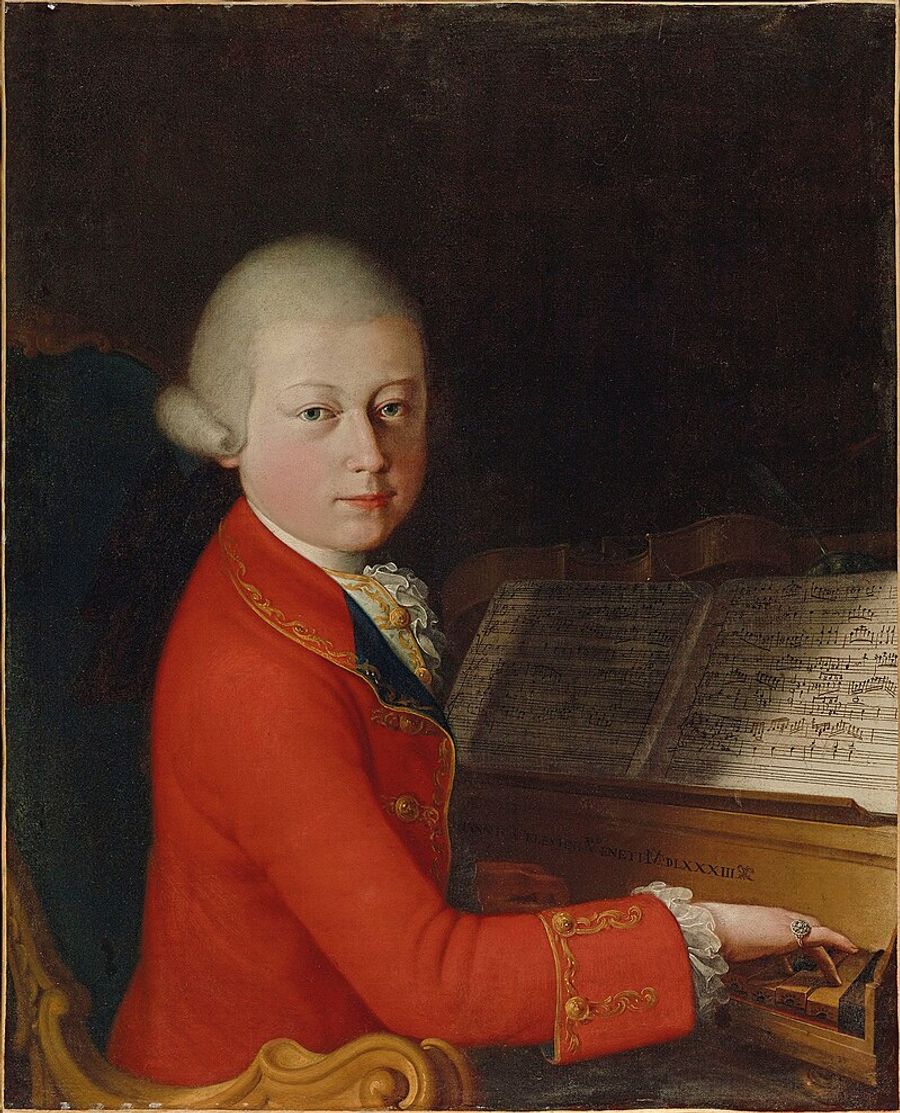
- Köchel Number
- K9 Anh.C 11.04 | K6 Anh. C 11.04
- Genre
- Orchestral Music
- Form
- Symphonies
- Key
- F Major
- Date
- c. November 1771
- Place
- Milan?
- Age
- 15
Mozart’s so-called Symphony No. 56 in F major (K. Anh.C 11.04; sometimes also cited as K. 98) is a four-movement work long circulated under his name, but now generally treated as spurious or at least of doubtful authorship [1] [2]. A pencilled note in an early thematic catalogue suggests “1771 Milan Nov”, which would place it amid the Mozarts’ Italian journeys, when Wolfgang was 15, yet no secure Mozart-source transmission survives to confirm the attribution [1].
Background and Context
The traditional dating “1771, Milan?” for K. Anh.C 11.04 aligns, in a broad way, with Mozart’s teenaged Italian period, when he was absorbing operatic and orchestral idioms at close range. Yet the symphony’s provenance is unstable: the work was once accepted by major 19th-century authorities, but later writers found its fingerprints insufficiently Mozartian, and modern reference lists place it among the symphonies of spurious or doubtful authenticity [1] [2].
Musical Character
On the page, K. Anh.C 11.04 looks like a conventional mid-18th-century four-movement symphony in F major, with the movement plan:
- I. Allegro (4/4)
- II. Andante (2/4)
- III. Menuetto (3/4)
- IV. Presto (2/4) [1]
The scoring is similarly standard for the time:
- Winds: 2 oboes
- Brass: 2 horns
- Strings: violins I & II, viola, cello, double bass
(Keyboard and bassoon continuo reinforcement would have been a customary option in many orchestras, even when not explicitly notated.) [1]
In character, the work is often discussed less for any singular musical profile than for the ways it fails to match Mozart’s securely attributed early symphonies—its turns of phrase prompting comparisons with other contemporary schools rather than with Mozart’s more distinctive youthful voice [1].
Place in the Catalog
For listeners mapping Mozart’s symphonic development, K. Anh.C 11.04 is best treated as a peripheral document: it preserves a plausible 1770s symphonic “type”, but its doubtful attribution prevents it from serving as firm evidence of Mozart’s technique in 1771 (Milan or elsewhere) [1] [2].