- Köchel Number
- K9 Anh.A 51 | K6 Anh. A 51
- Genre
- Orchestral Music
- Form
- Symphonies
- Key
- E Flat Major
- Date
- 1764
- Age
- 2
Mozart’s so‑called Symphony No. 3 in E♭ major (K. Anh.A 51), dated 1764, survives as a doubtful item: the music is now attributed to Carl Friedrich Abel, with Mozart’s connection likely limited to copying and (in one version) altering the wind scoring.[1][2]
Mozart's Life at the Time
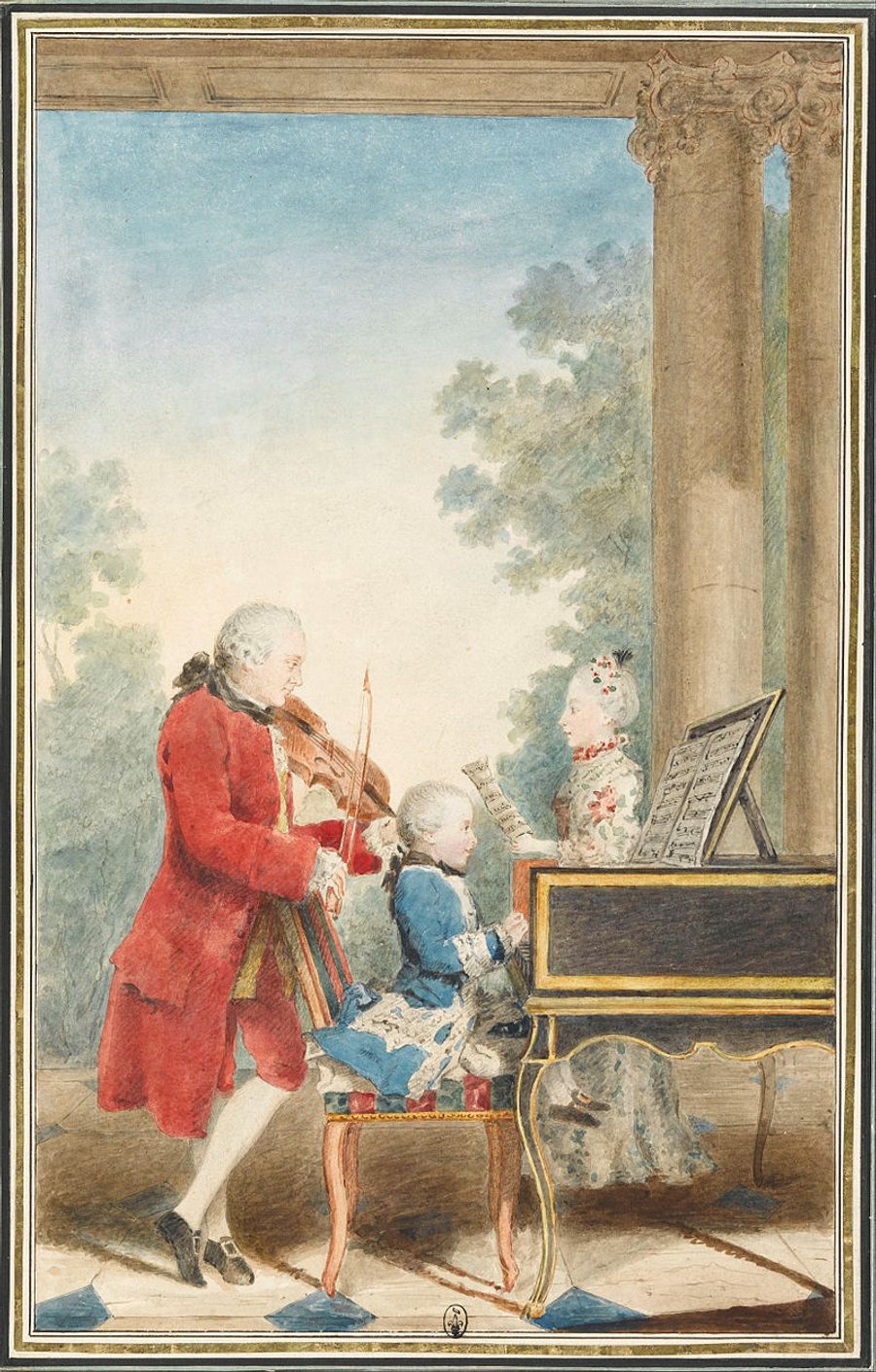
In 1764 Mozart was still a small child on the family’s grand Western European tour; he had not yet begun the sustained symphonic composing documented from his later childhood. A widely circulated contemporary image from this period is Louis Carrogis de Carmontelle’s watercolor of the Mozart family, made in Paris in early 1764.[3]
Musical Character
The piece traditionally listed as Mozart’s Symphony No. 3 in E♭ major is now regarded as spurious: it corresponds to a symphony by Carl Friedrich Abel (often identified as Abel’s Symphony in E♭, WK 18).[1][2] What seems distinctly “Mozartian” here is not the thematic substance but a practical adjustment in orchestration: Mozart’s copy replaces Abel’s two oboes with two clarinets, an alteration plausibly reflecting the players available in a particular performance rather than a compositional re‑imagining.[1][2] In that sense, K. Anh.A 51 sits less as a “toddler symphony” than as a small window onto the musical environment surrounding the traveling Mozarts in 1764—where copying, repertory, and instrumentation choices were part of everyday musical life.
Sources
[1] IMSLP: Carl Friedrich Abel, Symphony in E-flat major, WK 18 (notes include misattribution as Mozart ‘Symphony No. 3’ and the clarinet-for-oboe substitution).
[2] Wikipedia: ‘Symphony No. 3 (Mozart)’ — overview of the misattribution to Mozart, attribution to Abel, and Mozart’s clarinet substitution in his copy.
[3] MozartDocuments: Carmontelle watercolor portrait of the Mozart family (Paris stay, early 1764) — contextual portrait reference.