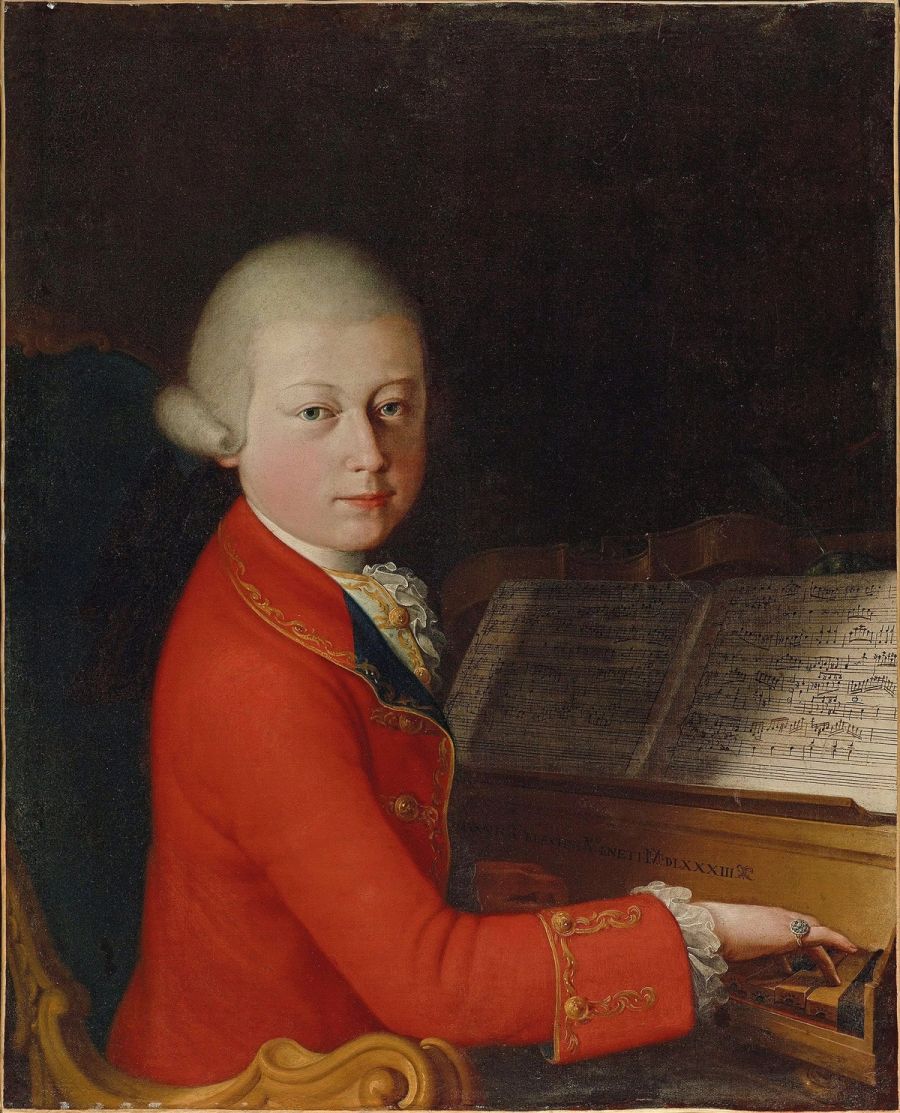
- Köchel Number
- K9 84 | K6 73q
- Genre
- Orchestral Music
- Form
- Symphonies
- Key
- D Major
- Date
- 1770
- Place
- Milan or Bologna
- Age
- 14
Symphony No. 11 in D major (K. 84/73q) is a brief three-movement symphony traditionally attributed to Mozart but regarded as of doubtful authenticity. This article outlines its Italianate layout, modest orchestration, musical character, and the competing evidence behind its attribution.
Composition & Context
Symphony No. 11 in D major, K. 84/73q is traditionally attributed to Wolfgang Amadeus Mozart and is believed to have been composed circa 1770, possibly during his time in Italy (Milano or Bologna) while still a teenager. The piece is one of several youth symphonies that share a three-movement Italianate form rather than the later four-movement Viennese model.
Instrumentation
The orchestration of the work is modest: two oboes, two horns in D (or in D major), and string section (first and second violins, viola, cello/bass). Some sources indicate a continuo bass (harpsichord or organ) and possibly bassoon reinforcement, typical of the era. Notably, it lacks trumpets and timpani, which makes the sound lighter relative to some of Mozart’s other early “festive” symphonies. This more intimate scoring is in keeping with the Italian overture/symphony aesthetic of the time.

Form & Musical Character
The symphony comprises three movements:
Allegro (D major) – a brisk opening movement in common time with a clear, galant-style theme and orchestral clarity.
Andante (A major) – slower, more lyrical, and contrasts in mood; some analysts note its “Gluckian ambience.”
Allegro (D major) – a spirited finale, showing repeated triplet figures and operatic buffa affinities in its rhythm.
Stylistically, the work reflects the youthful Mozart’s assimilation of Italianate symphonic writing: elegant, concise, with clear textures and a preference for three-movement overture-type form. Due to its brevity and form, the piece is often interpreted less as a full symphonic argument and more as an orchestral divertimento or overture-style symphony.
Authorship Uncertainty
The work’s attribution is uncertain. Although an early Viennese manuscript attributes it to Wolfgang Amadeus Mozart, 19th-century copies assign it alternatively to Leopold Mozart (his father) and Carl Ditters von Dittersdorf. Musicologist Neal Zaslaw conducted stylistic comparisons and concluded that Wolfgang remains the most likely composer of the three candidates. The absence of an autograph score further weakens certainty, and thus the symphony is listed among Mozart’s “of doubtful authenticity.”
Reception & Legacy
Symphony No. 11 has not entered the standard concert repertoire in the way Mozart’s later symphonies did, but it has value for scholars and performers interested in his early orchestral work. Modern editions (such as the Neue Mozart-Ausgabe) include the work with a caveat of doubtful authenticity. Its compact form—typically running around 9–12 minutes—makes it suitable for inclusion in recordings of Mozart’s early symphonies, offering a window into his developmental stage as a symphonist. Interpretive notes often highlight the work’s operatic flavour (especially in the finale) and its streamlined orchestration as part of the Italian symphonic style.
References
Sources
- https://en.wikipedia.org/wiki/Symphony_No.11%28Mozart%29
- https://it.wikipedia.org/wiki/Sinfonia_n.11%28Mozart%29
- https://www.sin80.com/en/work/mozart-symphony-11-k84
- https://www.flaminioonline.it/Guide/Mozart/Mozart-Sinfonia11.html
- https://en.wikipedia.org/wiki/Mozart_symphonies_of_spurious_or_doubtful_authenticity