- Köchel Number
- K9 80 | K6 73f
- Genre
- Chamber Music
- Form
- String Quartets & Wind Quartets
- Key
- G Major
- Date
- 15 March 1770
- Place
- Lodi
- Age
- 14
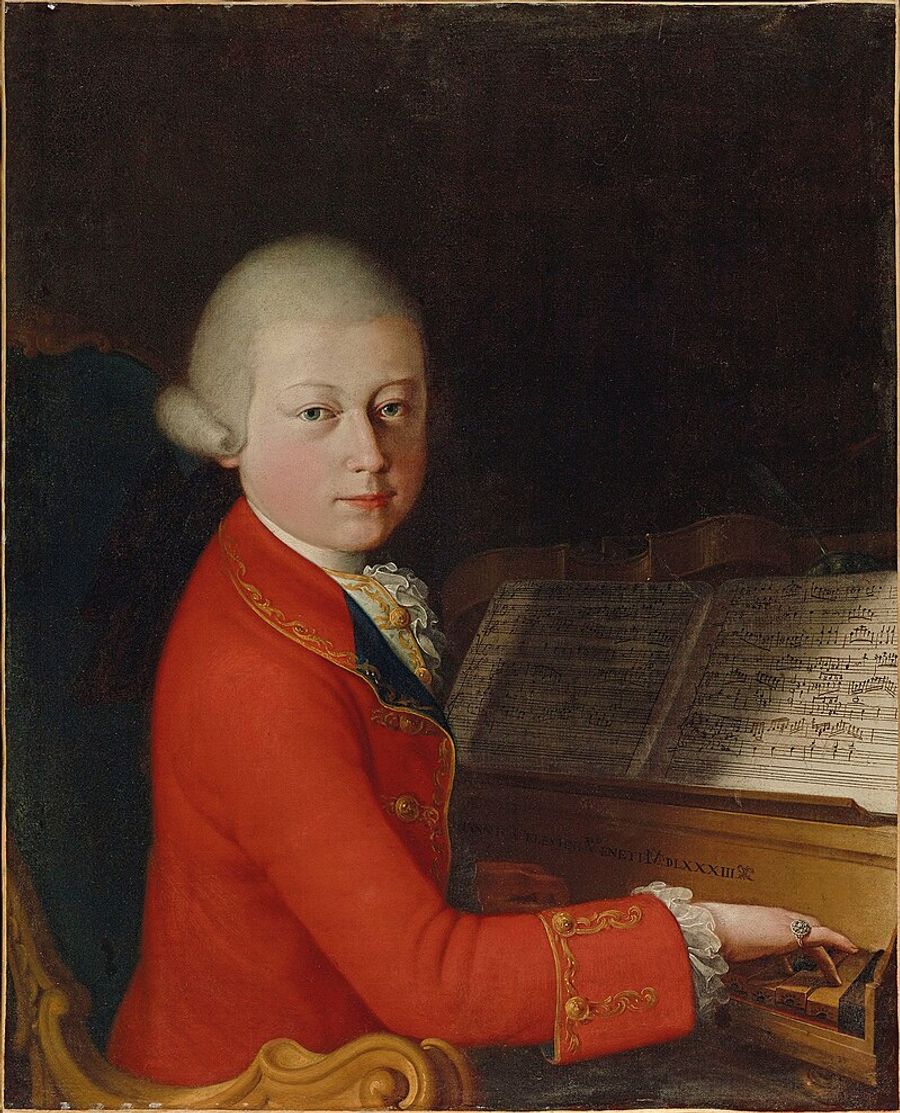
Mozart’s String Quartet No. 1 in G major, K. 80—often called the “Lodi” Quartet—was completed in northern Italy on 15 March 1770, when the composer was only fourteen. Written during the first Italian tour with Leopold Mozart, it is an early, Italianate experiment in a genre Mozart would later transform under Haydn’s influence.
Background and Context
Mozart’s first published “quartet” legacy is usually associated with the mature works of the 1780s—above all the six quartets dedicated to Joseph Haydn. Yet the genre entered his workshop much earlier. String Quartet No. 1 in G major, K. 80 belongs to the Italian journey (1769–1771) undertaken by Wolfgang Amadeus Mozart (1756–1791) and his father Leopold, a period in which the teenage composer absorbed operatic melody and the chamber idioms circulating in northern Italy.[1]
The quartet’s nickname comes from Lodi (Lombardy), a small town where the Mozarts stopped while traveling. What makes K. 80 especially revealing is not that it anticipates the contrapuntal conversations of the “Haydn” quartets, but that it shows Mozart testing how far a fluent, vocal Italian manner can be sustained within four string parts. In short, it is a document of apprenticeship—already confident, occasionally daring, and more personal than the label “early work” suggests.
Composition and Dedication
Mozart completed K. 80 at an inn in Lodi on 15 March 1770—with an autograph annotation specifying completion “at 7 o’clock in the evening,” a detail preserved in later scholarship.[1] The work is scored for the standard quartet ensemble:
- Strings: violins I & II, viola, violoncello
Although commonly performed in four movements today, the quartet began life as a three-movement piece; Mozart later added a Rondo finale, a practice noted in the Köchel-Verzeichnis discussion of his early quartets.[2] IMSLP accordingly lists the composition date range as 1770–73.[3]
No dedicatee is securely attached to K. 80. However, an intriguing afterlife is documented: in a letter of 24 March 1778, Mozart reminded Leopold of the piece and reported that he had arranged copies for Baron Otto Heinrich von Gemmingen-Homberg in Mannheim—evidence that Mozart still valued the work well beyond his Italian adolescence.[1]
Form and Musical Character
In its familiar four-movement form, K. 80 is striking for how it begins: not with a brisk opening allegro, but with a poised, singing slow movement—an Italianate gesture that foregrounds lyricism over display.[4] The movement scheme is:[3]
- I. Adagio
- II. Allegro
- III. Menuetto (with Trio)
- IV. Rondo – Allegro (added later)
I. Adagio
The opening Adagio sets the quartet’s tone with long-breathed phrases and a texture that can feel almost like a condensed operatic scene—melody supported by gently articulated inner parts. Even when the first violin carries the main line, the accompaniment is not merely harmonic padding; Mozart already shows interest in balancing sonority across four independent instruments.
II. Allegro
The Allegro provides the expected contrast: brighter pulse, clearer periodic phrasing, and a more overtly “public” character. One can hear Mozart experimenting with the quartet as a social genre—music intended for intimate rooms rather than theatrical stages—while still leaning on the rhetorical clarity of contemporary Italian instrumental writing.
III. Menuetto and Trio
The Menuetto anchors the work in courtly dance style, yet it also previews Mozart’s later knack for making “simple” forms feel dramatically pointed through articulation and harmonic turns. The Trio’s change of color (notably its shift to C major in some descriptions) heightens the sense of a miniature scene-change within a compact design.[4]
IV. Rondo – Allegro
The added Rondo finale is crucial to how modern listeners experience K. 80. Beyond supplying a satisfying close, it nudges the quartet toward the later four-movement norm. The Mozarteum’s Köchel-Verzeichnis notes that Mozart appended this Rondo to his “firstling” (his Erstlingswerk)—a small but telling sign that he reconsidered the piece after further exposure to quartet writing.[2]
Reception and Legacy
K. 80 occupies an unusual position in Mozart’s quartet output: it is neither a student exercise to be dismissed nor a mature landmark that defines the genre. Its legacy is instead that of a vivid starting point. Scholarship on Mozart’s early quartets places K. 80 at the threshold of a longer story—one that runs through the “Milanese” quartets of 1772–73 and eventually into the Viennese encounter with Haydn that reshaped Mozart’s quartet technique.[1]
For today’s performers and listeners, the quartet’s value lies in its immediacy: the melodic grace of Italian travel years, the novelty of a slow opening, and the historical fascination of hearing a fourteen-year-old composer already thinking in four-part string textures. Heard alongside the later quartets, K. 80 becomes more than an “early number”—it becomes a portrait of Mozart in motion, composing on the road, absorbing styles, and quietly laying groundwork for the masterpieces to come.
Sources
[1] Cambridge Core (Cambridge University Press) — excerpt from a chapter on Mozart’s early quartets (completion at Lodi on 15 March 1770; autograph annotation; 1778 letter about making copies for Gemmingen-Homberg).
[2] Köchel-Verzeichnis (Internationale Stiftung Mozarteum) — note that Mozart’s early quartets were three-movement works and that he later added a Rondo to K. 80.
[3] IMSLP — work page giving instrumentation, movement list, and composition year range (1770–73).
[4] Wikipedia — overview with completion date/place, four-movement outline, and basic movement/key details.