- Köchel Number
- K9 634 | K6
- Genre
- Piano Music
- Form
- Piano Pieces
- Key
- F Major
- Date
- 1767
- Age
- 11
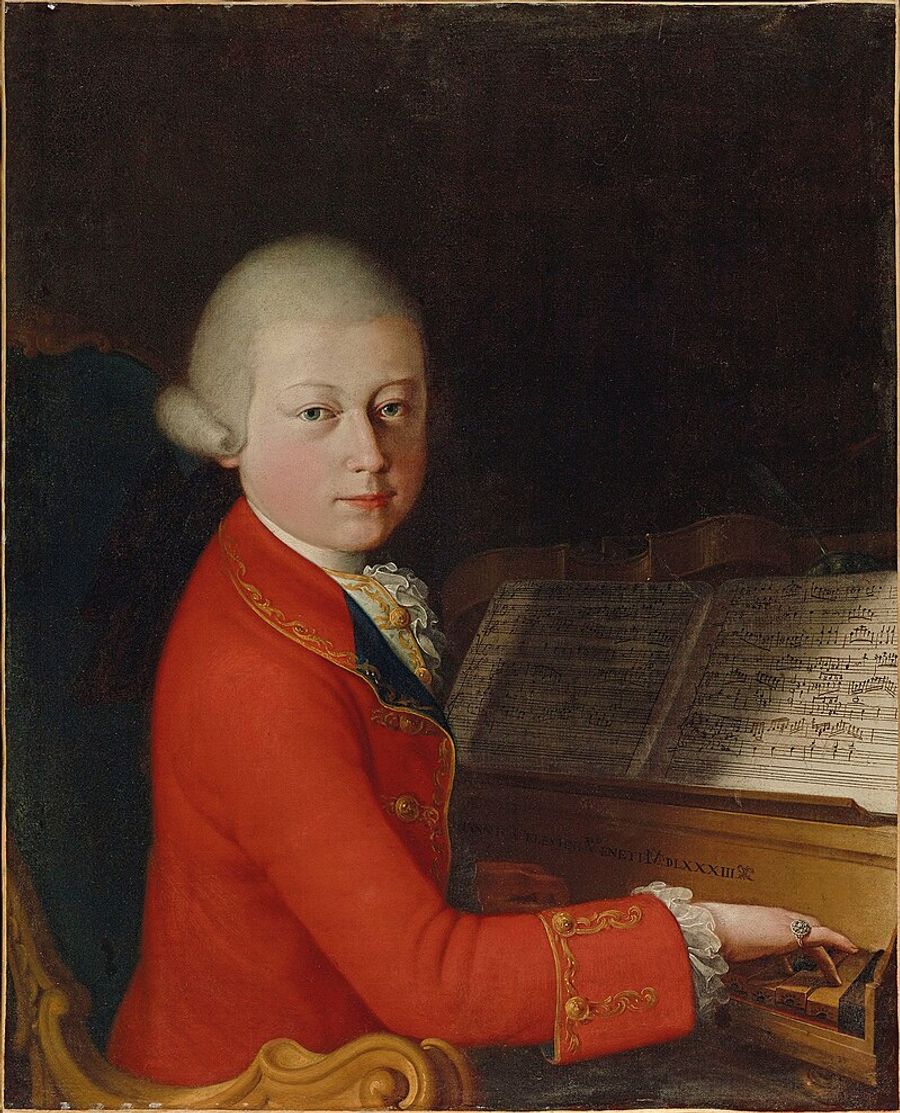
The Polonaise in F major (K. 634) is a short keyboard dance transmitted under Mozart’s name but generally treated as a work of doubtful authenticity. It is usually dated to around 1767—when Wolfgang Amadeus Mozart (1756–1791) was 11—though neither place of composition nor a secure provenance is firmly established.[1]
Mozart’s Life at the Time
Around 1767, Mozart was an 11-year-old composer-performer whose daily life was split between Salzburg and the family’s renewed push for courtly opportunities abroad. In September 1767 the Mozarts left Salzburg for Vienna, hoping to benefit from imperial festivities; the stay was disrupted by a smallpox outbreak, which forced periods of flight and interruption.[2] Against that unsettled backdrop, a small, teachable keyboard dance such as the Polonaise in F fits plausibly into the sort of material copied, played, and exchanged within domestic music books—even when the authorship attached to such pieces is not fully reliable.[1]
Musical Character
On the page, K. 634 presents a straightforward keyboard polonaise in F major: a moderately paced dance built on the genre’s characteristic triple-meter gait and repeated-strain layout, with a brief da capo return.[3] Its writing is largely chordal and tuneful rather than contrapuntal, suggesting a practical piece meant for fluent reading and stylish articulation—skills central to Mozart’s keyboard training at this age. In that sense, even if the attribution proves spurious, the music still mirrors the mid-1760s sound-world in which the young Mozart learned to shape clear phrases, balance melody with accompaniment, and turn dance rhythm into something performable and elegant.[1]
Sources
[1] Internationale Stiftung Mozarteum, Köchel-Verzeichnis work entry: KV 634 “Polonoise in F for clavier” (authenticity and basic catalog data).
[2] Wikipedia: “Mozart and smallpox” (Mozart family’s departure for Vienna in September 1767 and disruption caused by the epidemic).
[3] IMSLP (EU): NMA facsimile scan of the Nannerl Notenbuch / early keyboard pieces, including the Polonaise in F with “Da capo” marking (supports musical-layout description).